

Arizona wineries that rely heavily on direct-to-consumer sales may not survive the wine slump of the 2020s.
At least, that’s the warning from Flying Leap Vineyards co-founder, president and CEO Mark Beres. After a pandemic-era surge, U.S. wine sales fell sharply last year — a decline Beres said deepened into this year.
Unless wineries find a way to bring Gen Z into wine culture, he believes the industry’s recovery will stall.
"The market has changed, it’s completely changed, so in my opinion, the classic farm winery model really doesn't work anymore," Beres said.
Up until 2019, the wine industry had been consistently growing. A 2021 report from the Arizona Wine Growers Association found production nearly tripled from 2012 to 2019, with business revenues reaching $155.9 million that year. When COVID-19 hit and people stayed home, sales took off.
"They had nothing that they could do other than sit around and drink," Beres said. "The demand appeared to be almost unstoppable. It was growing weekend by weekend."
Many vineyard owners, including Beres, responded by overproducing.
"This isn’t a product you can just make instantly. It takes time," Beres said. "People were worried that in a few years, they wouldn’t have enough wine to meet demand. ... The wineries in Arizona, and elsewhere around the world really, produced a massive quantity of wine."
But global wine consumption fell last year to its lowest level since 1961, according to the International Organization of Vine and Wine.
Beres attributes the American downturn to sharp rises in production costs, a decline in demand for beverage alcohols and market saturation.
One solution, he said, is making wine an experience and a destination.
"We do all kinds of different things other than selling wine in our tasting rooms," Beres said.
Flying Leap, based in Elgin, sees only about 40% of its sales from direct-to-consumer transactions; the rest comes from its restaurants, fruit sales, distribution and refrigerated haulage programs and other services, according to Beres.
"That sort of enhancement to the customer experience, I think, is what it's going to take to really succeed going forward in the wine business," Beres said. "Younger consumers in particular, these Gen Z folks, they're really tuned into this kind of thing."
Gen Z drinkers, who approximately 21 to 28 years old, make up only 3.6% of the country’s alcohol spending, according to RaboBank.
Gen Z’s indifference to wine culture is a well-known problem for Arizona producers.
Elgin-based Callaghan Vineyards owner Kent Callaghan said he hasn’t seen much growth this year, with sales on track to match 2024.
"Industry-wide, there’s no question there’s been a retrenchment. People are backing away," Callaghan said. "Most people that are somewhat insulated are folks that serve food at their wineries. That kind of turns it into more than a winery, but for us wine is all we do."

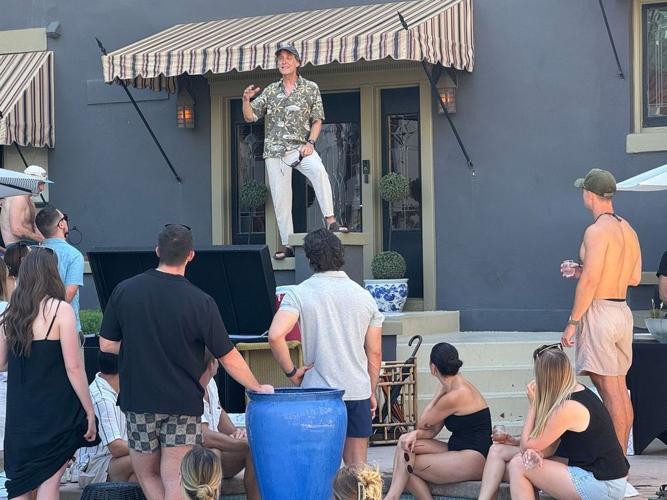
One of Page Spring Cellars' first events aimed at introducing Gen Z to wine culture, titled "Pour Decisions," shown here, combined lessons on pairing wine with food, perfectly opening a bottle and tasting how temperature changes flavor.
Not all downhill
Page Springs Cellars founding winemaker Eric Glomski said he has long believed wine must be paired with an experience. His winery’s strong year is proof.
"In the last decade, when we were a mature business and knew what we were doing, '24 was our worst year," Glomski said. "My wife and I got re-involved and tried really hard to figure out what was going on, and if all goes well, '25 could be equal to or supersede our best year ever."
Page Springs, located in Cornville near Sedona, produces estate-grown grapes and offers a tasting room, restaurant, wine club and a lineup of events designed to appeal to younger drinkers.
Glomski said one of his first events aimed at introducing Gen Z to wine culture, titled "Pour Decisions," combined lessons on pairing wine with food, perfectly opening a bottle and tasting how temperature changes flavor. The successful event ended poolside with dessert wine to top off the evening.
"We’ll do something like a rosé party at a pool, and we bring all of our wines down and invite a hundred Gen Z'ers, and we just have a blast at a pool somewhere," Glomski said. "I think my generation shot ourselves in the foot a little bit by making wine not as fun and disarming."
Similar to Beres’ point, Glomski said wineries need to build authentic connections with younger consumers.
"Literally we sat down with our kids and a couple bottles of wine and went, 'All right, let’s talk about this,'" Glomski said.
Page Springs is in talks to join Tempe’s 2026 Rosé Disco, an EDM (Electronic Dance Music) festival featuring more than 30 wineries and “world-class DJ sets in one pink-and-white paradise,” according to the event’s website.
"The whole idea is just to have fun," Glomski said. "I love wine and all the serious stuff, but on the other hand, there are days where we should say ... 'let’s just pop corks, spray wine in the air and have a great time.'"
It needs to be tasty
When Skyhaven Wines co-founder Chris Brinkmeyer toured a Napa winery a decade ago, he didn’t expect to taste the best wine he’d ever had straight from a barrel.
"I was like, 'Bottle that and I’ll buy it right now,' and they were like, 'No, no, this still has another 18 months,'" he said. "In my mind, I wondered why they’d do that to this wine. It tasted lush and fruity and wonderful."
He said that moment made him realize consumers were drinking harsh wines because they’d been “conditioned” to expect them.
"Napa wine has conditioned this country to expect that red wines are bitter, harsh and astringent," he said.
Brinkmeyer believes younger consumers aren’t buying wine because they don’t think it tastes good. To change that, Skyhaven avoids new oak barrels that can impart strong flavors.
"We still put our wine in barrels for about 18 months. It allows it to age a little bit before we bottle it, but it doesn’t infuse these harsh flavors that oak often does put into wine," he said. "We want to drink wine. Grape wine, not oak wine."
Skyhaven only began selling this year, but Brinkmeyer said reception has been strong. He hopes to see growth as Skyhaven drops its pilot white wines and rosés early next year.
"You’ve got to have a really good, approachable wine from the first sip," he said.
As the industry confronts stalled demand, shifting tastes and a generation that isn't into its products, Flying Leap’s Beres said the wineries that survive will be the ones willing to adapt.
"(Gen Z) is looking for experiences, not just products, so successful businesses are gonna be the ones that can bring that experience to them," Beres said.

