


Some things never get old.
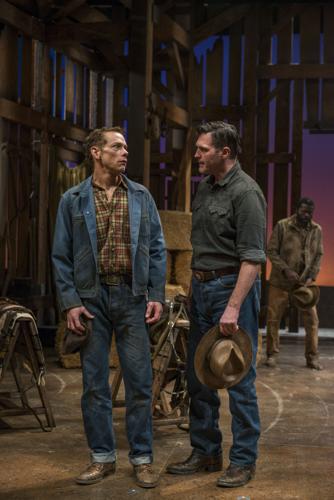
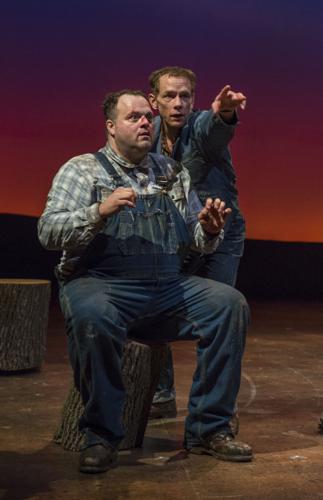
Take John Steinbeck’s “Of Mice and Men,” for instance. Arizona Theatre Company opens the play in previews this weekend.
Steinbeck wrote the 1937 novella in a new style.
“My idea,” Steinbeck told The New York Times shortly after it was published, “was to write a play in the form of a novel. It was an experiment. I wanted to call it at first ‘a play to be read.’”
The famous director George S. Kaufman read it soon after it was published and immediately saw the theatrical potential in the dialogue-rich story. Steinbeck had a few offers to transfer it to the stage, but Kaufman’s reputation won out over others.
Steinbeck worked with the director to adapt the play — which didn’t take much; about 85 percent of the dialogue is straight from the book.
The ATC production is co-produced with Milwaukee Repertory Theatre, and that company’s artistic director, Mark Clements, directs.
The story, required reading in almost every high school — and banned in some — takes place during the Great Depression. It is about two migrant workers, Lennie and George. Lennie is large, mentally childlike, and loves to pet soft things. George, his protector, has a dream of owning a ranch someday; he and Lennie would run it. But that dream is threatened when they get jobs as field workers at a ranch with a beautiful woman, the boss’ son, Curley, who has a mean streak, and a few other ranch hands to lend drama and texture to the story.
Here are a few not-well-known facts about the play:
Write what you know
Steinbeck had worked in Soledad, Calif., where the play takes place, and once had a job as a blindstiff — that’s what migrant workers were called.
“The characters are composites to a certain extent,” he told the Times in the ‘37 article. “Lennie was a real person. He’s in an insane asylum in California right now. I worked alongside him for many weeks. He didn’t kill a girl. He killed a ranch foreman. Got sore because the boss had fired his pal and stuck a pitchfork right through his stomach. I hate to tell you how many times I saw him do it.”
Curley’s wife
The lone woman in the Steinbeck play never gets a name — she’s known just as “Curley’s wife.” She is denigrated in the dialogue, dismissed as a tease and a floozy. That interpretation of the character disturbed Clare Luce, who played the role in the original ‘38 production. Steinbeck wrote her a letter to try to help her understand the character.
“She grew up in an atmosphere of fighting and suspicion,” Steinbeck wrote to the actress. “Quite early she learned that she must never trust anyone but she was never able to carry out what she learned. A natural trustfulness broke through constantly. ... Her moral training was most rigid. She was told over and over that she must remain a virgin because that was the only way she could get a husband. This was harped on so often that it became a fixation. It would have been impossible to seduce her. She had only that one thing to sell and she knew it.
“Now, she was trained by threat not only at home but by other kids. And any show of fear or weakness brought an instant persecution. She learned to be hard to cover her fright. And automatically she became hardest when she was most frightened. She is a nice, kind girl, not a floozy. No man has ever considered her as anything except a girl to try to make. She has never talked to a man except in the sexual fencing conversation. She is not highly sexed particularly but knows instinctively that if she is to be noticed at all, it will be because someone finds her sexually desirable.”
About that title
Steinbeck first called the book “Something That Happened.” By the time it was published, the title had changed to “Of Mice and Men.” The origin of that was the Robert Burns poem “To a Mouse,” which contains the line: “The best-laid schemes o’ mice an’ men gang aft agley.”
Dog gone
Steinbeck wrote in longhand, and his manuscript looked quite tasty to his dog, Max, who ate the original draft.

