



“Fences” is stunning.
Arizona Theatre Company’s production of the August Wilson play, which opened Friday, stuns you to silence. To horror. To tears.
The acting stuns. The set stuns. The story stuns.
It is — and this is not an exaggeration — a beautiful, brilliant play in a beautiful, brilliant production.
Director Lou Bellamy called on an ensemble of actors who have worked together before, and it showed — they were like one living organism breathing together, giving this powerful play all the deep roots, all the humanity, and all the nuance “Fences” deserves.
“Fences” is one of 10 plays the late playwright wrote about the African-American experience in this country over the last century. Each is set in a different decade; “Fences” is in the 1950s, though it ends in ’65. And while the play is about that experience, Wilson makes it clear that, really, it is about the human experience.
Troy Maxson was a talented baseball player who played in the Negro Leagues and was too old to play by the time the major leagues broke the color line. His experience has taught him that the black man will never get a fair shake.
His bitterness is palpable, as is his pride in supporting his family. He is not happy being a garbage man, but he beams at his ability to bring a paycheck home to his wife, Rose.
This tragic figure is also a mean father to his son Cory, who is denied the chance for a football scholarship because Troy sees no future in it — he says a job at the grocery store is a much more secure bet. And he is a philanderer. And a riveting storyteller. A drinker, and a man with a temper that flares up with terrifying frequency.
The play revolves around Troy and those in his universe: his children, his patient wife Rose, his longtime friend Bono and his brother Gabriel, who suffers from an injury he received in World War II fighting for a country that treated him like a second-class citizen.
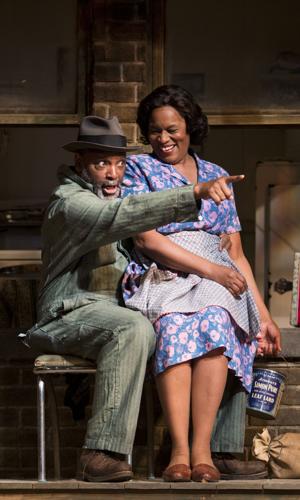
David Alan Anderson wore Troy’s bitterness like a second skin. But he also sank deeply into the man’s humor and humanity. It was hard to like him, but even harder to not like him. Wilson’s tragic Troy was given a full, deeply felt life, thanks to the actor.
Kim Staunton’s Rose breaks your heart as she tries to negotiate her way around her volatile husband. But when she is confronted with his infidelity, we see a woman with an inner strength that, once again, stuns. Rose’s compassion and her pain, her anger and forgiveness, are clear and gorgeous in the actress’ hands.
The role of Gabriel is a smaller one, but Terry Bellamy made it large. The character is the wise fool. His head injury gives him an innocence, but his insights are, yup, stunning. When Bellamy’s Gabriel attempts to open the gates of heaven but finds he can’t blow his horn, he reverts to a primal dance that brings a clarity to suffering and how it can be dealt with. This is a tough role, and can be easily overplayed. Terry Bellamy — the director’s brother — would have none of that. He made it clear that Gabriel’s innocence and insight were essential to the family and to the sadness and hope that the story ends with.
The cast is filled out by James T. Alfred as Troy’s jazz-playing son Lyons, born before Troy and Rose met; Marcus Naylor as Bono, Troy’s friend and, in a way, his conscience; Edgar Sanchez as Cory, the beaten-down son of Troy and Rose; and fifth-grader and Tucsonan Simeeyah Grace Baker, who played Raynell, the daughter of Troy’s lover, who died while giving birth to her.
All gave clarity to the play and their relationships with Troy. It’s impossible to find fault with any performance.
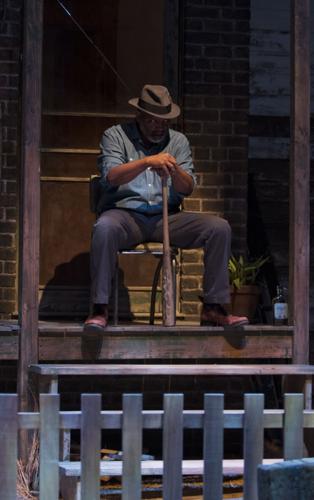
Or with the set, designed by Vicki Smith. The two-story, red-brick house, clearly poor and proud, was the centerpiece. The dirt yard, the peeling paint on the building next door, the electrical wires that crisscross the neighborhood, put us right there in Pittsburgh, sitting on the front porch with the Maxson family.
If you care anything about poetry (it is in nearly every line Wilson wrote), theater that insists you pay attention without ever being didactic, and an evening that feeds the mind and spirit, go see “Fences.” You will be stunned.

