


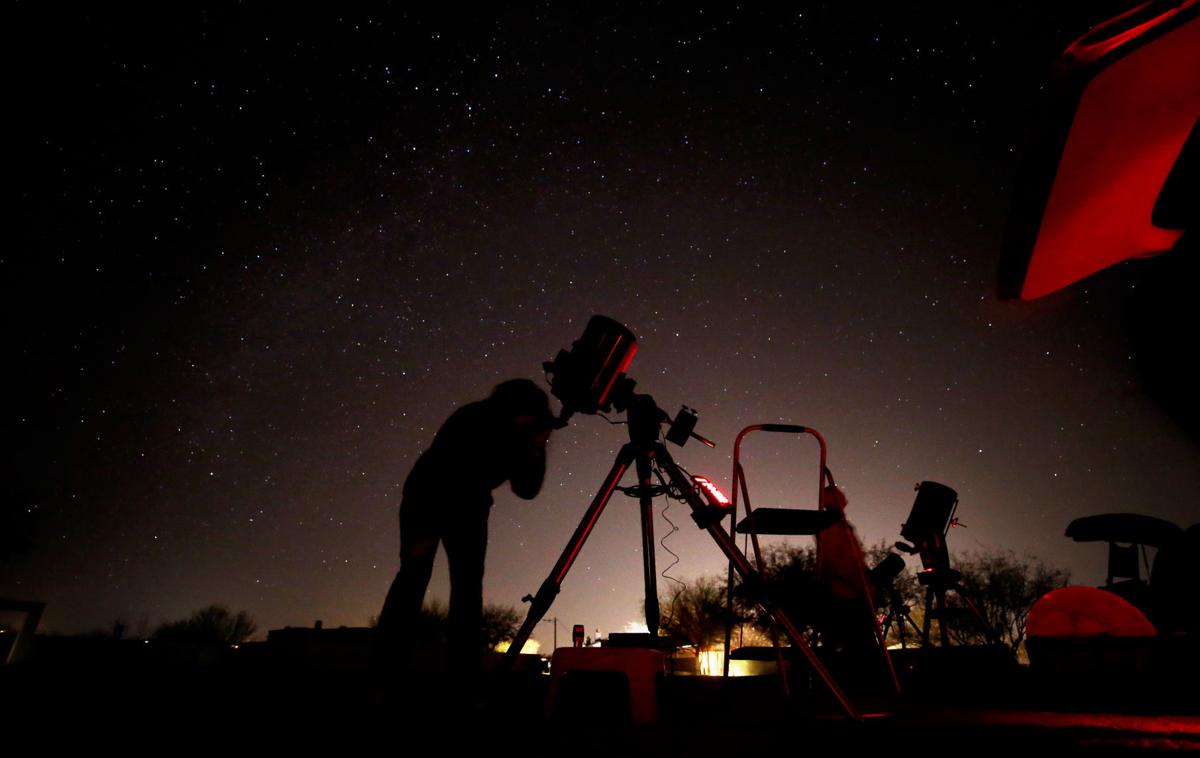
Tucson Amateur Astronomy Association (TAAA) astronomy events
The TAAA is an active amateur astronomy club open to people of all ages. Its members include professional astronomers, advanced amateur astronomers and beginners.
In fact, the TAAA welcomes beginners and encourages families with interested children to become members. The TAAA has an outstanding program of star parties (stargazing astronomy events) for schools and select groups, averaging 125 a year. Many of these are open to the public, and the TAAA offers many public star parties where there are telescopes set up for viewing the moon, planets, double stars, star clusters, galaxies and other celestial objects. Check out the TAAA online calendar for events in your part of Tucson. The TAAA monthly meeting (details on the TAAA website) is normally held the first Friday of the month on the University of Arizona campus starting at 6:30 pm.
Learn more about the TAAA:
TAAA Facebook page facebook.com/TucsonAstronomy
TAAA phone – (520) 792-6414.
TAAA Chiricahua Astronomy Complex
In the last decade, the TAAA has developed a dark-sky site in Cochise County with permanent structures and telescopes called the Chiricahua Astronomy Complex, named for the nearby Chiricahua Mountains.
The site features permanently mounted 40-inch and 14-inch telescopes, a ramada, ample parking, restrooms, four RV spaces and a warm room.
Fundraising is underway to expand the site with sleeping quarters, a learning center and additional telescopes. Monthly night-sky observing for club members and stargazing events for the public are frequently held at the complex. Contact the TAAA for more details.
The Chiricahua Complex is a two-hour drive from Tucson, but worth the trip for its superb dark sky and assortment of excellent telescopes.
Annual Grand Canyon Star Party — June 9-16.
The Grand Canyon Star Party can be thought of as America’s star party. It was originally started by TAAA member Dean Ketelsen in 1991, and 2018 will be the 28th year.
“For eight nights in June, park visitors explore the wonders of the night sky on Grand Canyon National Park’s South Rim with the Tucson Amateur Astronomy Association and on the North Rim with the Saguaro Astronomy Club of Phoenix. Amateur astronomers from across the country volunteer their expertise and offer free nightly astronomy programs and telescope viewing,” says a National Park Service website, www.nps.gov/grca/planyourvisit/grand-canyon-star-party.htm
The star party averages 45 telescopes and over 1,500 people each night.
Future dates are listed on the TAAA website at:
tucsonastronomy.org/upcoming-events/grand-canyon-star-party/
Saturn at opposition — June 27
Saturn will be on the opposite side of the Earth from the sun — what astronomers call “opposition” on June 27.
Its face will be fully illuminated by the sun, and it will be brighter than any other time of the year as well as being visible all night long. A small telescope will show Saturn’s glorious rings and its brightest moon, Titan. No doubt Saturn, as well as Mars, will be star party favorites this summer.
Mars at opposition — July 27 — a must-see event
Mars is drawing closer to the Earth and becoming much brighter than usual. It will be at opposition on July 27, when it will be even brighter than Jupiter, which is usually the fourth-brightest object in the sky after the sun, moon, and Venus.
Mars will be at its brightest since 2003. Most of the time, details on Mars’ surface are difficult to see due to the planet’s small size and the unsteadiness of the atmosphere.
This summer, a good telescope on a night with a steady atmosphere should show details on Mars such as its south polar cap. Mars is a must-see event around the time of its opposition.
The Perseids — Aug. 12-13
The Perseids are one of the three-best and most-predictable meteor showers, the others being the Leonids in November and the Geminids in December.
This year, the Perseids are predicted to peak on the night of Sunday, Aug. 12, and the morning of Monday Aug. 13. The thin crescent moon sets in the early evening and will not hinder meteor observing.
More local astronomy resources
There are several more local astronomy resources within easy reach on the computer or via the phone. Check them out for their ongoing activities and offerings:
Flandrau: The UA Science Center
1601 E. University Blvd; 621-STAR.
Starizona Adventures in Astronomy and Nature
5757 N. Oracle Road, Suite 103; 292-5010.
Stellar Vision Astronomy Shop
3721 E. 37th St.; 571-0877.
Mount Lemmon SkyCenter
Others in the area:
- Kitt Peak National Observatory Visitor Center and Museum
- : Nightly observing program at the Kitt Peak Visitor Center. www.noao.edu/noao/pio/pop
- San Pedro Valley Observatory
- : www.arizona-observatory.com. 1-888-455-6934; 520-226-3225.
- Dark-sky astronomy sites in Arizona
- : www.tripsavvy.com/finding-astronomy-sites-in-arizona-1652516

