

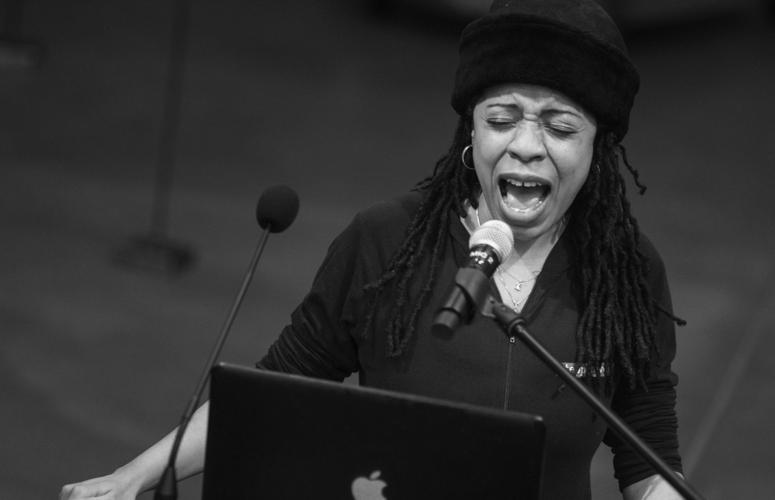
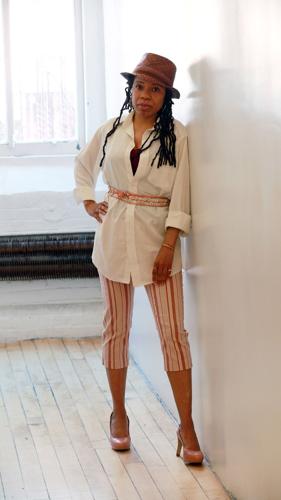

Tracie Morris is coming to town.
That’s exciting news for lovers of words, avant-garde and sound poetry, and of perspectives that push you to think in new ways.
Morris is a poet, performer, singer, a theater professor at New York City’s Pratt Institute and the author of several books, including “handholding: 5 kinds,” published late last year by Tucson’s Kore Press.
But that short list of what she does doesn’t give a clue to what’s in store when one spends an evening with Morris.
You see, she is smart. And funny. And talented. And original. The one-time champion slam poet’s insights on race, feminism and politics are compelling and provocative.
Morris is here in support of her book, and Kore Press is planning a series of events, including an evening with Morris and Stanley Kubrick’s 1999 movie “Eyes Wide Shut,” starring Tom Cruise and Nicole Kidman. The piece, included in the Kore Press book, provides alternative dialogue for the movie, one from a feminist, black perspective. She calls this sort of call and response between her and Kubrick’s movie “handholding.” The book has her doing the same with other artists.
Traveling in Mexico, she answered our questions by email:
Why “Eyes Wide Shut?”
“What intrigued me, ultimately, was the reversal that I ‘discovered’ in the film: In this film, in my humble opinion, the straight, successful white guy knows the least of anyone in the film.
“He’s the ingénue. I don’t think I’d seen that in a film before.
“All aspects of knowledge: carnal, relational, intellectual, social, even medical (the subtexts of his patients’ desire, his lack of knowledge of his patients’ status when he enters the hospital, etc.), all the things he thought he knew about life based on his personal choices and privileges were turned on their heads. ...
“I also read through Kubrick’s archives in London a bit and that absolutely reinforced my sense of the meta-commentary on race, class, sex, power and desire that Kubrick was aiming for. To me, this is what the film is about.”
Politics of all sorts are woven through your art. What kind of impact, if any, has the last election and the current state of the country had on your work?
“The last election has, oddly to some, made me more optimistic. We are currently in very unusual times as a country, but one of the things that is no longer the case is that people are passive: About the importance of their vote, the need to actively engage with politics and politicians, that we have to be active forces for the change we want to see. There is a large-scale understanding of this among regular folks, not just activists, that we haven’t seen in a long time, if ever. That gives me hope. People who are very different are starting to come together on specific ideas. ...
“So I would say that the impact it’s had on my work is to be energized, positive and more connected to people who want to feel connected to the world, in real time, not just virtually.”
With the threat to federal funding for the arts, it seems they are more and more devalued. What role does art play in our lives?
“I don’t think art is being devalued, I think the current federal administration wants to starve out the arts because of its value, because the arts are important, and they know it. ... I think the pushback to support the arts will come from conventional and surprising corners of the country.
“Arts, aesthetics, help define who we fundamentally are as humans. It’s not a luxury. Art shapes us and our understanding. Our sense of who we are is often based on the intangible and concrete ways in which we express the meaning and beauty (as well as the ugliness, horror and fear) of our being.
“Art gives us joy, grounding and helps us to understand the world. We are not just made to go through life doing things to survive, to perpetuate ourselves. Art infuses our lives with meaning. I feel that we could not exist, as humans, without it.”
You haven’t been to Arizona since the state’s SB 1070 legislation seven years ago. Why now?
“I love Arizona. It’s one of the most beautiful states I’ve ever seen. It’s got it’s own energy, a sense of itself, that I adore. I feel like I’m in another dimension whenever I visit. It’s like nowhere else.
“I, and others, especially initially, felt that the state no longer held that ‘luster’ when it was overtly, and legally, dividing its inhabitants. When I can’t connect to a place in a generous way, it’s better for me to avoid it. ...
“Now that the teeth have been thoroughly taken out of SB 1070 and it’s no longer compelling folks to show their papers, now that it’s truly a shell of its former self, I feel I can come back to the state with joy, I can focus on sharing my work here. ... I’ve missed Arizona — a lot. I hope to return regularly. I have to say again, there’s no place like Arizona for me.”

