



Communing with nature has nothing to do with my twice-weekly pre-dawn treks up Tumamoc Hill.
Don’t get me wrong; I love flora, fauna and everything in between.
But I hit that summit long before the sun has decided to rise. It’s pitch black out. I rely on the moon and cell phone flashlight apps to light my way.
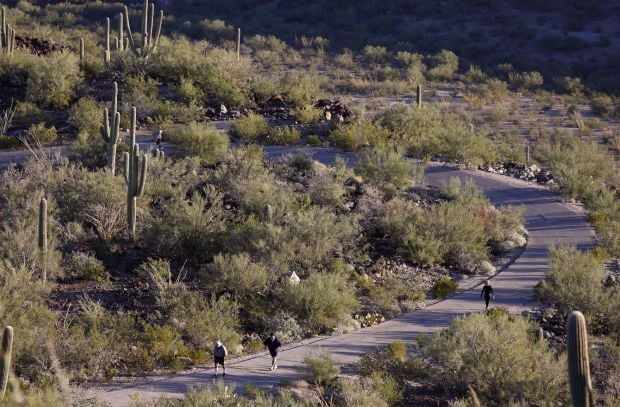
I know Tumamoc is a paved road that traverses lush desert with amazing city views. But beyond brief as-the-sun-rises glimpses on the way down, I never really saw it fully in the light of day until I started up the hill just after dawn one recent Monday.
I love a good, invigorating challenge. I’m serious about working out — but not gym rat serious with bulging biceps supported by a diet of kale and quinoa. I like to sweat and feel the burn and sting of pushing myself. If I don’t look a hot, sweaty mess at the end of a workout, I don’t feel like I’ve done enough.
That’s why I love Tumamoc.
Each incline feels steeper than the last. It gets a bit easier with time, but I doubt anyone — myself included — could say with a straight face that Tumamoc is easy.
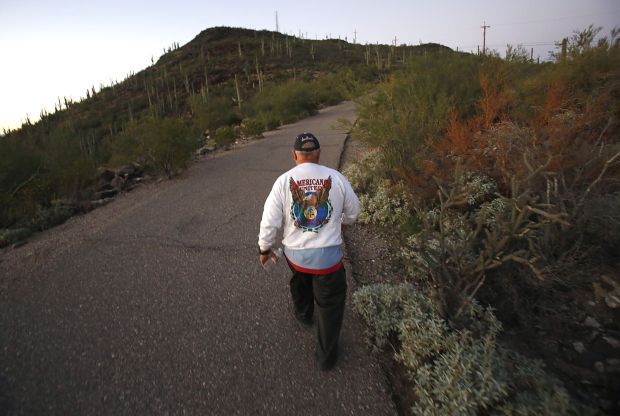
But it’s doable. Just ask Willie Gálvez, a 68-year-old Vietnam vet who does the hill three to four times a week.
“I do the same amount every week,” he said on that recent Monday morning, panting a bit as he trundled up the final incline that feels like a 90-degree skyward climb. “Some days I go all the way to the top, and then I’ll come halfway down and go back up again. And the next time I’ll only go up about half way and then come down.”
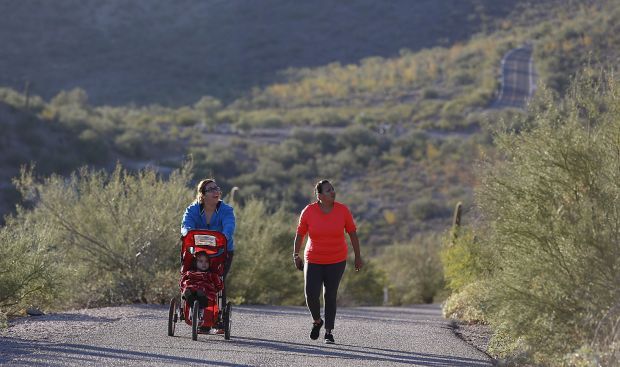
The mother daughter team of Linda and Beverly Cooper have been Monday morning regulars on Tumamoc for about a year. They hit the mountain around 6 a.m. so that they can be done before the path closes to the public at 7:30 — that’s when researchers from the University of Arizona start on the clock. The UA has owned the facility since the 1960s.
“It’s a great way to work out and great way to spend time with someone at the same time,” said daughter Beverly, 31, better known as “Bev Rage” to fans of the Serious Truck Stop Waitresses roller derby team.
I started doing Tumamoc with a gym friend in September. My workout passion is indoor cycling at LA Fitness in Marana, led by an instructor named Tracy. She’s a lawyer by day and I’m sure she is very pleasant and accommodating to her clients. But when I see her at 5:45 a.m., she’s a merciless drill sergeant. She barks orders to push harder, spin faster.
“We didn’t get up this early to give less than 150 percent,” she reminds us when someone starts to whine.
Point taken.
When I step onto Tumamoc’s paved road on Monday and Friday mornings, I take a deep breath and hear Tracy’s words.
The first thing you see when you go through the main gate is a collection of casitas. One is an elaborately adorned shrine with the Virgin draped in rosaries. You can stop and meditate or pray for the strength to make it all the way up or the courage not to cry when you chicken out halfway.
The road from there slopes gently at first, almost deceivingly so. But just as you take that deep breath of self confidence — “This is nothing!” — the slope angles upward and continues, higher, higher, higher. You will try to walk arrow straight like your mother told you — shoulders back, head up — but gravity plays against you. You will involuntarily slump forward, gulping in air as you alternate between taking small almost tip-toe steps to giant lunges.
“The first one is always shockingly harder than it looks,” Beverly Cooper said. “It seems like the gentle slope but it’s super long. Every time it is challenging.”
You catch your breath on the first switchback, where you find several stone buildings and a greenhouse and a second locked gate with room for pedestrians to enter.
The paved road here is a little more rutted and it’s mostly flat until you round the first corner. That’s where it starts another incline. It gradually gets steeper, then turns a second corner. Your mind tells you that it will get easier.
It doesn’t.
The incline gets steeper and longer. You start breathing a little heavier. There’s not enough oxygen to talk. You will try to breath through your nose; you will mostly fail. You round another corner; you’ve lost count. Your mind and body tell you you must be close to the top.
When it’s dark, you can never tell exactly where you are. That’s a good thing; if you don’t see what lies ahead you can convince yourself that you are almost there.
For me, the final stretch is the hardest. My body tells me that the hill has just gotten appreciably steeper, although I have no idea if that is the truth or my imagination. I trudge along, watching as the folks who got there before me pass me on the way down. I have come this far; I am not stopping. The road turns and I see the glittering lights of the radio towers and the twinkling city lights below — way below. So close; another 100, 200 yards. Push. Breathe. Push. Breathe.
“I have to be honest with you,” Gálvez said, gulping in air as we rounded that final turn. “Even though I’ve been doing it 10 months, it’s still hard. But I always go to the top.”
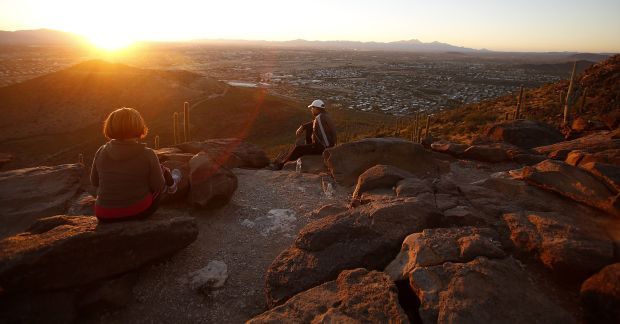
At the top, Gálvez finds a rock near a ledge of boulders overlooking “A” Mountain, which looks like a little hill. We gaze out on a canopy of twinkling lights flickering against headlights streaming off three major roads. A breeze comes out of nowhere; it is the best gift Mother Nature can give.
This is the highlight for Linda Cooper, who in addition to going with her daughter on Mondays does the trail by herself one or two other times a week.
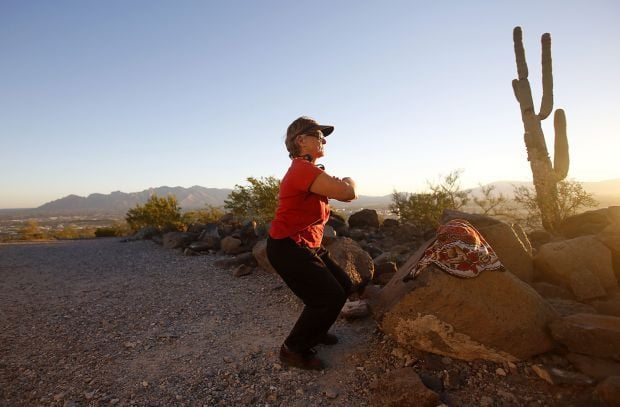
“For me it’s almost like a meditation going by myself. I like the quiet,” she said. “I see the vegetation, the animals. I watch the sunrises. It’s so beautiful and peaceful and everyone’s so friendly.”
A few weeks ago a woman reported being attacked by a man. She wasn’t injured and no one has been charged, but since then early morning regulars have been quick to greet one another with a “good morning” or “hello” as if to say “we’re all good here.” (You would be surprised how many people walk before the sun rises.)
Those pleasantries are even nicer when you’re making your way down. Some people are so giddy they run all the way. I’m not that brave. My biggest fear with doing Tumamoc in the dark is that I will lose my footing on the way down and go tumbling off the side. There’s one conversation I don’t want to have with my kids — explaining why an unflattering photo of my dramatic rescue made the back page of the paper.

