


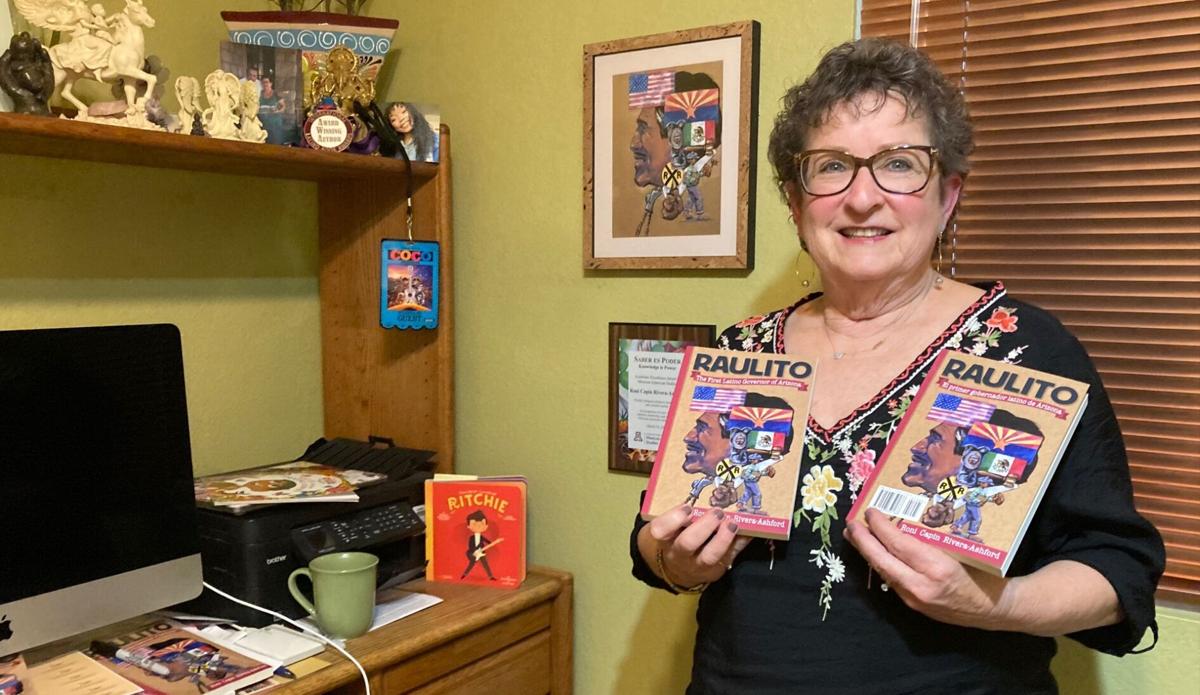
Roni Capin Rivera-Ashford has known for most of her life she’s a writer. Even when young, she wrote poems and letters. She collected her thoughts on paper.
“If I was sick, or lonely, or miserable, I would wake up and start writing,” she said of the teenage Roni. “When I was away at school, writing was a remedy for me. It calmed my head and relaxed my heart. I just felt better when I wrote.”
Even so, she was as surprised as anyone to learn she was an author, too.
It took her a while — Rivera-Ashford was 50 when her name first appeared on the cover of a book — but there’s no denying it now.
Since releasing “My Nana’s Remedies” in 2002, she has authored five more books, the latest being “Raulito: The First Latino Governor of Arizona.” Like all her books, “Raulito” is presented both in English and Spanish. “Raulito: El Primer Gobernador Latino de Arizona” reads through from one of the book’s two covers, the English version from the other.
All of Rivera-Ashford’s writing helps us understand who she was before becoming an author.
The daughter of Jewish parents, she was raised in Nogales, in large part by her father’s mother — the Nana she honored in her first book.
“My parents were away on business a lot, so I spent a lot of time with my Nana,” Rivera-Ashford said. “We had local housekeepers, too, so I was raised in two cultures. I can speak a little Yiddish. I made my Bat Mitzvah. But I was surrounded by the love and wonderful culture of Mexico, too. I tell people now I’m a Jewish author with a Mexican heart.”
Those were the days when the border between the U.S. and Mexico was a line painted down the middle of International Street.
“When we were kids, we would say we were going across the line, and we would walk back and forth into Mexico all the time,” Rivera-Ashford said. “Some kids had relatives on both sides. There were days we’d grab a stick of butter and a saltshaker and run into town to buy a dozen fresh, warm tortillas. They’d be gone by the time we got home.”
Instinctively bilingual, she became a bilingual educator, first in Nogales and later in Tucson.
All these experiences can now be seen in her books, which should have meaning to all kids but particularly bilingual children whose families speak Spanish at home.
“Teachers near the border know it’s important to find out what a child’s primary language is before teaching them how to read,” she said. “You start by teaching them to read in their primary language. The skills transfer. Once they learn how to speak English, they’ll learn how to read in English.”
As a first grade and second grade teacher, she would write sentences and short paragraphs and invite her students to illustrate them.
Later, she patched those paragraphs into stories. At some point in the 1990s, she wondered if any of her stories might make a good book.
“Kids wanted to hear stories they could relate to, situations they were familiar with,” Rivera-Ashford said. “I’m trying to do that now with my books. I want kids to see that the people in my stories are just like the ones they know at home.”
They’re certainly people Rivera-Ashford knew at home.
She followed “My Nana’s Remedies” with “My Tata’s Remedies,” recounting lessons learned from her late father-in-law, Gus. The cover of the book, in fact, is a rendering of Gus himself.
Her latest book, “Raulito,” stemmed from a friendship Rivera-Ashford developed with Gov. Castro after he moved back to Nogales. He told Rivera-Ashford her books reminded him of books he himself had read as a child.
Interestingly, “Raulito” begins with an introduction written by Castro shortly before he died.
Few authors reveal themselves more fully than Rivera-Ashford has, clearly subscribing to the theory that writers should “write what you know.”
“Deep down, I know I’m a teacher,” she concluded, simply. “I’m retired from the classroom now, but I’m still teaching. I’m just teaching with my books.”
Footnotes
Our local book community paused last week to remember Tucson author Elizabeth Gunn, who passed away at 92. Gunn wrote 18 mysteries after the age of 70, two of them while in her 90s. Seven of her novels were set in Tucson. She was a great friend of the Tucson Festival of Books and our local bookstores. She died in Helena, Montana, where she had recently moved to stay with her daughter.
Pulitzer Prize winner Rita Dove, formerly the Poet Laureate of the U.S., will read from her collection “Playlist for the Apocalypse“ Thursday, Oct. 13, at the UA Poetry Center. The free program will begin at 7 p.m. To learn more, visit poetry.arizona.edu.
Oct. 31 is the submission deadline for the Tucson Festival of Books’ Literary Awards Writing Contest. Prizes totaling $5,200 are available to the winners in fiction, nonfiction and poetry. For entry information, visit tucsonfestivalofbooks.org.
One of Rivera-Ashford’s friends growing up in Nogales was Alberto Rios, later a finalist for the 2002 National Book Award in Poetry and the first Poet Laureate of Arizona. He is now a professor at Arizona State University and Director of the Piper Center for Creative Writing in Phoenix.

