


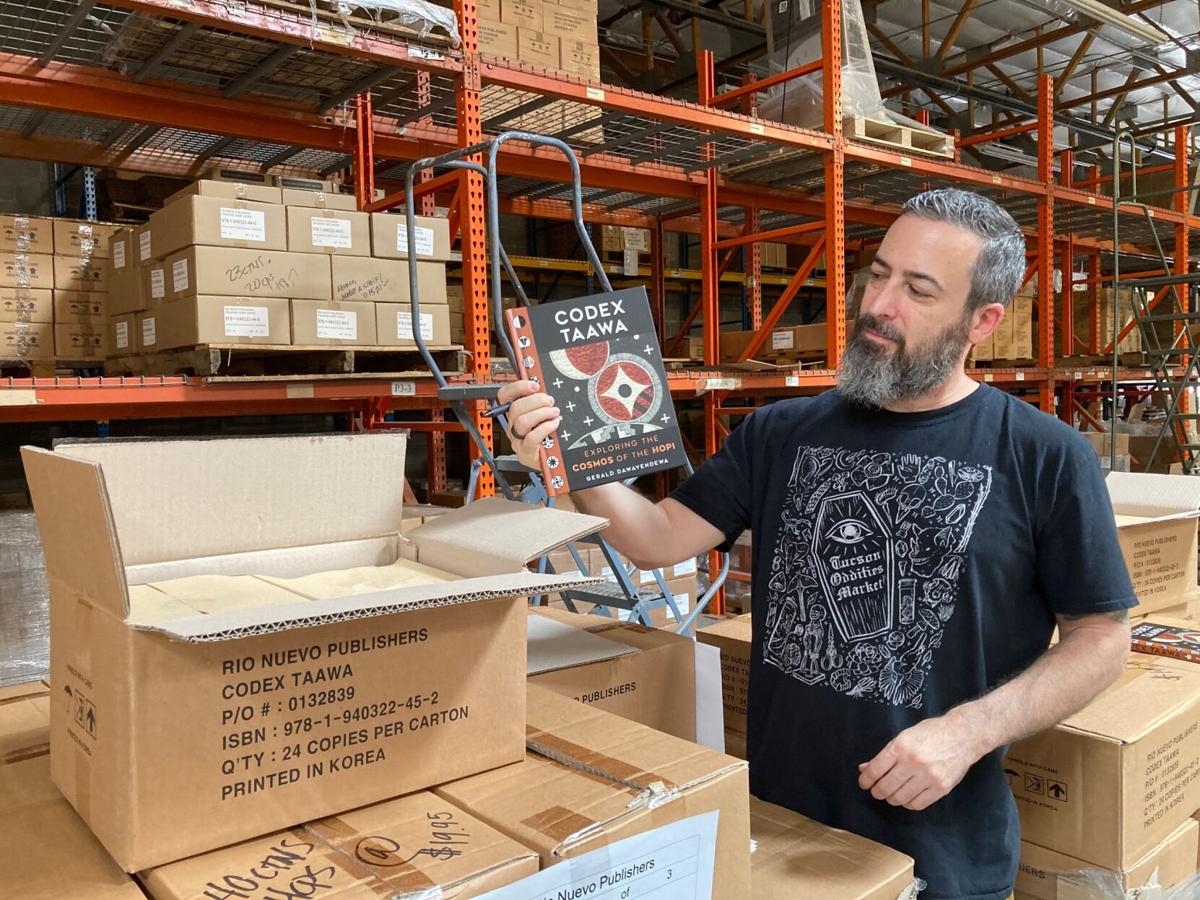
If you are in one of the many gift shops at Yellowstone National Park, you will find Rio Nuevo books. If you are in the historic La Fonda Hotel in Santa Fe, you will find Rio Nuevo books. And if you are driving on Bonita Avenue near downtown Tucson, you will find … well, you know.
Rio Nuevo is Tucson’s largest independent publisher, and it is very much back in business after a two-year lull due to the pandemic.
In the last nine months alone, Rio Nuevo Publishers has released five new titles, ranging from a Day of the Dead cookbook to an encyclopedia of venomous animals.
Local legend Jim Turner offered an easy-reading history of our state in “Arizona.” Another well-known Tucsonan, Gerald Dawavendewa, explored Hopi spirituality and astrology in “Codex Taawa.” Bob Rosebrough gave us an insider’s biopic of Gallup, New Mexico, in “A Place of Thin Veil.”
“It’s great to make books again,” managing editor Aaron Downey confessed. “In 2020 and ’21, I think we put out a grand total of two. I wouldn’t say we’re back to full speed yet, but we’re getting there.”
Rio Nuevo is a regional publisher that limits its scope to adult nonfiction about life in the Southwest, West and northern Mexico. That said, it’s surprising how many things it finds to talk about.
“Our target audience isn’t huge,” Downey said. “But within that space we have a really wide range of interests: history, art, food, animals, culture. … We care a lot about all those things.”
There are dozens of independent presses in the West, many in Arizona. Rio Nuevo is hardly the largest, releasing only four or five titles a year. But when it agrees to take on a project, Rio Nuevo promises to do it right.
“We are nothing without good authors, and we want to deliver a book they will be proud of,” Downey said. “They’re the creators. We just help with the packaging.”
Exhibit A: When the COVID-19 lockdowns began in 2020, Rio Nuevo had just started printing a cookbook called “Dining With the Dead, A Feast for the Souls on Day of the Dead.”
“When we saw we would have no place to sell it, we stopped the press,” Downey recalled. “Then, later, when things started to open up again, we didn’t have enough cash on hand to finish it.”
So Rio Nuevo launched a Kickstarter campaign, asking for help. Donations totaled $27,000, the presses rolled and the gorgeous hardcover cookbook is now on sale.
“Mariana Nuno and Ian McEnroe had been working on that book for five years,” Downey said. “They put everything they had into it. We just had to find a way to get it printed.”
Exhibit B: “Navajo Code Talker Manual” looks and feels like a military code book from World War II. The concept came from an Ohio art student’s project that Downey saw online. It is top-bound, printed on heavy paper, and includes tabs, foldouts and other fun tools that teach the reader how to break the Navajo code.
“When we put it out to bid,” Downey said, “none of our regular printers could do it. I finally found a printer that specializes in board games. The book is out now and looks great.”
While Rio Nuevo is a “regional press,” it would be easy to substitute “local” for “regional.” Not only do many of its authors live in Tucson, so do most of the editors, researchers, indexers and designers the firm contracts to produce each book.
“We try to keep everything as local as we can,” Downey said. “If we can find people in Tucson, we will. If we can find people in Arizona, we will. We want our people to know what we’re all about.”
No page is left unturned, so to speak. If there is a question about a word in Navajo, Rio Nuevo will call one of its friends in the nation. If a book can be improved with a map, it contracts a cartographer.
One noteworthy hallmark of a Rio Nuevo release is the quality of its covers. “Despite what we say, we all judge books by the cover,” Downey said. “Good covers are absolutely important.”
From an author’s perspective, there is another big benefit. In addition to managing Rio Nuevo, Downey is the general manager of Treasure Chest Books, one of the West’s leading distributors.
Credit their co-founders, Tucsonans Ross Humphreys and Susan Lowell. They launched and linked the two together in 1999.
“One of the huge advantages we have as a publishing company is that we distribute our own books,” Downey admitted.
Like Rio Nuevo, Treasure Chest targets the West and Southwest. It is large enough to market 350 different publishers, but still small enough to be nimble. As the number of independent bookstores dwindled, Treasure Chest found other places to sell books.
“Now you can find us in hotel gift shops, convenience stores, truck stops, national and state parks, botanical gardens, museums … ‘wherever books are sold,’ ” Downey said.
Death Valley? Crater Lake? Tohono Chul? Check, check, check.
“We sell to a Native American Museum in Arkansas, too,” Downey said.
Rio Nuevo and Treasure Chest Books now share a warehouse and office space at the same location on Bonita, just blocks from a home once owned by Lowell’s great-grandparents.
Fortunately for the rest of us, it’s safe to say they aren’t going anywhere anytime soon.
Footnotes
For the record, Rio Nuevo Publishers (rionuevo.com) has no connection to the assessment district that funds redevelopment projects downtown.
Rio Nuevo’s first star author was co-founder Susan Lowell. By 1999, she had written seven books, including “The Three Little Javelinas.” The other co-founder, Ross Humphreys, is her husband. They met in the newsroom of the Tucson Citizen. She was a reporter there, he a photographer.
According to Bookdepository.com, Rio Nuevo and Treasure Chest have now published and marketed some 200 books over the years.
While Rio Nuevo is Tucson’s biggest independent, our largest publisher is University of Arizona Press. Its fall catalog lists 20 new books releasing over the next six months.

