


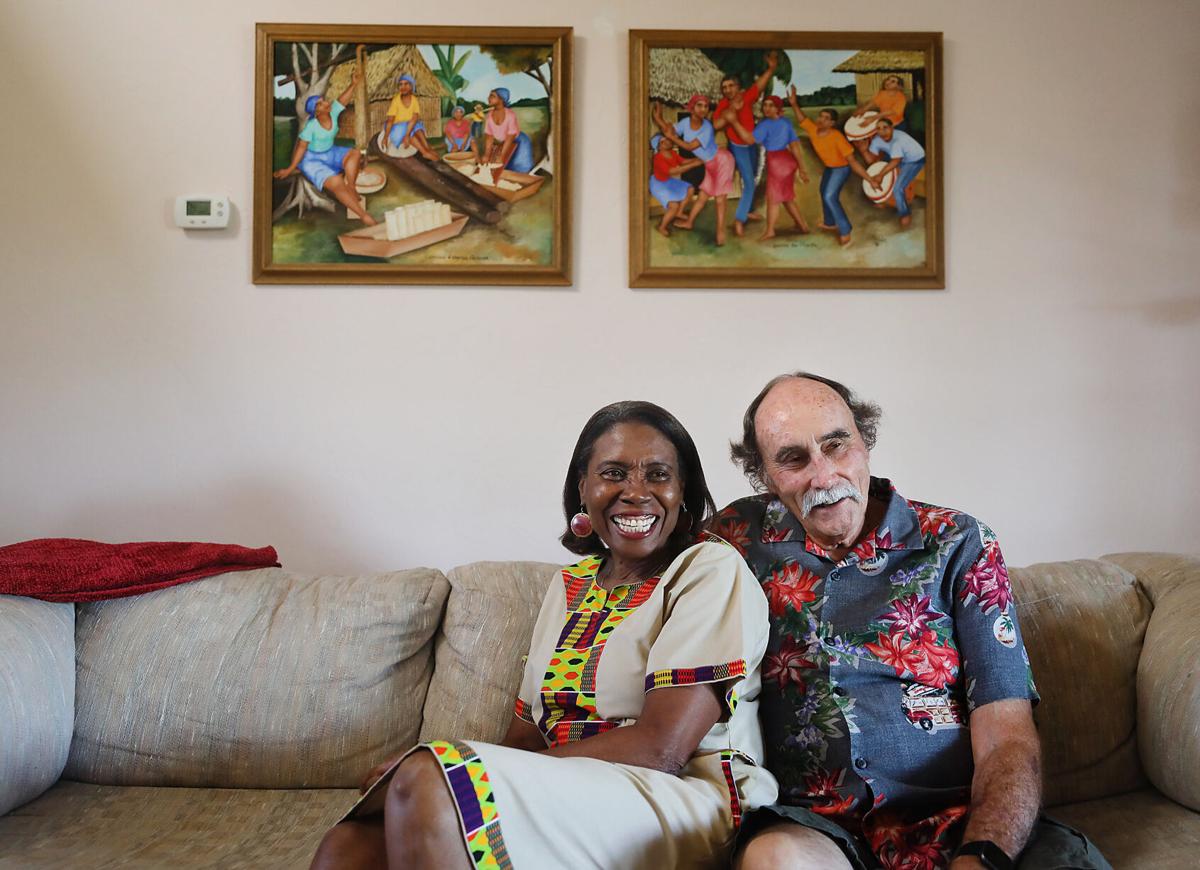
There’s vivid art on the walls of the bright foothills home of PhDs Harriet and Tom Scarborough.
“That painting was done by my cousin, Benjamin Nicholas,” says Harriet, pointing to a beach-landing scene. “It depicts the arrival of our common ancestor, a turtle fisherman, who settled Barranco—the southernmost village in Belize. Benjie painted scenes representing our culture.”
Retired TUSD administrator Harriet is Garifuna. Her culture is that of the Garinagu people, formerly called Black Caribs, driven from St. Vincent Island to the Central American coast in the eighteenth century.
In their retirement, Harriet and her husband Tom, former principal of Cholla High School, have been offering professional development to educators in Belize, only fully independent from Britain since 1981. Consummate educators, they want to “give back.”
Harriet, 68, seems to have been born to teach. The daughter of the principal of the K-8 school in Barranco, she started teaching when she was still in her teens. Graduating from St. Catherine’s Academy in Belize City when she was only fifteen, she returned to Barranco and joined her father’s faculty. With friends and family there, she could have stayed on. But she was thrown an unexpected “life-line”: via contact with one of Harriet’s young students, Tucsonans Gloria and Spencer Giffords—parents of former Representative Gabrielle—offered to help her earn a degree at the University of Arizona.
Eventually, with a UA master’s in Reading, she was ready to go home. But she had met “my Tomás,” who “didn’t believe in long-distance romance.” They were married in 1980, and have lived here since.
Kingman-raised Tom, 75, is a veteran of the Vietnam War. Just two weeks after graduating from the University of Arizona — with plans to become a wildlife biologist — he was drafted into the Infantry. Waxing Dickensian about his war period (“…the best of times; the worst of times.”), he recounts an experience that set him on his career track:
Stepping out of a helicopter one Friday night in Phu Bai, anticipating a welcome “stand-down” week of cold beer, hot showers, and relief from action, Tom was pulled aside by his platoon sergeant. Thrusting at Tom a thick manual on 81 mm. mortar-plotting, the sergeant announced, “You’re teaching this tomorrow. For eight hours. And then, you’re teaching it the next day for four more hours.”
Tom sat up until three o’clock that night trying to figure out how to present this material to “forty armed, angry 19-year-olds who didn’t want to listen to me.” What’s worse was that what the manual described was “not what we do in the field.” Finally Tom came up with a practical way to present the material. “I guess it was a lesson plan,” he says. Then, after another 3 a.m. planning session the next night — knowing that lecture wasn’t going to cut it — he developed application strategies that involved teams, competitions, and simulations. In the end, the full platoon of armed, angry guys successfully plotted mortar fire. Having had fun.
Tom had discovered he liked teaching.
Designing lessons suited to his students’ interests and abilities then became fundamental for Tom as a science teacher at Catalina and Cholla High Schools, principal of Cholla, principal coach in TUSD, and team leader for state-wide school accreditation.
Fundamental to Harriet as an educator was her determination to serve all students — regardless of background or preconceptions of ability. “You can’t teach just the ones that have already learned,” she still reminds educators. Her career covered teaching fourth grade in Globe, Reading at Pistor Junior High, and Reading and English at Tucson High Magnet. From Language Acquisition Specialist at Tucson High, she was tapped to be High School Language Arts Specialist for the district. When she retired in 2007, she was on TUSD’s leadership team as Senior Academic Officer for Curriculum and Professional Learning.
Both Scarboroughs continued in education when they left TUSD. Harriet became a consultant for Research for Better Teaching, crisscrossing the country presenting to administrators and teachers. Tom was hired back by TUSD to coach principals, and he led accreditation review teams for schools throughout the state
Their retirement volunteer work grew out of a disappointment.
Harriet had developed a proposal for the University of Belize to collaborate with the University of Arizona to adopt the National Writing Project. When Harriet brought the proposal to the UB president, he welcomed it enthusiastically. Unfortunately, though, he left office. When she then showed up to discuss the program with the new dean, she got the cold shoulder. Even the Minister of Education couldn’t be bothered to consider the collaboration.
Harriet was stung that her “giving back” had gone awry. But then another collaboration opportunity presented itself — with Tom: Touring the campus of her Belize City high school, they ran into the current principal, Salome Tillett. In the course of their conversation, Harriet recounted the Writing Project fiasco. Tillett looked at both of them and said, “I am president of the Belize Association of Principals of Secondary Schools, and we could use your help.”
Thus, in 2007, the Scarboroughs became a professional development team for Belize education.
Principal Tillett has nothing but praise for the work of Harriet and Tom. “While they have personally mentored me, and I like to claim them,” she writes, “they have done much to improve the secondary education landscape for Belize.” They have given workshops to the full, fifty-school association of secondary school principals, who, in turn, have brought them to their schools to work with faculty and staffs. “If you were to ask any secondary school educator about ‘professional learning communities,’ ‘no-shame, no-blame teaching,’ ‘backward design,’ ‘high expectations teaching,’” she continues, “I have no doubt it would be attributed to working with this dynamic team.”
The principal of Bishop Martin High School in Orange Walk, Angel Leiva, adds two tenets he’s gained from the Scarboroughs: first, that the purpose of learning should be made clear to the learner; second, that ALL students can learn. “What has struck me through the years,” he writes, “is the phrase No Secrets Teaching. It’s about being transparent in the delivery of education.” Additionally, as opposed to earlier British colonial attitudes, they expect students to succeed “regardless of socioeconomic status and academic aptitude.”
And it seems Belizean educators are not about to cut ties with the Scarboroughs. Dr. Jeremy Cayetano, former principal of Stann Creek Ecumenical College who is now general manager of Anglican Schools of Belize, first reached out to the Scarboroughs for tools to help her school’s teachers. Now she’s asked them to lead a 300-teacher workshop in January, 2022, “to help more students succeed.”
The couple is home in Tucson now, but they have plans for their next trips to Belize. RBT, the education corporation Harriet worked for, has donated 400 teaching strategy books to Belizean educators, and they’ll be delivered in December. “We’re going to load up the Highlander and drive around Belize dropping off books,” says Harriet, delighted. “We’ll be like Santa Claus!”
“The Skillful Teacher,” however — not unlike “Field Manual FM Mortar Fire Direction Center Procedures” — is a big, dense book. Tom is already making lesson plans to introduce it to teachers.

