



This is part of an occasional series of conversations with Tucson composers.
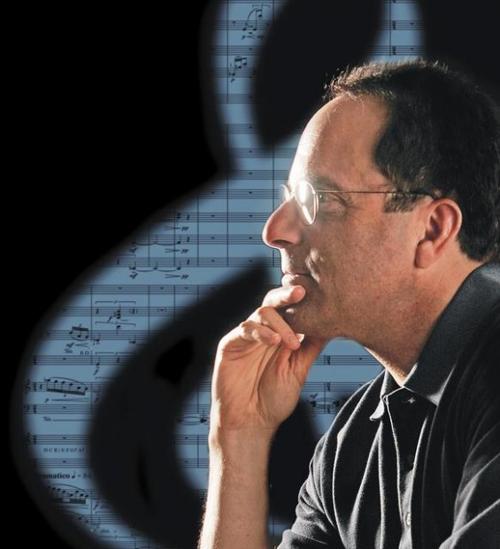
Tucson composer Daniel Asia is experiencing a first. He is writing an opera.
"We almost had the Metropolitan Opera (interested), but then they said, 'You know, we just got too much stuff, but we love the project'," he said last week as he packed for a weekend ski trip to Colorado with his daughter. "That would have been my fantasy, if they had commissioned me."
"It's a fabulous libretto," he added of the opera's story line, based on the novel "The Tin Angels," the first book by his longtime friend, the poet and novelist Paul Pines.
The pair will be reunited on Sunday for a concert of Asia's works, some of it inspired by Pines' poetry and writings. The concert will benefit Congregation Anshei Israel and also will feature longtime Asia collaborators tenor Robert Swensen and pianist Tannis Gibson. The three are colleagues at the University of Arizona School of Music, where Asia heads the composing department.
The 54-year-old Yale graduate and former composer in residence with the Phoenix Symphony chatted about the concert and his creative process that has led him to compose 75 pieces including four symphonies — a fifth makes its world premiere late next year with the Tucson Symphony Orchestra, Asia said — four or five shorter orchestral works, a piano and a cello concerto, several song cycles and numerous chamber works. He also has recorded 10 CDs of his compositions "so people can hear all the symphonies," he said.
Seattle native Asia, who played trombone as a teen, began composing seriously during his first year at Hampshire College in Massachusetts.
"Hampshire was an interesting place. It was the experimental college in the '70s," he recalled. "If you were 18 years old and you were a writer, you wrote."
So back in college, as an 18-, 19-year-old kid, were you prepared to actually start writing music seriously?
"That's a great question. I don't know. Is anybody ever actually ready to do something seriously until they conclude they are ready to do something seriously? . . . I guess it's when you decide, 'Oh, I think I have something to say. I better figure out how to say it.' You study and you learn and you practice and you throw things away. I don't think there's anything to replace the concept of sitting your rear end down on the chair and trying."
So how would you define your sound?
"American."
What is American music?
"Americans have a very strong and very singular sense of rhythm from having grown up with popular music and jazz. Something that isn't quite as blocked in as the European tradition tends to be. Americans tend to be more laid back in what they do or allow or how they put things together."
Is your music regularly played by American orchestras?
"I would say it's regularly irregularly played. It's hard to get orchestras to play symphonies, quite frankly. Orchestras are conservative institutions. They think somehow the public is more interested in hearing Beethoven and Brahms than Asia. It's a shame, because it's not true. . . . In my humble estimation, 70 percent of their literature should be brand new just like any other arts organization.
"Classical music is not a dead tradition. It's a very living tradition, but it's being played as if it's dead."
Is there a clear-cut root of the problem?
"America is being overwhelmed by popular culture. It's a battle for us. Do I mind popular culture? Not particularly. Do I mind when popular culture is considered art or replaces art? Yes. . . . An artistic experience is meant to provide something a little bit richer, something a bit deeper and something meant to last a bit longer."
So what is your process when you sit down to compose?
"Absolute panic at the start."
How so?
"The beginning of any project is always fraught with difficulties. Confronting the empty page or the empty canvas or the empty computer screen is always daunting. Getting started is always hard."
So how do you get started?
"You have certain ways of promoting ideas. You think of a gesture. You think of a shape. You think of a rhythm. You think of a couple of pitches. Then all of a sudden something starts to develop. . . . After that it's a matter of good ideas. It should be propelled by strong musical ideas. But we live in a time where people don't quite know what a musical idea is, and that's why there's so much bad music."
So what is a musical idea? Does pop music have it?
"Pop music does, but they just tend to be rather simple or superficial in their implications and the way they are worked out. Musical ideas are defined by shape, by rhythm and pitch. It needs to have some sort of way of making its way into the brain. Because the idea is to create a character or a set of characters that then are taken on a journey. That is what defines the classical music experience as opposed to the popular music experience. Pop music says here's the idea, then here's the idea again. And then it says here's the idea again, untransformed. And here's the idea again. Which is fine because that's the form it takes at three minutes long. The classical idea is to take an idea and take it on a journey where it metamorphoses and changes over time and becomes something different."
So when you sit down to write, are you at a piano?
"I write at a piano or a drawing table or a drafting table. I don't use a computer to write my music. I'm an old fogey in other words."
Do you play the piano well?
"Nope. I play it very poorly. I only started playing piano, much to my mother's chagrin, once I got to college."
Have you ever written a piece for trombone?
"I have. It's called 'Dream Sequence 1.' It's way out there. But you should listen to it. It's funny. . . . It's a musical theatrical piece about the internal life of a trombonist. . . . It's not your standard piece."
So do you have an iPod?
"I do, as of four months ago. I'm way behind. The question is do I use my iPod."
Do you?
"Very rarely."
So what's on it?
"I use it instead of carrying all my CDs around. When I play stuff for people when I go to a college or university, I can put all of my stuff on the iPod and connect it to a computer and play it."
So your iPod is all about Daniel Asia?
"I have to tell you it is. I don't listen to that much on an iPod. In fact, here's the nasty little secret: I don't listen to music except when I'm really listening to music. But since I spend most of my day engaged in creating music, I don't spend my off hours listening to other music."
So what do you do for fun?
"My wife will tell you I have no hobbies. That's not exactly true. I love to read."
What's the last book you read?
"I just read a book on the fine art of small talk."
"America is being overwhelmed by popular culture. It's a battle for us."
Daniel Asia, composer
Preview
Daniel Asia and Friends: "A Journey Through Music and Words"
•Featuring composer Daniel Asia and his works; poet Paul Pines; tenor Robert Swensen; and pianist Tannis Gibson.
•When: 3 p.m. Sunday.
•Where: Congregation Anshei Israel, 5550 E. Fifth St.
•Tickets: $25, $15 for seniors and $10 for students for general admission; $100 for reserved seats and a post-concert reception; $54 for preferred seats. Proceeds benefit Congregation Anshei Israel.
•Details: Call Donna Levy at 403-0849.
•Program:
"Breath in a Ram's Horn," a song cycle based on Pines' poems.
"Why Jacob?" for solo piano.
Excerpts from Symphony No. 5, a choral symphony for solo voices, a tenor, bass baritone, chorus and orchestra based on psalms and poetry by Pines and Israel's greatest poet Yehuda Amichai.

