

LONDON — British playwright Tom Stoppard, a playful, probing dramatist who won an Academy Award for the screenplay for 1998's "Shakespeare In Love," died at age 88.
In a statement Saturday, United Agents said Stoppard died "peacefully" at his home in Dorset in southern England, surrounded by his family.
"He will be remembered for his works, for their brilliance and humanity, and for his wit, his irreverence, his generosity of spirit and his profound love of the English language," they said. ""It was an honor to work with Tom and to know him."
The Czech-born Stoppard was often hailed as the greatest British playwright of his generation.
His brain-teasing plays ranged across Shakespeare, science, philosophy and the historic tragedies of the 20th century. Five of them won Tony Awards for best play: "Rosencrantz and Guildenstern Are Dead" in 1968; "Travesties" in 1976; "The Real Thing" in 1984; "The Coast of Utopia" in 2007; and "Leopoldstadt" in 2023.

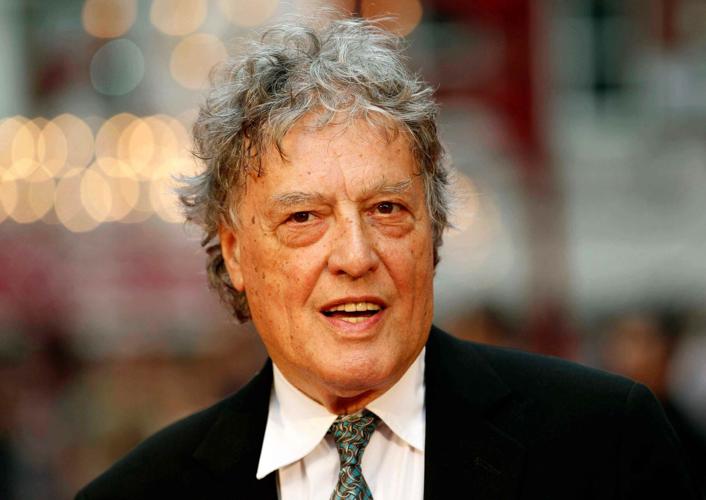
British playwright Tom Stoppard poses Sept. 4, 2012, as he arrives for the world premiere of "Anna Karenina" in London.
The writer was born Tomás Sträussler in 1937 to a Jewish family in Zlín in what was then Czechoslovakia, now the Czech Republic. His father was a doctor for the Bata shoe company, and when Nazi Germany invaded in 1939 the family fled to Singapore, where Bata had a factory.
In late 1941, as Japanese forces closed in on the city, Tomas, his brother and their mother fled again, this time to India. His father stayed behind and later was killed when his ship was attacked as he tried to leave Singapore.
In 1946 his mother married an English officer, Kenneth Stoppard, and the family moved to Britain. The 8-year-old Tom "put on Englishness like a coat," he later said, growing up to be a quintessential Englishman who loved cricket and Shakespeare.
He did not go to university but began his career, aged 17, as a journalist for newspapers in Bristol, southwest England, and then as a theater critic for Scene magazine in London.

He wrote plays for radio and television including "A Walk on the Water," televised in 1963, and made his stage breakthrough with "Rosencrantz and Guildenstern Are Dead," which reimagined Shakespeare's "Hamlet" from the viewpoint of two hapless minor characters. It premiered at the Edinburgh Fringe Festival in 1966 and was staged at Britain's National Theatre before moving to Broadway.
A stream of exuberant, innovative plays followed, including meta-whodunnit "The Real Inspector Hound" (first staged in 1968); "Jumpers" (1972), a blend of physical and philosophical gymnastics, and "Travesties" (1974), which set intellectuals including James Joyce and Vladimir Lenin colliding in Zurich during World War I.
Musical drama "Every Good Boy Deserves Favor" (1977) was a collaboration with composer Andre Previn about a Soviet dissident confined to a mental institution — part of Stoppard's long involvement with groups advocating for human rights groups in the Soviet Union and Eastern Europe.

He often played with time and structure. "The Real Thing" (1982) was a poignant romantic comedy about love and deception that featured plays within a play, while "Arcadia" (1993) moved between the modern era and the early 19th century, where characters at an English country house debated poetry, gardening and chaos theory as fate had its way with them.
"The Invention of Love" (1997) explored classical literature and the mysteries of the human heart through the life of the English poet A.E. Housman.
"The Coast of Utopia" (2002) was an epic trilogy about pre-revolutionary Russian intellectuals, and Stoppard drew on his own background for "Rock'n'roll" (2006), which contrasted the fates of the 1960s counterculture in Britain and in Communist Czechoslovakia.
"The Hard Problem" (2015) explored the mysteries of consciousness through the lenses of science and religion.
Stoppard was a strong champion of free speech who worked with organizations including PEN and Index on Censorship. He claimed not to have strong political views otherwise.

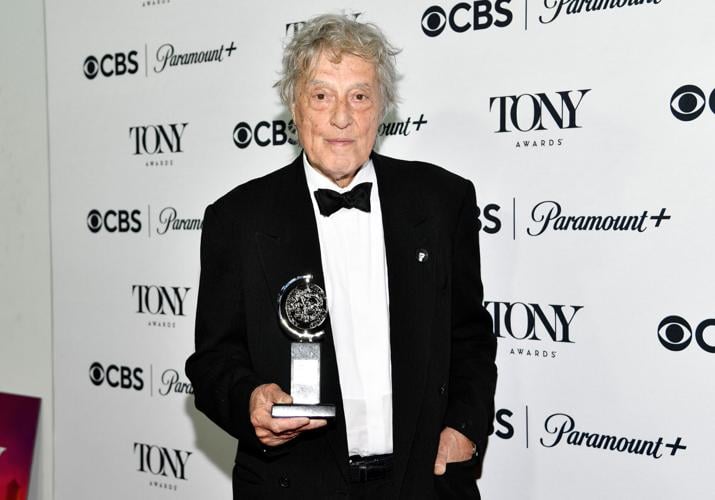
Tom Stoppard poses with the award for best play for "Leopoldstadt" on June 11, 2023, in the press room at the 76th annual Tony Awards at the Radio Hotel in New York.
"Leopoldstadt" drew on his own family's story for the tale of a Jewish Viennese family over the first half of the 20th century; it won four Tonys. Stoppard said he began thinking of his personal link to the Holocaust quite late in life, only discovering after his mother's death in 1996 that many members of his family, including all four grandparents, died in concentration camps.
Stoppard also wrote many radio plays, a novel, television series including "Parade's End" (2013) and many film screenplays. These included dystopian Terry Gilliam comedy "Brazil" (1985), Steven Spielberg-directed war drama "Empire of the Sun" (1987), Elizabethan romcom "Shakespeare in Love" (1998) — for which he and Marc Norman shared a best adapted screenplay Oscar — code breaking thriller "Enigma" (2001) and Russian epic "Anna Karenina" (2012).
He also wrote and directed a 1990 film adaptation of "Rosencrantz and Guildenstern are Dead," and translated numerous works into English, including plays by dissident Czech writer Václav Havel, who became the country's first post-Communist president.
Queen Elizabeth II knighted him in 1997.
He was married three times: to Jose Ingle, Miriam Stern — better known as the health journalist Dr. Miriam Stoppard — and TV producer Sabrina Guinness. The first two marriages ended in divorce. He is survived by four children, including the actor Ed Stoppard, and several grandchildren.
Photos: Notable deaths in 2025
Peter Yarrow
Updated
Peter Yarrow, the singer-songwriter best known as one-third of Peter, Paul and Mary, the folk-music trio whose impassioned harmonies transfixed millions as they lifted their voices in favor of civil rights and against war, died Tuesday, Jan. 7, 2025. He was 86.
Sam Moore
Updated
Sam Moore, the surviving half and higher voice of the 1960s duo Sam & Dave that was known for such definitive hits of the era as “Soul Man” and “Hold On, I'm Comin,’” died Friday, Jan. 10, 2025. He was 89.
David Lynch
Updated
David Lynch, the filmmaker celebrated for his uniquely dark vision in such movies as “Blue Velvet” and “Mulholland Drive” and the TV series “Twin Peaks,” died just days before his 79th birthday.
Bob Uecker
Updated
Bob Uecker, the voice of his hometown Milwaukee Brewers who after a short playing career earned the moniker "Mr. Baseball" and honors from the Hall of Fame, died Thursday, Jan. 16, 2025. He was 90.
Joan Plowright
Updated
Award-winning British actor Joan Plowright, who with her late husband Laurence Olivier did much to revitalize the U.K.'s theatrical scene in the decades after World War II, died Thursday, Jan. 16, 2025. She was 95.
Cecile Richards
Updated
Cecile Richards, a national leader for women’s rights who led Planned Parenthood for 12 tumultuous years, died Monday, Jan. 20, 2025. She was 67.
Garth Hudson
Updated
Garth Hudson, the Band's virtuoso keyboardist and all-around musician who drew from a unique palette of sounds and styles to add a conversational touch to such rock standards as "Up on Cripple Creek," “The Weight” and "Rag Mama Rag," died Tuesday, Jan. 21, 2025 at age 87.
Marianne Faithfull
Updated
Marianne Faithfull, the British pop star, muse, libertine and old soul who inspired and helped write some of the Rolling Stones' greatest songs and endured as a torch singer and survivor of the lifestyle she once embodied, died Thursday, Jan. 30, 2025. She was 78.
Dick Button
Updated
Figure skating great and authoritative commentator Dick Button, who was the winner of two Olympic gold medals and five consecutive world championships, died Thursday, Jan. 30, 2025. He was 95.
Barbie Hsu
Updated
Barbie Hsu, a Taiwanese actress who starred in the popular TV drama “Meteor Garden” that once swept Asia, died Monday, Feb. 3, 2025, after contracting pneumonia triggered by the flu. She was 48.
Irv Gotti
Updated
Irv Gotti, the boisterous, smiley music mogul who founded Murder Inc. Records and was behind major hip-hop and R&B artists, died Wednesday, Feb. 5, 2025. He was 54.
Tony Roberts
Updated
Tony Roberts, a versatile, Tony Award-nominated theater performer at home in both plays and musicals and who appeared in several Woody Allen movies — often as Allen's best friend — died Friday, Feb. 7, 2025. He was 85.
Paquita la del Barrio
Updated
Mexican musical legend Paquita la del Barrio, known for her powerful voice and fierce defense of women, died at her home in Veracruz early Monday, Feb. 17, 2025. She was 77.
Jerry Butler

Jerry Butler, a premier soul singer of the 1960s and after whose rich, intimate baritone graced such hits as "For Your Precious Love," "Only the Strong Survive" and "Make It Easy On Yourself," died Thursday, Feb. 20, 2025. He was 85.
Voletta Wallace

Voletta Wallace, the dedicated mother of the late great rapper The Notorious B.I.G. and protector of his legacy, died Friday, Feb. 21, 2025. She was 78.
Roberta Flack

Roberta Flack, the Grammy-winning singer and pianist whose intimate vocal and musical style made her one of the top recordings artists of the 1970s and an influential performer long after, died Monday, Fe. 24, 2025. She was 88.
Michelle Trachtenberg

Michelle Trachtenberg, a former child star who appeared in the 1996 “Harriet the Spy” hit movie and went on to co-star in two buzzy millennial-era TV shows — “Buffy the Vampire Slayer” and “Gossip Girl” — died Wednesday, Feb. 26, 2025. She was 39.
Gene Hackman and Betsy Arakawa
Updated
Gene Hackman, the prolific Oscar-winning actor whose studied portraits ranged from reluctant heroes to conniving villains and made him one of the industry’s most respected and honored performers, has been found dead along with his wife, 65-year-old concert pianist Betsy Arakawa, at their home in February. He was 95.
David Johansen

David Johansen, the wiry, gravelly-voiced singer and last surviving member of the glam and protopunk band the New York Dolls who later performed as his campy, pompadoured alter ego, Buster Poindexter, died Friday, Feb. 28, 2025. He was 75.
Roy Ayers
Updated
Roy Ayers, a legendary jazz vibraphonist, keyboardist, composer and vocalist known for his spacy, funky 1976 hit “Everybody Loves the Sunshine” that has been sampled by such R&B and rap heavyweights as Mary J. Blige, N.W.A., Dr. Dre, 2Pac, Mos Def and Ice Cube, died Tuesday, March 4. He was 84.
Pamela Bach

Pamela Bach, an actor and the ex-wife of “Baywatch” star David Hasselhoff, died Wednesday, March 5. She was 62.
John Feinstein

John Feinstein, one of the country's foremost sports writers and the author of numerous bestselling books, including the groundbreaking “A Season on the Brink” about college basketball coach Bob Knight, died unexpectedly Thursday, March 13. He was 69.
Émilie Dequenne
Updated
Émilie Dequenne, the Belgian actor who won a top Cannes Film Festival prize for her breakout role in “Rosetta,” died Sunday, March 16, of a rare cancer in a hospital outside of Paris. She was 43.
Kitty Dukakis

Kitty Dukakis, the wife of former Massachusetts governor and Democratic presidential candidate Michael Dukakis, who spoke openly about her struggles with depression and addiction, died Friday, March 21. She was 88.
Mia Love

Former U.S. Rep. Mia Love of Utah, a daughter of Haitian immigrants who became the first Black Republican woman elected to Congress, died Sunday, March 23. She was 49.
Denis Arndt

Denis Arndt, a character actor and favorite of TV writer and producer David E. Kelley, getting cast in “L.A. Law,” “Picket Fences” and “Chicago Hope,” and later earning a Tony nomination for his Broadway debut at age 77 in a play about mismatched lovers, died March 25. He was 86.
Richard Chamberlain

Richard Chamberlain, the handsome hero of the 1960s television series "Dr. Kildare" who found a second career as an award-winning "king of the miniseries," died Saturday, March 29. He was 90.
Val Kilmer

Val Kilmer, the brooding, versatile actor who played fan favorite Iceman in “Top Gun,” donned a voluminous cape as Batman in “Batman Forever” and portrayed Jim Morrison in “The Doors,” died April 1. He was 65.
Wink Martindale

Wink Martindale, the genial host of such hit game shows as “Gambit” and “Tic-Tac-Dough” who also did one of the first recorded television interviews with a young Elvis Presley, died April 15. He was 91.
Pope Francis

Pope Francis, history’s first Latin American pontiff who charmed the world with his humility and concern for the poor but alienated conservatives over climate change and critiques of capitalism, died April 21. He was 88.
Steve McMichael

Steve McMichael, a star defensive tackle on the Chicago Bears’ famed 1985 Super Bowl championship team, died April 23 following a battle with ALS. He was 67.
Ruth Buzzi

Ruth Buzzi, who rose to fame as the frumpy and bitter Gladys Ormphby on the groundbreaking sketch comedy series “Rowan & Martin’s Laugh-In” and made over 200 television appearances during a 45-year career, died May 1. She was 88.
Jim Dent

Jim Dent, who grew up in the caddie yards of Augusta, Georgia, and went on to become one of the PGA Tour's longest hitters and one of the top Black golfers of his generation, died May 2. He was 85.
James Foley

James Foley, a journeyman director best known for “Glengarry Glen Ross,” died May 6. He was 71.
David H. Souter

Retired Supreme Court Justice David H. Souter, the ascetic bachelor and New Hampshire Republican who became a favorite of liberals during his nearly 20 years on the bench, died May 8. He was 85.
Johnny Rodriguez

Country music star Johnny Rodriguez, a popular Mexican American singer best known for chart-topping hits in the 1970s such as “I Just Can’t Get Her Out of My Mind,” “Ridin’ My Thumb to Mexico” and “That’s the Way Love Goes,” died May 9. He was 73.
Robert Benton

Robert Benton, the Oscar-winning filmmaker who helped reset the rules in Hollywood as the co-creator of "Bonnie and Clyde," and later received mainstream validation as the writer-director of "Kramer vs. Kramer" and "Places in the Heart," died May 11. He was 92.
Charles Strouse

Three-time Tony Award-winner Charles Strouse, Broadway's industrious, master melody-maker who composed the music for such classic musical theater hits as "Annie," "Bye Bye Birdie" and "Applause," died May 14. He was 96.
George Wendt

George Wendt, an actor with an Everyman charm who played the affable, beer-loving barfly Norm on the hit 1980s TV comedy “Cheers” and later crafted a stage career that took him to Broadway in “Art,” “Hairspray” and “Elf,” died May 20. He was 76.
Jim Irsay

Jim Irsay, the Indianapolis Colts’ owner who leveraged the popularity of Peyton Manning into a new stadium and a Super Bowl title, died May 21 at age 65.
Dave Shapiro

Dave Shapiro, a groundbreaking music executive in the heavy metal and hard rock scene, died May 22 in a San Diego plane crash. He was 42.
Marcel Ophuls

Marcel Ophuls, the Academy Award-winning filmmaker whose landmark 1969 documentary “The Sorrow and the Pity” shattered the comforting myth that most of France had resisted the Nazis during World War II, died May 24. He was 97.
Phil Robertson

Phil Robertson, who turned his small duck calling interest in the sportsman's paradise of northern Louisiana into a big business and conservative cultural phenomenon, died May 25, according to his family. He was 79.
Rick Derringer

Guitarist and singer Rick Derringer, who shot to fame at 17 when his band The McCoys recorded “Hang On Sloopy,” had a hit with “Rock and Roll, Hoochie Koo” and earned a Grammy Award for producing “Weird Al ” Yankovic's debut album, died May 26. He was 77.
Loretta Swit
Updated
Loretta Swit, who won two Emmy Awards playing Maj. Margaret Houlihan, the demanding head nurse of a behind-the-lines surgical unit during the Korean War on the pioneering hit TV series “M.A.S.H.,” died May 30 at her New York City home, likely from natural causes, publicist Harlan Boll said. She was 87.
Jonathan Joss
Updated
Jonathan Joss, a voice actor best known for his work on the animated television series "King of the Hill," was fatally shot near his Texas home June 2. He was 59.
Sly Stone

Sly Stone, the revolutionary musician and dynamic showman whose Sly and the Family Stone transformed popular music in the 1960s and ’70s and beyond with such hits as “Everyday People,” “Stand!” and “Family Affair,” died June 9. He was 82
Brian Wilson

Brian Wilson, the Beach Boys’ visionary and fragile leader who helped compose and arrange “Good Vibrations,” “California Girls” and dozens of other summertime anthems and became one of the world’s most influential and admired musicians, died June 11. He was 82.
Anne Burrell
Updated
TV chef Anne Burrell, who coached culinary fumblers through hundreds of episodes of “Worst Cooks in America,” died June 17 at her New York home. She was 55.
Jimmy Swaggart

Televangelist Jimmy Swaggart, who became a household name amassing an enormous following and multimillion-dollar ministry only to be undone by his penchant for prostitutes, died July 1. He was 90.
Michael Madsen

Michael Madsen, the actor best known for his coolly menacing, steely-eyed, often sadistic characters in the films of Quentin Tarantino including “Reservoir Dogs” and “Kill Bill: Vol. 2,” died July 3. He was 67.
Malcolm-Jamal Warner

Malcolm-Jamal Warner, who as teenage son Theo Huxtable on “The Cosby Show” was central to a cultural phenomenon that helped define the 1980s, died July 20 in an accidental drowning in Costa Rica. He was 54.
Ozzy Osbourne

Ozzy Osbourne, the gloomy, demon-invoking lead singer of the pioneering band Black Sabbath who became the throaty, growling voice — and drug-and-alcohol ravaged id — of heavy metal, died July 22, just weeks after his farewell show. He was 76.
Chuck Mangione

Two-time Grammy Award-winning musician Chuck Mangione, who achieved international success in 1977 with his jazz-flavored single “Feels So Good” and later became a voice actor on the animated TV comedy “King of the Hill,” died July 22. He was 84.
Hulk Hogan

Hulk Hogan, the mustachioed, headscarf-wearing, bicep-busting icon of professional wrestling who turned the sport into a massive business and stretched his influence into TV, pop culture and conservative politics during a long and scandal-plagued second act, died July 24 in Florida. He was 71.
Tom Lehrer

Tom Lehrer, a song satirist who gained a popular following in the 1950s and ’60s lampooning marriage, politics, racism and the Cold War, and then largely abandoned his music career to return to teaching math at Harvard and other universities, died July 26. He was 97.
Ryne Sandberg

Ryne Sandberg, a Hall of Fame second baseman who became one of baseball’s best all-around players while starring for the Chicago Cubs, died July 28. He was 65.
Jeannie Seely

Jeannie Seely, the soulful country music singer behind such standards like “Don’t Touch Me,” died Aug. 1. She was 85.
Terence Stamp

Terence Stamp, the British actor who often played the role of a complex villain, including that of General Zod in the early Superman films, died Aug. 17. He was 87.
Jerry Adler

Jerry Adler, who spent decades behind the scenes of storied Broadway productions before pivoting to acting in his 60s with roles on “The Sopranos” and “The Good Wife,” died Aug. 23. He was 96.
Davey Johnson

Davey Johnson, an All-Star second baseman who won the World Series twice with the Baltimore Orioles as a player and managed the New York Mets to the title in 1986, died Sept. 5. He was 82.
Rick Davies

Rick Davies, the co-founder, singer and songwriter of British band Supertramp, died Sept. 6 after a long battle with cancer, the band said. He was 81.
Charlie Kirk
Updated
Conservative activist Charlie Kirk died Sept. 10, after he was shot at an event on the Utah Valley University campus in Orem. He was 31.
Polly Holliday

Polly Holliday, a Tony Award-nominated screen and stage actor who turned the catchphrase “Kiss my grits!” into a national retort as the gum-chewing, beehive-wearing waitress aboard the long-running CBS sitcom “Alice,” died Sept. 10. She was 88.
Robert Redford

Robert Redford, the Hollywood golden boy who became an Oscar-winning director, liberal activist and godfather for independent cinema under the name of one of his best-loved characters, died Sept. 16. He was 89.
Brett James

Grammy award-winning country songwriter Brett James, whose string of top hits includes “Jesus, Take the Wheel” by Carrie Underwood and "When the Sun Goes Down” by Kenny Chesney, died in a plane crash in North Carolina on Sept. 18. He was 57.
Claudia Cardinale

Acclaimed Italian actor Claudia Cardinale, who starred in some of the most celebrated European films of the 1960s and 1970s, has died in France Sept. 23. She was 87.
Jane Goodall

Jane Goodall, the intellectual, soft-spoken conservationist renowned for her groundbreaking, immersive chimpanzee field research in which she documented the primates' distinct personalities and use of tools, died Oct. 1. She was 91.
Joan Kennedy

Joan B. Kennedy, the former wife of Sen. Edward M. Kennedy who endured a troubled marriage marked by family tragedies, her husband’s infidelities and her own decades-long struggles with alcoholism and mental health, died Oct. 8. She was 89.
Sister Jean

Sister Jean Dolores Schmidt, the chaplain for the men's basketball team at Loyola Chicago who became a beloved international celebrity during the school's fairy-tale run to the Final Four of the NCAA Tournament in 2018, died Oct. 9. She was 106.
John Lodge

John Lodge, the singer and bassist of British rock band The Moody Blues for more than 50 years, died Oct. 10. He was 82.
Diane Keaton

Diane Keaton, the Oscar-winning star of “Annie Hall,” “The Godfather” films and “Father of the Bride,” whose quirky, vibrant manner and depth made her one of the most singular actors of a generation, died Oct. 11. She was 79.
June Lockhart

June Lockhart, who became a mother figure for a generation of television viewers whether at home in “Lassie” or up in the stratosphere in “Lost in Space,” died Oct. 23. She was 100.
Nick Mangold

Nick Mangold, a two-time All-Pro center who helped lead the Jets to the AFC championship game twice, died Oct. 25, less than 2 weeks after announcing he had kidney disease. He was 41.
Donna Jean Godchaux
Updated
Donna Jean Godchaux-MacKay, a soulful mezzo-soprano who provided backing vocals on such 1960s classics as “Suspicious Minds” and “When a Man Loves a Woman” and was a featured singer with the Grateful Dead for much of the 1970s, died Nov. 2. She was 78.
Dick Cheney

Dick Cheney, the hard-charging conservative who became one of the most powerful and polarizing vice presidents in U.S. history and a leading advocate for the invasion of Iraq, died Nov. 3. He was 84.
Diane Ladd
Updated
Diane Ladd, a three-time Academy Award nominee and actor of rare timing and intensity whose roles ranged from the brash waitress in “Alice Doesn’t Live Here Anymore” to the scheming parent in “Wild at Heart,” died Nov. 3. She was 89.

