

A new study suggests that babies can distinguish between objects at 2 months old, earlier than scientists previously thought.

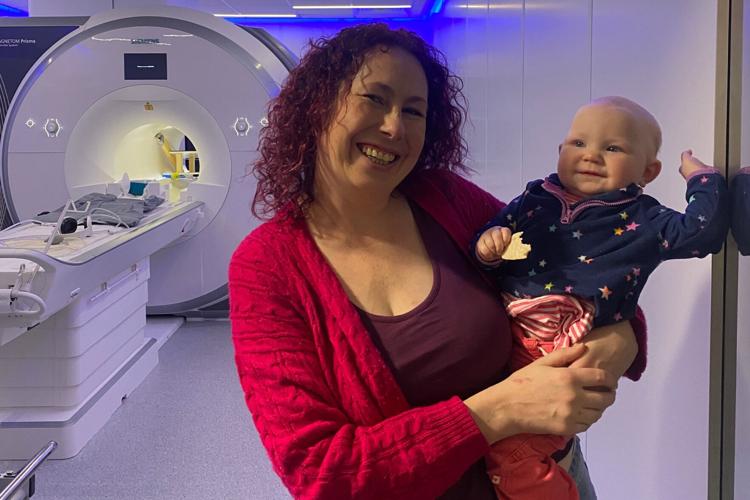
In this undated photo, Baby Blaise attends her 9-month Foundcog scan with her mother, Mary, at Trinity College Institute of Neuroscience in Dublin, Ireland.
The findings, published Monday in Nature Neuroscience, may help doctors and researchers better understand cognitive development in infancy.
“It really tells us that infants are interacting with the world in a lot more complex of a way than we might imagine,” said lead author Cliona O’Doherty. “Looking at a 2-month-old, we maybe wouldn’t think that they’re understanding the world to that level.”
The study looked at data from 130 2-month-olds who underwent brain scans while awake. The babies viewed images from a dozen categories commonly seen in the first year of life, such as trees and animals. When babies looked at an image like a cat, their brains might “fire” a certain way that researchers could record, O'Doherty said. If they looked at an inanimate object, their brains would fire differently.

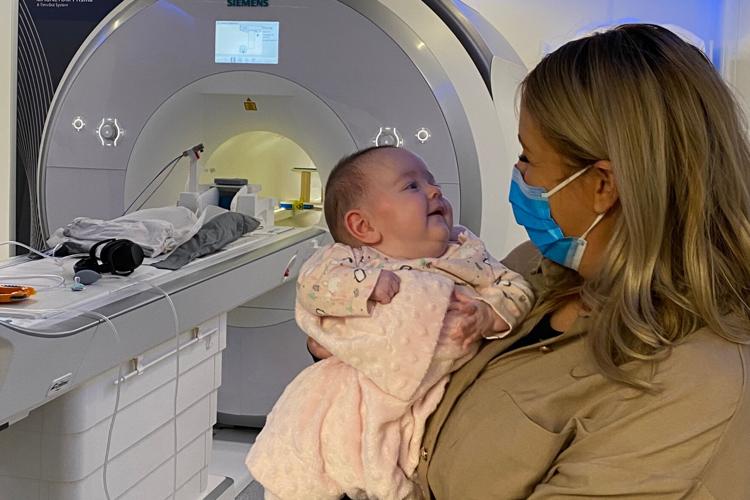
In this undated photo, baby Sadie attends her 2-month Foundcog scan with her mother, Donna, at Trinity College Institute of Neuroscience in Dublin, Ireland.
The technique — known as functional magnetic resonance imaging, or fMRI — allowed scientists to examine visual function more precisely than in the past. Many previous studies relied on how long an infant looked at an object, which can be difficult to assess at younger ages. Some of those past studies suggested that infants as young as 3 to 4 months could distinguish between categories such as animals and furniture.
“What we’re showing is that they really already have this ability to group together categories at 2 months,” O'Doherty said. “So it’s something much more complex than we would’ve thought before.”
In the new study, many of the babies returned at 9 months, and researchers successfully collected data from 66 of them. In the 9-month-olds, the brain was able to distinguish living things from inanimate objects much more strongly than in the 2-month-olds, O'Doherty said.

Some things are out of our control, like cognitive decline, but we can slow it down if we make the right choices. Veuer’s Maria Mercedes Galup…
Someday, researchers said, scientists may be able to connect such brain imaging to cognitive outcomes later in life.
Liuba Papeo, a neuroscientist at the National Center for Scientific Research in France, said the number of babies in the study is one thing that makes the work “impressive and unique.” Brain imaging with very young infants presents challenges.
“One — perhaps the most obvious — is that the infant needs to (lie) comfortably in the fMRI scanner while awake without moving," she said in an email.
O’Doherty, who did the work at Trinity College Dublin in Ireland, said the key was making the experience as comfortable as possible for the babies. Inside the scanner, they reclined on a bean bag so they were snug.
The images “appear really big above them while they’re lying down,” she said. "It's like IMAX for babies.”


How multilingualism may boost cognitive skills in children with autism
How multilingualism may boost cognitive skills in children with autism
Updated
Recent research suggests that children with autism spectrum disorder may experience significant cognitive benefits from growing up in multilingual environments, according to a study by University of California, Los Angeles Health researchers.
The study, published in Autism Research, reveals that children from multilingual households, both with and without autism, demonstrated enhanced executive function capabilities compared to their peers in monolingual households. These improvements encompassed crucial skills such as attention control, cognitive flexibility, and social perspective-taking, LA Post reports
Dr. Lucina Uddin, professor of Psychiatry and Biobehavioral Sciences at UCLA Health and director of the UCLA Brain Connectivity and Cognition Laboratory, led the investigation. "Speaking multiple languages, whether or not you have a diagnosis of autism, is associated with better inhibition, better shifting or flexibility, and better ability to take perspective," Dr. Uddin said.
The research team examined more than 100 children between the ages of seven and 12, including both autistic and non-autistic participants from monolingual and multilingual households. Most multilingual families in the study communicated in Spanish and English at home. Parents assessed their children's executive function abilities through comprehensive surveys.
The assessment focused on three key areas of executive function: inhibition control, working memory, and cognitive shifting. Researchers also evaluated core autism-related traits, including social communication skills and repetitive behavior patterns.
Data analysis revealed that multilingual exposure correlated with enhanced inhibitory control and cognitive flexibility across both autistic and non-autistic groups. Dr. Uddin explained the mechanism behind these improvements: "If you have to juggle two languages, you have to suppress one in order to use the other. That's the idea, that inhibition might be bolstered by knowing two languages."
The findings challenged previous concerns about potential language development delays in autistic children exposed to multiple languages. Instead, the research indicated no adverse effects and suggested possible developmental advantages.
"The big takeaway is we do not see any negative effects of speaking multiple languages in the home," Dr. Uddin said. "It is actually beneficial to celebrate all the languages associated with your culture."
Building on these promising results, Dr. Uddin and her team are expanding their research. A new study will involve approximately 150 children with autism and incorporate additional executive function assessments, language evaluations, and brain imaging techniques to deepen understanding of how multilingualism affects neurodevelopment in autism.
The research contributes to a growing body of evidence supporting the cognitive benefits of multilingual exposure during childhood development, particularly for individuals with autism spectrum disorder.

This story was produced by the LA Post and reviewed and distributed by Stacker.

