


ORACLE — There's a fork in Linda Vista Road here.
• Take it left and you find yourself traveling back in time, surrounded by quiet and a solitary creative energy. Sculptors such as Joy Fox McGrew and Imo Baird can pass hours undisturbed in their small studios carved out of an old dude ranch barn.
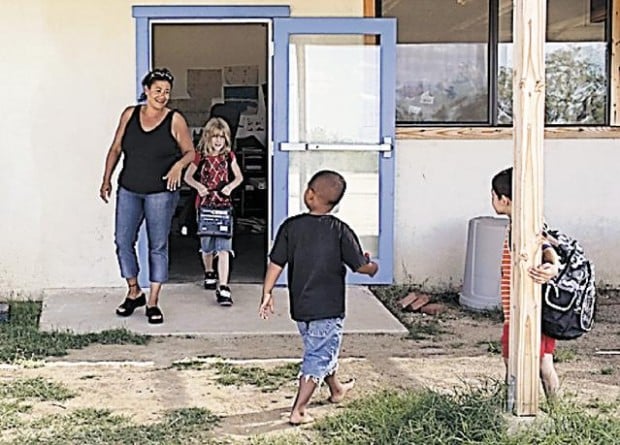
• Stay to the right and take the road just beyond where it becomes a dusty one-laner, and you'll find yourself knees to eyeballs in creativity at its loudest. At Rancho Linda Vista's Wilson Barn, a half-dozen school kids with boundless energy run around the dirt parking lot while another dozen inside the old horse barn create stuffed animals, paint and play American Indian flute.
Two halves of the same whole make up the historical Rancho Linda Vista artists colony. Although their approaches are vastly different, their goal is the same: to ensure that the artist community lives on.
In the beginning
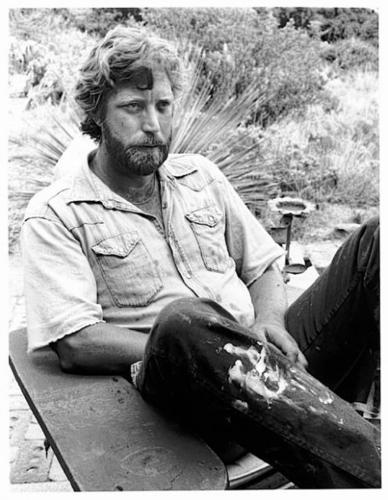
Nearly 42 years ago, Charles Littler, a Tucson artist and University of Arizona professor, persuaded a group of colleagues to buy George Wilson's former dude ranch and turn it into an artist commune. They all embraced the mission statement — "to be a place that was conducive to the arts," in the words of founding member McGrew — and the perks that came with being young, wild, artistic and uninhibited in the late 1960s.
"I thought we were nuts," said McGrew, widow of nationally known painter Bruce McGrew, who goes by the name Joy Fox when showing her sculptures. "Our second child was just born, and we had the two little kids."
"It had a lot of idealism in it, some of which is still around," added seminal ranch member Andy Rush, who left his UA teaching job and moved to the ranch a year after the first wave of settlers.
"There's always been two strains to the ranch residency. One strain is academic and very much connected to the world of the university. . . . The other is much more connected to the consciousness movement," said Rush, who still lives at the ranch and is the driving force behind The Drawing Studio in Tucson.
Rush's daughter, Maggie Rush Miller, and McGrew's daughter, Shelley McGrew, were among 28 "ranch kids" finding their own way through the era. As their parents experimented with their art and the counterculture's psychedelic drugs, the kids got a world-class artistic education.
"It was crazy. In the '60s when they came out here, their energy and focus was on creating something. I don't even know if they knew we were here. The kids, we just went along for the ride," said Miller, 45, a former dancer and actor.
"It was a really fun, vibrant place to grow up as a little kid," said Shelley McGrew, 45, a part-time labor and delivery nurse at Northwest Medical Center and a former choreographer and dancer.
"Ranch kids" find their legacy
Miller returned to the ranch from New York City in 1998 with her husband, Emmy-winning daytime-television scriptwriter Royal Miller. They have three children: Cougar, 6; Ezekiel, 9; and Ivy, 10. Shelley McGrew, who is divorced, returned home from New York the following year and is raising daughters Lyra Rahner, 9, and Cezanne Rahner,12, in the same ranch house where she grew up.
"It's completely my home," said McGrew, who is measuring the growth of her daughters on the same door frames her parents used to measure her.
Both women were artistic — how could they not be, growing up surrounded by some of the region's most prolific and famous artists, including Rush, Jim Davis, Bruce McGrew and Bailey Doogan? And both felt the driving need to give back to the community of Oracle that had embraced the ranch throughout their lives.
They formed RLV OracleArt, a nonprofit arm of the ranch that sponsors arts classes for mostly disadvantaged children from the nearby communities of Oracle, San Manuel and Mammoth.
"They are taking it into another realm, teaching and educating and working with children," Joy Fox McGrew said. "I think that they're interested in art and the art they were exposed to their whole lives. It's all related. It's part of a family."
"What Maggie's doing and what Shelley's doing, I think, is going to be incredibly important," Rush added. "It's one way to get the kids to know there's something better. It's a huge social (outreach) — more so than the arts."
The pair started with a summer arts camp, held in the barn gallery on the ranch's main campus. The plan was near perfect: A big chunk of the ranch's 32 full-time residents leaves in the summertime for cooler climes, which meant the program wouldn't disturb too many of the artists who work in studios surrounding the gallery.
But after a few summers of having about 50 kids tramping around the gallery and its communal courtyard, some artists began complaining.
"They didn't obstruct it; they just bitched," said Rush, 78. "They could see the value of it."
New location, new chapter
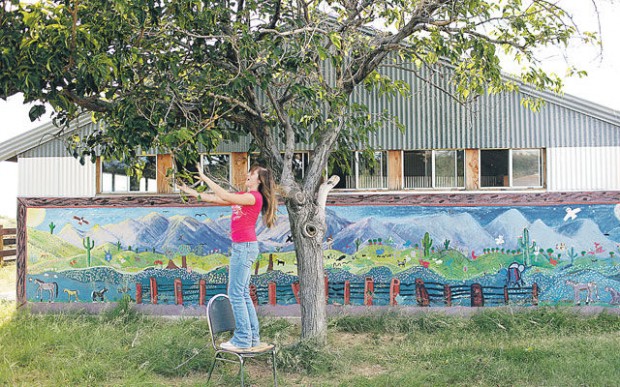
In 2007, two years after incorporating RLV OracleArt as a nonprofit organization and appointing an 11-member board of directors, the group bought the 4,000-square-foot Wilson Barn, a tin-roofed building that seems oddly out of place among the area's modern, stuccoed, two-story homes.
The former horse barn that was once a part of the original Rancho Linda Vista dude ranch was a mess, Shelley McGrew said. They nearly gutted the 1950s-era structure, replacing the dirt floors with concrete, dividing the building into several rooms, and adding a kitchen and bathroom.
In summer 2008, they moved the arts camp to the newly dubbed Wilson Barn Art Center. This year, Sierra Oaks relocated its arts classes there and buses its kids there four days a week.
"It's just so nice to be able to spread out," Miller said on a recent afternoon as she waited for the Sierra Oaks van to arrive with arts students.
Inside the barn, eight preteen boys gathered around a table, distracted from their artistic endeavors — making stuffed animals from the patterns laid out on the table before them — as they listened to school-day gossip delivered by a husky kid with tousled brown hair.
"C'mon, brother," Miller told one of the boys in a gentle tone, and they quickly dispersed to the small sewing room off the kitchen.
At the back of the covered patio in a small room scarcely larger than a kid's bedroom, two rambunctious 5-year-olds thumped on small drum heads with sticks nearly longer than their forearms. Their music teacher, James Stevens, who teaches at the Allegro School of Music in Tucson and for the Tucson Symphony Women, called out, "Right, right. Left, left. Good."
"I think that's one of the gifts we have from growing up on the ranch," McGrew said. "It was the feeling that anyone could do art, and there was value in doing art. And I think that's very much what Maggie and I are doing."
For the most part, the ranch has embraced OracleArt and its mission. Members pitched in to convert the Wilson Barn into the arts center, and several of the ranch's artists and craftsmen, including Rush, teach classes there.
"This is a big deal for these kids," Miller said. "They don't know that they're working with the best of the best. But they will know."
A two-pronged future
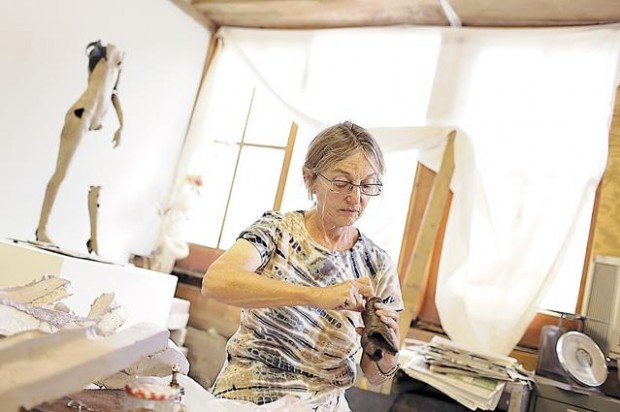
Bronze sculptor Judy Stewart props open the door to her small studio, where she works so quietly that you can hear the leaves rustle on the trees.
Plaster dust speckles her jeans and T-shirt. Every now and again, she brushes a strand of gray hair from her bespectacled eyes.
Stewart is still referred to among seminal ranch members as a newcomer, even though she has been there 18 years. She is not wholly convinced that the ranch's future should be so fully vested in OracleArts. "The future of this place is going to be determined by how our individual lives go," she says.
"I think most people would acknowledge that the heart of the ranch is art and the pursuit of art," she said. "Those of us involved in the arts, this is what we hope will happen: As we meet our demise, we hopefully will be replaced by people who share that philosophy."
Others see room for both missions.
"OracleArt is more of our public outreach," said Joy Fox McGrew. "The (Wilson) barn enables us to have a more public venue.
"There will always be artists. I think we'll always have that mission. Things will change, but hopefully it will always be a place for art."
Visiting the ranch
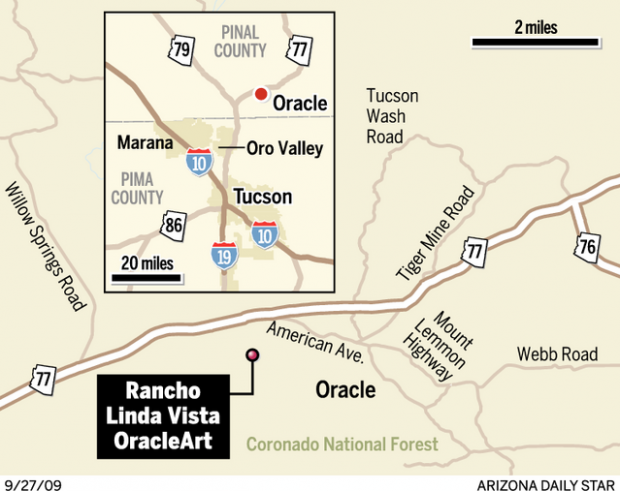
Rancho Linda Vista Barn Gallery at the historical artists community is open to the public. It showcases paintings, drawings and sculptures by ranch artists. Hours: 1 to 5 p.m. Sundays. It's in the center of Rancho Linda Vista in Oracle (see map). Details: www. rancholindavista.org

