


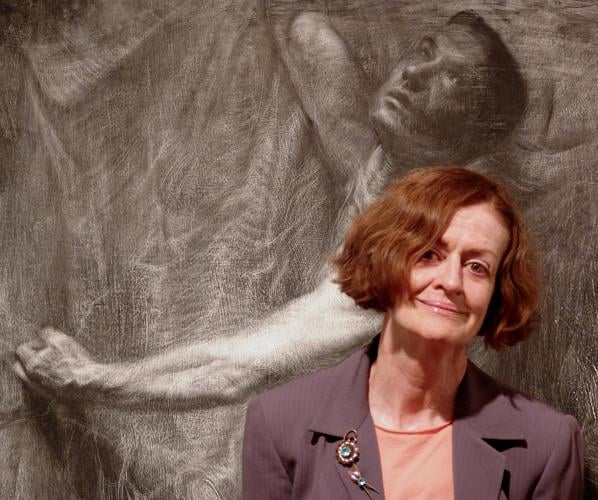

Every day after school, Moira Doogan and her dog Jiggs would wander into her mother’s University of Arizona area art studio.
While Moira regaled her mother with school day tales, Bailey Doogan would create “something extraordinary.”
“I loved the smell of her studio, the paint, turpentine ... the feel of the air and the lighting, warm and bright, with NPR or a mixtape playing in the background. Jiggs and I would stretch out on her rug. Sometimes my mom would take a break and join us,” Moira Doogan recalled last week as she made funeral arrangements for Doogan, who died July 4; the feminist artist whose works have been on display around the country was 80 years old.
“I am profoundly saddened she is gone,” Moira Doogan said. “She will be dearly missed.”
“She was tiny, maybe 5 feet tall and not much more than 5 inches wide, but her presence was enormous, and so is her absence,” longtime friend and artist Alice Leora Briggs said in an email. “Those of us who knew and loved her are so fortunate.”
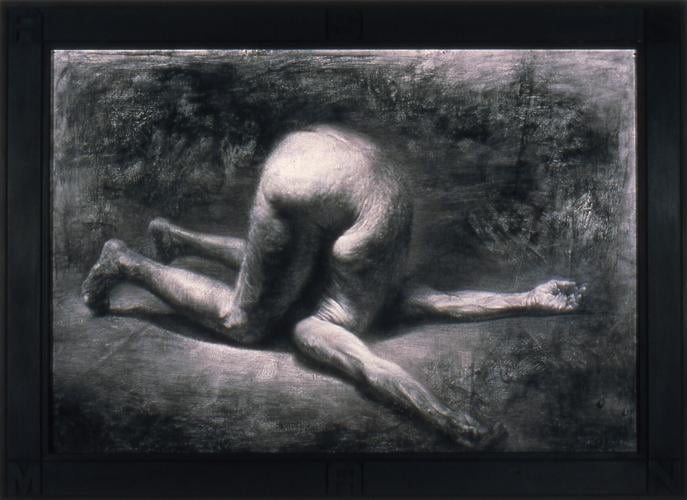
Doogan, known for her large-scale self-portrait nudes accentuating every wrinkle and blemish of aging, left a legacy that friends and fellow artists say will endure.
“I think her work went way beyond feminism,” said fellow Tucson artist Chris Rush, a longtime friend and former student. “She is always considered a feminist artist, but I think she will be remembered as a great artist.”

Bailey Doogan's works have hung in galleries around the country.
“Every show was just jaw dropping. ... The work was kind of edgy and provocative and sometimes in your face,” said Etherton Gallery owner Terry Etherton, who has championed Doogan’s works since her first show at his gallery in 1983. “Even if you didn’t appreciate her message, people would walk in the gallery and go, ‘Wow, who is this?’ And I would say, ‘This is a local artist.’”
Doogan was born Margaret Mary Bailey in Philadelphia on Oct. 24, 1941, the daughter of a milkman and sales clerk. She was raised Catholic in a working-class Irish neighborhood and earned a degree in illustration — the precursor to today’s graphic arts — before landing a job in New York’s male-dominated advertising industry.
“She was precocious and willful, and somehow she got out of Philadelphia and got to New York and worked in commercial art,” Rush said.
Her biggest coup was redesigning the iconic Morton Salt Girl in 1968. The design, of the girl with an umbrella and a leaking box of salt, was used by the company until 2014.
Doogan left the agency in 1969 after learning that her male coworkers were paid more than she was. She moved to Tucson that year to teach graphic design at the University of Arizona — the first female professor at the UA School of Art.
“Everybody I talked to said she was one of the best teachers they ever had,” said Tucson Museum of Art Curator Julie Sasse, who met Doogan when Sasse was galleries curator at the UA in the mid-1990s.

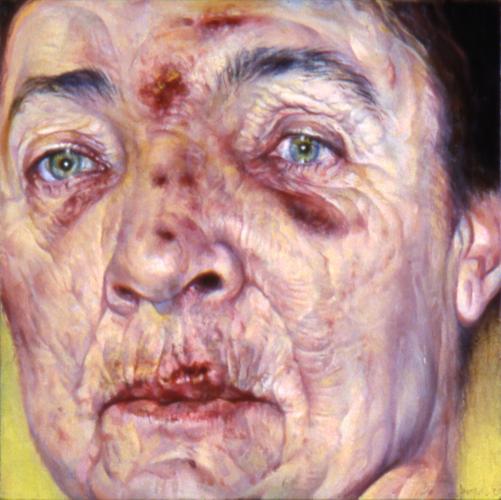
Bailey Doogan, Face (After the Accident), Age 54, 2002, oil on linen, 12 x 12 in., ©Bailey Doogan
Doogan was married to Ed Doogan for a year, during which she gave birth to their daughter. She and Moira lived for several years at Rancho Linda Vista, the artist community in Oracle that was founded by UA professors. She left the community when Moira was 3 or 4, her daughter said, and moved into a house near the UA.
In the early 1980s, after earning a master’s degree in film from UCLA, Doogan focused her artwork, small and large-scale, on the human body. The Catholic church was omnipresent in much of her art, which also was unapologetically rooted in feminism and politics.
One of her most outwardly political works was her 1990 72-inch by 50-inch charcoal work “The Hard Place (For Mairead Farrell),” which is part of the Brooklyn Museum of Art’s permanent collection. The work, which was donated to the Brooklyn museum by a couple who long supported Doogan’s works, is an elegy to the Irish Republican Army member who was murdered by the British Army in Gibraltar in 1988.
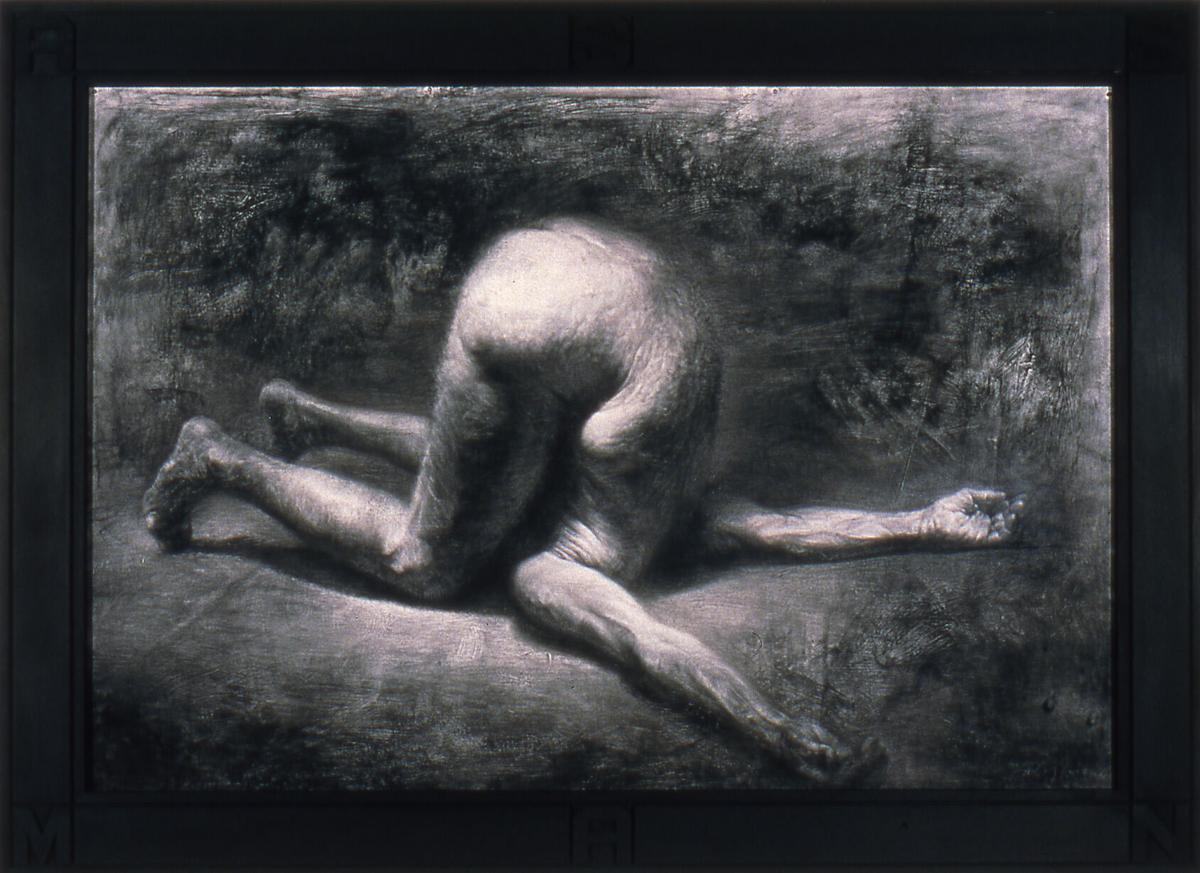
Doogan, though, is most known for the nudes that occupied her late career.
“It wasn’t the male and female gaze; it was addressing the aging body in ways that ... were almost a difficult subject matter for people to depict because no one wants to see the aging body or the imperfect body,” Sasse said. “She would depict nudes in a way that she was honest about it and by that honesty there was a beauty and dignity in what she portrayed.”
In 2006, Sasse teamed up with Etherton to present a sweeping retrospective of Doogan’s works with two exhibits: “Bailey Doogan: Selected Works 1971-1998” at TMA and “Bailey Doogan: Selected Works 1993-2005” at Etherton.

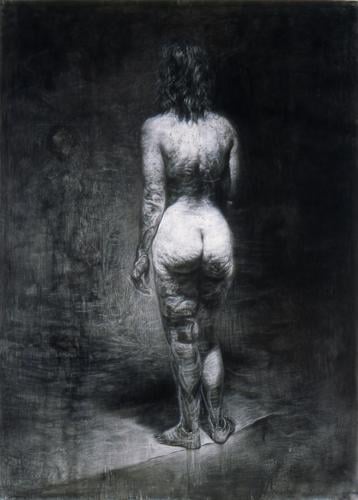
Bailey Doogan, A Back, 2002, charcoal on primed paper, 72 x 52 in., ©Bailey Doogan
“Most museums won’t venture out of the nonprofit area, but we decided it was going to be a big enough show that it was going to take two spaces,” said Etherton, who created a glossy catalogue of Doogan’s works that included essays from several noted artists and one, “Logo Girls,” written by Doogan that addressed the cultural phenomenon of using images of girls including her Morton Salt Girl to sell products.
In her 1988 portrait “Pour It On,” Doogan reimagined the Morton Salt Girl as an older, nearly nude woman.
“She did a gigantic outrageous, almost horror show revamp of the Morton Salt Girl grown up ... and it was one of her most outrageous, creative pieces,” said Rush. “She was one of the most unafraid artists I ever met.”
“I think her most remarkable works are her late heroic-scale self-portraits, and they are very much about identity and identity changing as she aged,” Rush added. “They were full of humor, but they border on the grotesque. She could look the devil in the eye. ... She was one of the least chicken people I met, and she could really care little about what people thought of her work.”
“My mom was an amazing artist and deeply talented and a hard worker. Her work felt like magic to me as a child, and it still does,” said Moira Doogan, who is a nurse in Portland, Oregon. “Her work was so powerful and so important to her. She was a feminist, an activist, and I know that she would hope that comes through in her work.”
Moira Doogan said a memorial service will be planned for the fall, and memorial donations can be made to Planned Parenthood of Southern Arizona or the Tucson Audubon Society.
Contact reporter Cathalena E. Burch at cburch@tucson.com. On Twitter @Starburch

