



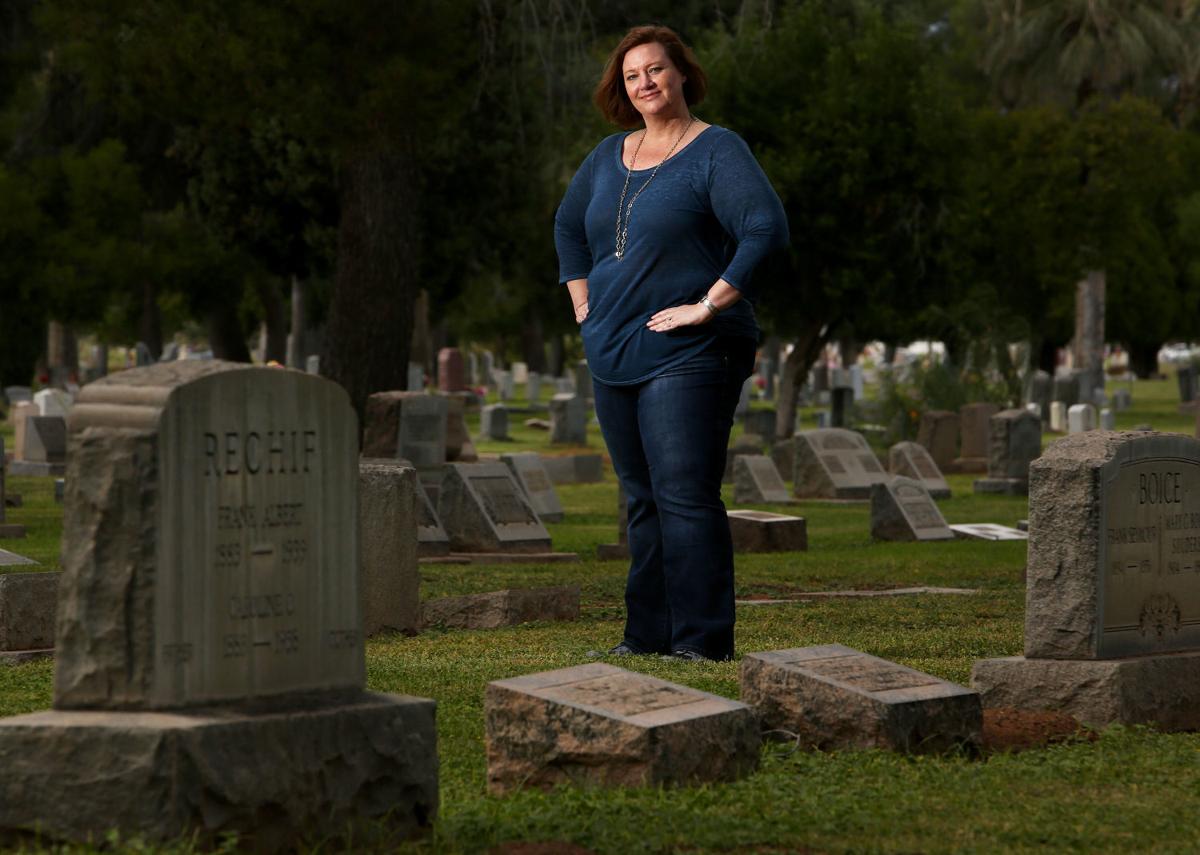
You might call them headstone hunters.
Or tombstone tourists.
But actually, the proper word is “taphophile” — a person who loves cemeteries.
“There’s nothing to be afraid of,” says Amy Urman, the president of the Pima County Genealogy Society. “When I see a tombstone, I see history.”
Urman is not alone. On websites such as Find A Grave, BillionGraves and the Arizona Gravestone Photo Project, taphophiles log thousands of photographs of headstones.
Some upload select images from personal genealogy projects, while others dump hundreds of shots onto these sites under the banner of community service.
Headstone hobbyists
Kay Ellen Fleming is a retired nurse who spends a good 40 hours a week researching family history and cruising cemeteries.
She prefers rural graveyards to the larger ones in the city, photographing “to preserve the fact that there was actually a living human being by that name who lived in that time period,” she says by phone, taking advantage of a class reunion in Wisconsin to photograph new cemeteries.
On Find A Grave, contributors can sign up to be a photo volunteer, fulfilling headstone photo request in a given ZIP code. Fleming isn’t an official photo volunteer, but she still checks in on requests near Tucson or when she travels. So far, she has uploaded about 30,000 photographs.
“I figure a lot of people can’t take the time to go into the country and walk through brush and clear it away,” says Fleming, who has been working on genealogy for about 40 years. “When I find an old cemetery that has not been photographed, I just stay there and do the whole thing.”
And when she puts those headstone images online, the information about the deceased becomes globally accessible.
“Sometimes over time, those stories and names and dates and places can get lost,” says Michelle Ercanbrack, a family historian with Ancestry.com, which acquired Find A Grave in 2013. “Even though we are more mobile as a society than we have ever been, it still takes work and planning to visit those places in person.”
Collecting clues
Standing in Holy Hope Cemetery, 3535 N. Oracle Road, Urman gestures toward a grave adorned by a statue of a woman clinging to the cross of Christ.
“This is a sea of artwork to me,” says Urman, a private investigator. “They’re not graves. They’re hints.”
Symbols on headstones often provide next steps in the research process for a genealogist.
They might indicate religious, military or Masonic associations, referring a researcher to an organization with more records on that person.
“When this person died, these symbols meant something to them,” Urman says. “You can’t understand the loss and love of the family unless you know what the symbols mean.”
Even as modern technology allows families to swap the standardized symbols of past generations for more personalized images, headstones still tell stories.
“The size, stone type and design can tell about the socioeconomic status (of the family) and era of the stone,” Ercanbrack says by phone in Provo, Utah, where Ancestry.com is headquartered.
Not set in stone
While an epitaph may be carved into stone, that doesn’t guarantee its accuracy, Urman says.
Dates and family names can be wrong, and for online contributors, this can cause some serious ire with families who find photographs and compare them to conflicting family records. Corrections abound.
Genealogists consider tombstones secondary sources that often need verification, while vital records are primary sources, says Betty Cook, a docent with the Arizona Historical Society and board member for the Southern Arizona division.
Through the Arizona Department of Health Services, the public can access death certificates from at least 50 years ago and birth certificates from at least 75 years ago. Even this information can have its flaws.
Urman estimates that about 80 percent of the information she finds on gravestones is accurate, but ignorance, deliberate lies and a delay between the death and creation of a memorial can all convolute information.
Grief may also undermine accuracy. In March, Urman lost her 31-year-old daughter. At the time, sadness crippled her memory.
“I couldn’t even remember what my daughter’s occupation was,” she says. “You understand why (headstone information) could be true and why it could be false. You don’t know that until you live through it.”
Privacy battles
Serial gravestone photographers see what they do as a way of contributing to community history.
But not everyone agrees.
Cemetery policies often prohibit photography to protect the privacy of families.
“Many cemeteries want you to have a certified letter from the next-of-kin to take a picture of the gravestone,” Fleming says. “I have been led out of cemeteries.
“That’s why I shy away from the big city ones. Many of them say you cannot even take a picture of the tombstone.”
Online, she has been told by relatives to take down photographs of family members’ headstones.
Gail Meyer Kilgore is the state coordinator of the Arizona Gravestone Photo Project and manages sister projects in eight other states. She now lives in Colorado, but 28 years in Casa Grande made her familiar with Arizona.
Tucson cemeteries, she says, don’t have a reputation of being photography-friendly. Taphophiles toting cameras do so clandestinely and at the risk of penalty for breaking cemetery rules.
Signs at the entrance of Evergreen Mortuary and Cemetery, 3015 N. Oracle Road, state management must approve any photography on the grounds.
“We just want to be respectful to everyone,” says Peter Callaghan, the assistant general manager at the cemetery. “We try to give everyone the privacy and the respect that they deserve.”
There are more than 40,000 burials at Evergreen, but even for genealogy research, permission is necessary.
“A lot of schools will come here and have school projects, and that’s fine because there is a lot of history here,” he says. “We just don’t want it abused in any way.”
Find A Grave lists 150 cemeteries in Pima County, although that number includes a few smaller cemeteries within larger parks, the defunct Alameda-Stone Cemetery and a handful with only one or two burials listed so far.
Evergreen Mortuary and Cemetery, Holy Hope Cemetery and East Lawn Palms Mortuary and Cemetery all have more than 20,000 interments listed on Find A Grave. As of Friday, at least 65 percent of the listed internments for each cemetery had been photographed.
At Evergreen, about 30,900 burials were logged so far, with 88 percent photographed.
According to headstone photographers, these virtual cemeteries preserve what weather, age and vandalism can destroy.
“The older cemeteries, they are deteriorating,” Kilgore says. “Lots of times we photograph a cemetery, and then it is vandalized and stones are broken, but we may have a picture of it in our site.”
Picnics with the dead
Many of these headstone hunters and genealogists have similar stories. Their parents took them picnicking among family tombstones, or the birth of their own children sparked a greater interest in ancestry.
Cook, with the Arizona Historical Society, remembers her father stopping at cemeteries on Sunday afternoons and pointing out the gravestones of the ancestors he knew.
Cook, like Urman, also remembers maintaining grave sites at family picnics.
“You have a little lake and sit and have a sandwich and you’re with your relatives,” Urman says of the Illinois cemetery from her childhood. “It was never a creepy experience.”
In fact, she took her own children to cemeteries so often, they long believed everyone vacationed that way.
“It wasn’t until my daughter was in about fourth grade that she found out other people went to Disneyland,” Urman says.
The creepy factor just doesn’t exist for most taphophiles — even though falling into a grave is not an unknown experience for those who haunt cemeteries.
“I haven’t been bothered by the presence of ghosts, but I have been bothered by snakes,” says Fleming, relating an experience in a Canadian cemetery when a lawnmower sent dozens of snakes slithering in her direction. She got out fast.
But usually, headstone hunters relish the time they spend in the presence of the dead, piecing together the stories of lives lost.
“A tombstone is the last photograph of a person,” Fleming says. “It’s sort of their legacy.”

