

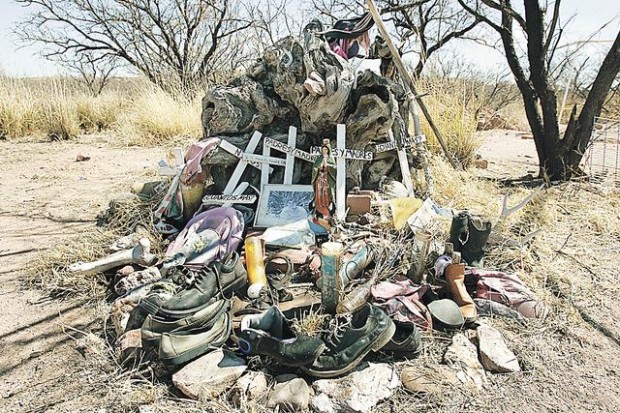
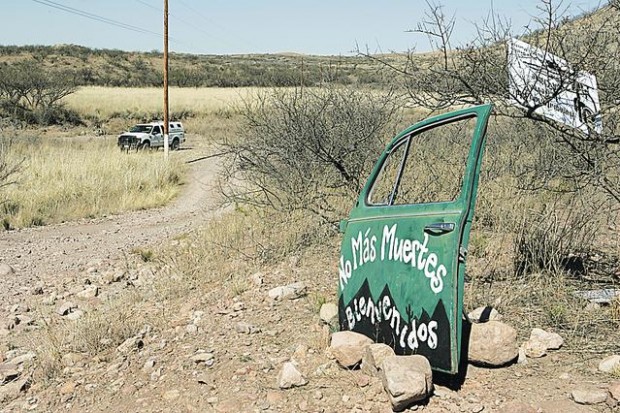
As I drive up to Byrd Baylor's house near Arivaca, a red pickup truck with four young volunteers pulls up beside me.
They are members of No More Deaths, the Tucson-based organization that offers humanitarian aid to border crossers from Mexico.
For the last five years they've set up camp on property owned by Baylor 11 miles from the border — in an area heavily traversed by illegal immigrants.
The volunteers "keep medical supplies and water there. And from there they hike into the hills, pick up water bottles, et cetera," says Baylor.
"It's lovely to have the support of people like Byrd," says volunteer Danielle Alvarado, a teaching assistant for the Tucson Unified School District. "We drive by here every single day, and sometimes we step in. Byrd is the model of hospitality."
It's little surprise that Baylor, whose books so often focus on the rhythms of the Southwest and its people, would be hospitable to strangers.
"When I go out for a walk, I never see anybody," says Baylor. "A lot of people crossing are fearful. They used to think once they crossed the border that they were safe, that people would help them.
"They move differently now. They're going down canyons or they're going way out on the reservation. It's more treacherous that way. They get hurt."
However, people do come to her house at times. She talks about a woman, about 40, and her nephew, about 20, who showed up at her door one day.
"The woman had severe cramps and was dehydrated. I gave her a couple of teaspoons of water. I had her lying down. The nephew said he wanted to turn themselves in, so I called the Border Patrol. I asked them to come and get her, that she needed medication."
After being asked where the woman was, Baylor answered that the woman was in her home. "He said I was harboring her. I said, 'I'll quit harboring her when you come to get her.' I kept calling. Nobody came. After five hours they came."
Rob Daniels, spokesman for the Tucson Sector of the U.S. Border Patrol, says, "We don't want to give an indication you can't give someone something to eat or drink, especially if they're in distress." The main distinction, he adds, is that "you're not furthering entry into the U.S. We always encourage people to call us."
Some of the Border Patrol's heaviest activity, he adds, occurs north of the border and west of Interstate 19 — right in the area where Baylor lives.
DID YOU KNOW
Byrd Baylor has been interviewed by National Public Radio several times regarding border issues.

