



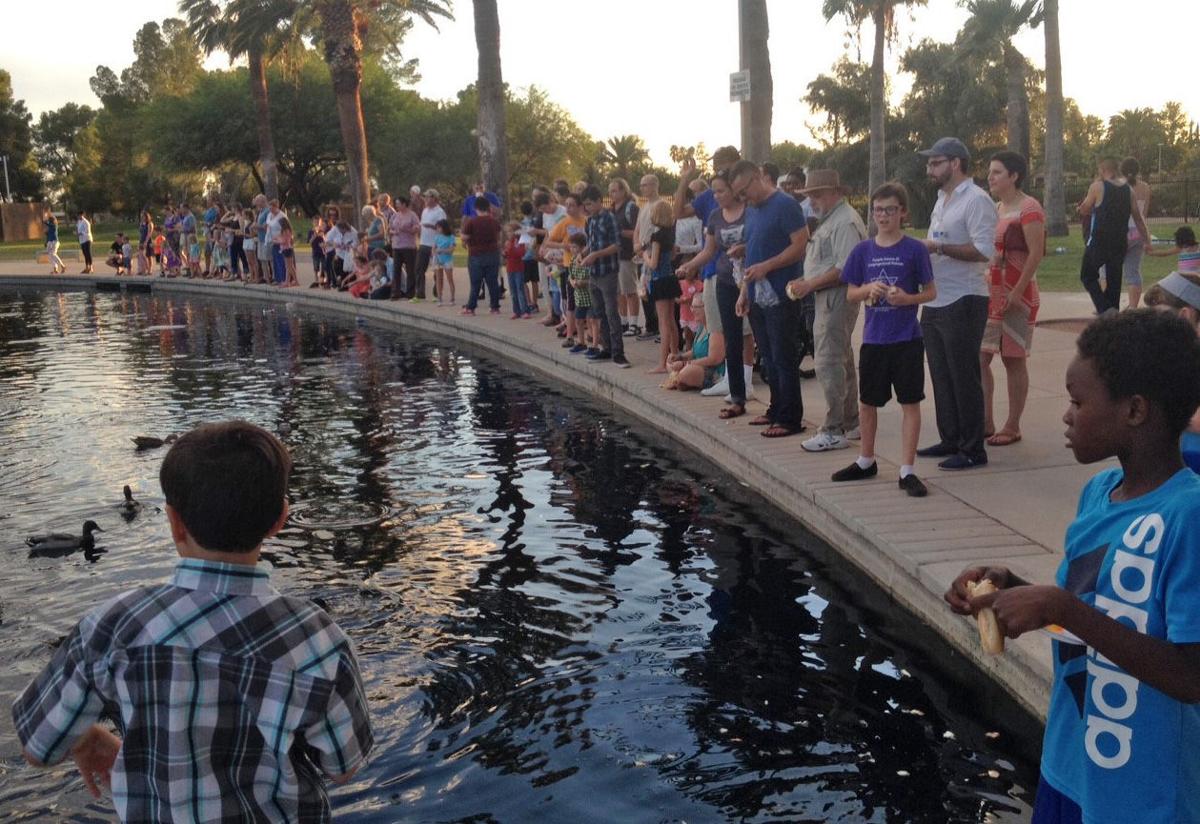
For the first time last year, Cantor Avraham Alpert led his congregation into dry bed of the Rillito River as part of a ritual tied to Rosh Hashanah, the Jewish New Year.
They brought with them chunks of bread to toss into the parched riverbed — an observance of a ritual called Tashlich, meaning “to cast” in Hebrew.
Each year during or after Rosh Hashanah, Jews gather around bodies of water to empty their pockets of bread crumbs — a symbol for the sins, failures and regrets of the past year.
Traditionally, men wearing a tallit, or prayer shawl, shake tassels on garment corners called tzitzit, meant to remind them of the commandments of God.
Rosh Hashanah begins at sundown Sunday and concludes Tuesday at nightfall, kicking off the year 5777 on the Jewish calendar.
It’s a fresh start for a new year, with imagery of flowing water sweeping unsavory memories downstream.
Except in Tucson, water can be hard to come by.
“When you live in a place where water is a lifeblood that you can’t take for granted, I think that also makes the experience more meaningful,” said Beth Surdut, a member of Alpert’s Congregation Bet Shalom.
When Alpert took the congregation to George Mehl Family Foothills Park last year to observe Tashlich, they stepped into the dry Rillito, ready to toss the bread, water or not.
And then the rain came.
“We had water,” Alpert said. “The water came to us. It was a miraculous kind of experience.”
Josef Lapko points out that Tucson’s landscape is not unlike southern parts of Israel.
“In Israel, all the synagogues go out, and all of the people with their kids stand outside facing the nearest water,” said Lapko, who moved to the United States from Israel less than two years ago.
“It could be the sea, the river. ... Some people do it in front of the fish aquarium if you don’t have any water around.”
In many religious traditions, including Judaism, water represents purification, said Rabbi Thomas Louchheim of Congregation Or Chadash.
“Even if the water is sitting still, there is a cleansing element that we get religiously,” said Louchheim, whose congregation will observe Tashlich by tossing fish food into the lake at Fort Lowell Park.
The flexibility is a good thing for Tucson, where rushing water is in short supply outside of monsoon season, which officially ended Friday.
The University of Arizona Hillel Foundation, for example, will gather around the turtle pond on campus.
The Secular Humanist Jewish Circle doesn’t even go outside. For this group, a bowl of water suffices.
“You tear off a piece of bread representing a feeling you would like to discard and throw it into the bowl,” said Becky Schulman, a board member of the group, which is not theistic but still values Jewish traditions. “You eat something sweet and reflect on repairing the world and your personal goals for the world.”
Although tradition calls for flowing water, ideally with fish, the actual water source is less important than the symbolism. Rabbi Ephraim Zimmerman of Chabad of Oro Valley notes that the Hebrew Bible does not even mention a Tashlich ceremony.
“The original idea would be that we are throwing it into the heavenly waters,” said Rabbi Yehuda Ceitlin of Chabad Tucson. “The water that we go to is symbolic of that, even if there isn’t any there. Where we do it in Tucson will be replicating what many have been doing in Jerusalem.”
The practice of “casting off” references verse 7:19 in the biblical book of Micah. There, God’s compassion leads him to “cast all their sins into the depths of the sea.”
The tether to Rosh Hashanah comes from the book of Nehemiah, Ceitlin said, noting the existence of multiple back stories to the ritual.
One links the ancient Israel tradition of crowning kings near a body of water with the idea of “crowning God as king” on Rosh Hashanah — the first day of the year, said Rabbi Ephraim Zimmerman of Chabad of Oro Valley.
Another tradition cites the biblical story of Abraham’s almost-sacrifice of his son Isaac. A river meant to keep him from obeying God but from which he was saved provides the Tashlich connection.
In Tucson, most congregations make do with park lakes within walking distance of the synagogue or temple, because some Jews choose not to drive on the holiday.
Chabad Tucson will hold Rosh Hashanah services at Himmel Park to allow worshippers to “connect with their roots in God’s creation or in God’s natural setting,” Ceitlin said.
For 18 years, Temple Emanu-El has been throwing what its senior rabbi, Samuel Cohon, called “the largest Tashlich in Tucson.”
Each year, anywhere from 100 to 200 individuals gather between the lake and rose garden at Reid Park for a picnic, complete with jumping castles, football, Rosh Hashanah songs and the blowing of shofars.
“It’s a fantastic urban space and the location where we do this between the rose garden and the lake is one of the lovely spots in Tucson,” Cohon said. “And every year, we lose at least one football in the lake.”
Gathered around the duck pond, picnickers then toss their bread crumbs into the water — a feast for the fish and ducks.
It’s festive but reflective.
“Tashlich involves yourself, your spirit and it doesn’t really involve the people around you at that moment, because we don’t know what goes on in other people’s lives,” said Surdut, an artist who also makes Jewish prayer shawls. “At that moment, if I was standing with five people or I was standing with 100 people, it wouldn’t make any difference. It all falls away.”

