


CINCINNATI – For one instant, the Bills’ chief concern was finding an early answer for the Cincinnati Bengals’ offense in one of the most anticipated games of the NFL regular season, one with ultra-high stakes for both clubs.
The next instant, none of that mattered.
Not the play – a 13-yard catch and run by Bengals receiver Tee Higgins.
Not the game – 5:58 remained in the first quarter and the Bengals leading 7-3.
And not the Bills’ season – not winning home-field advantage and not achieving their goal of reaching the Super Bowl for the first time since the 1993 season.
Football world reacts to scary injury to Bills' Damar Hamiln
None … of … it.
All that mattered was the health of Bills safety Damar Hamlin. Not his playing career. His life. His 24-year old life. His decades of remaining life with or without football.
In one of the scariest scenes to ever take place on an NFL field (and as the night went on, it became arguably the scariest), Hamlin completed a tackle of Higgins, rose to his feet … and then horror.
Hamlin looked staggered on his feet, and then in a violent manner, he collapsed onto his back, his head slamming into the turf.
He didn’t move.
Damar Hamlin has distinguished self as mature, generous member of Bills' team
This was Hank Gathers collapsing and dying on the court for Loyola-Marymount in 1990. This was Reggie Lewis staggering and then tumbling to the floor during a Boston Celtics game; he would die on the court months later. This was Detroit Lions player Chuck Hughes suffering a fatal heart attack on the field during a 1971 game against the Chicago Bears.
It was that kind of wrenching scene, which instantly morphed from a player-is-injured-but-the-game-will-go-on to something more serious.
Training staffs from both teams rushed to Hamlin’s aid near midfield. They reached for their radios to begin the communication. A backboard was carried from the Bills’ sideline. A stretcher was wheeled from the Bengals’ sideline.
It was 8:55 p.m.
The first 11 minutes, from the time Hamlin was injured until he was placed in the ambulance, felt like 11 hours.
The ambulance was backed out of the tunnel and to the end zone.
And the harrowing scene.
Hamlin was being administered with CPR. A double-take. And then a triple-take. This can’t be happening. A player dying on the field? That was now a possibility.
At this point, the reaction of the Bills’ players was another bad sign. Right tackle Spencer Brown turned around from the scene and put both his hands to forehead. Quarterback Josh Allen was distraught. Cornerback Tre'Davious White, sobbing, was consoled by center Mitch Morse. Coach Sean McDermott took a knee. Players were in tears, trying to get a view of their seriously-injured teammate.
A majority of the Bengals’ players were on one knee.
The stadium, so loud moments ago, was could-hear-a-pin-drop quiet.
At 9:10 p.m., the ambulance, now surrounded by Bills and Bengals players, left the playing field.
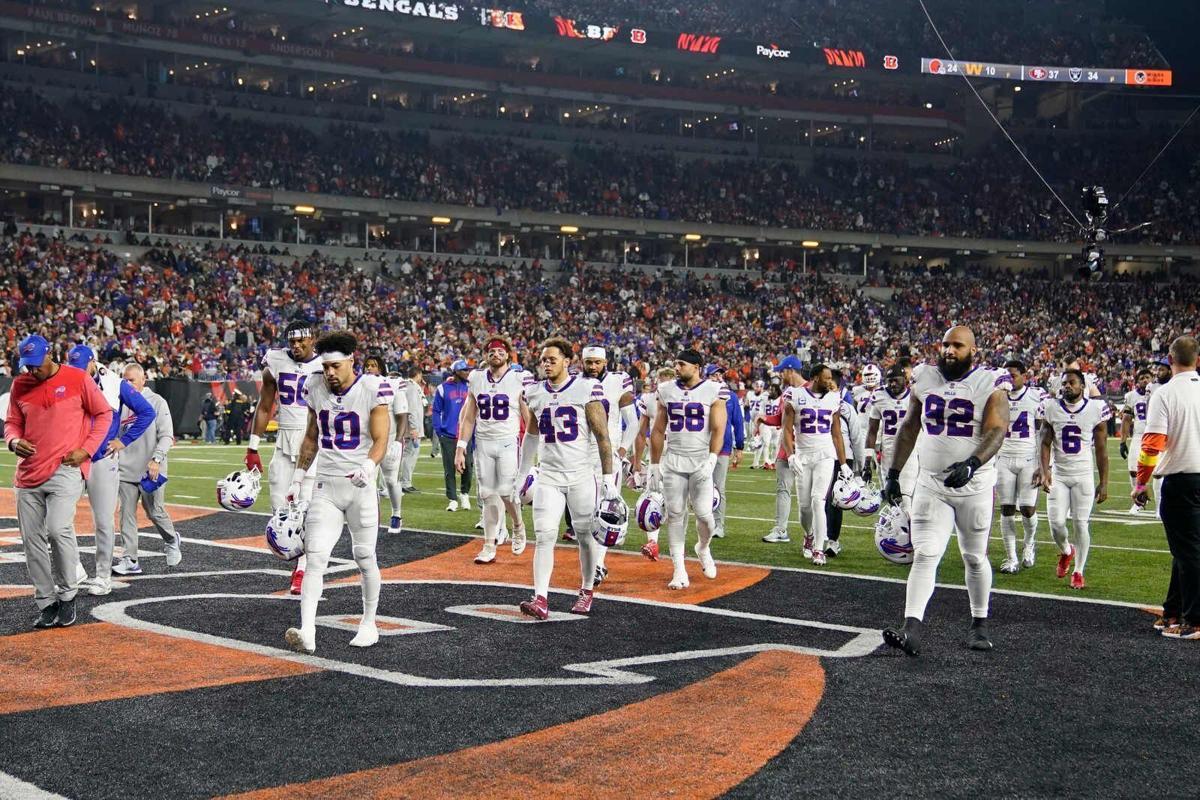
The Bills gathered for a prayer near their sideline.
Receiver Stefon Diggs, his eyes full of tears, addressed the players.
It appeared the game was set to resume. Bills players put their helmets back on, receiving hugs and handshakes from their teammates. This is what players are programmed to do. One of their guys is injured. They keep playing, keep fighting and keep playing to win.
Until they were told not to.
The right decision was made. The only decision was made.
The game did not go on.
At 9:17 p.m., after Bengals coach Zac Taylor walked across the field to talk to McDermott and the officiating crew led by referee Shawn Smith. Both coaches signaled their players to return to their locker rooms.
Smith made the announcement that the game had been suspended, “until further notification,” of Hamlin’s condition.
The scoreboard flashed a message:
“THE GAME IS TEMPORARILY SUSPENDED. PLEASE STAND BY FOR FURTHER INFORMATION.”
At 9:53 p.m., Bills personnel began packing up the equipment trunks behind their bench area. Eight minutes later, ESPN said the game was suspended for the evening.
Sixty-three minutes after Hamlin was initially injured, the game was postponed by the NFL, which said he was in “critical condition” and was transported to UC Medical Center. At 1:48 a.m., the Bills -- who flew back to the Buffalo area -- announced Hamlin had sustained a cardiac event and his heartbeat was "restored on the field."
Suspending the game was the right decision. No question about it. This wasn’t a broken leg or a back injury in which the player moved his arms and legs but was immobilized by a stretcher.
The Bills’ players and coaches were not in a state to continue. Same with the Bengals. The NFL is a brotherhood of players. It is the most physical sport, but after 60 minutes of cracking heads, they meet at midfield to swap jerseys and stories, and say, “Good game.”
The football side of postponing the game will be debated. Call the game a tie? Try to play on Tuesday or Wednesday? Those questions will be answered, but only later. All that mattered as Monday night stretched into Tuesday morning was the health and well-being of Damar Hamlin.

