


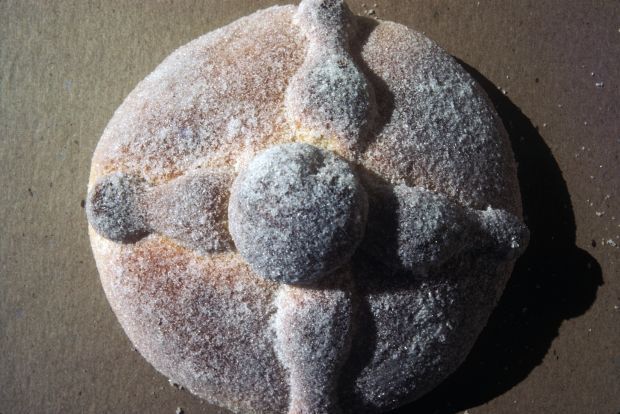
November 2 is All Souls’ Day in the Catholic Church — the day set aside for remembrance of the dead. In Mexico it is “el día de los muertos,” or the Day of the Dead.
Here in Arizona and Sonora, it is a time for cleaning, refurbishing, and decorating the family graves, and for visiting with the departed. A day later, when all the living have finished with their tasks, and before the first rain, our smaller cemeteries blossom into fields of color, with quantities of real and artificial flowers. I’ll devote a whole blog to that later on.
It is only recently that the central and southern Mexican traditions of candy skulls, playful skeletons, and the like have really arrived on the border.
In 1984 I was visiting with a baker in Nogales, Sonora, who made pan de muerto — “bread of the dead.” These are rich loaves made especially for the Day of the Dead. In his case some were round with bones modeled on them, and some had a roughly human shape. He told me that when he arrived from near Mexico City in the 1950s people would ask him what the loaves were for. Nowadays pan del muerto is available in many bakeries in Tucson, as well as across the border. Often different bakeries create different styles, so it’s worth visiting around.
The bread is not the only aspect of the stereotypic Mexican Day of the Dead that has established itself, especially in Tucson. Art museums and other secular institutions put up Day of the Dead altar displays — there’s going to be one in Special Collections at the UA Library, for instance. Both the serious and the playful aspects of the central Mexican Day of the Dead have taken strong roots among middle-class Tucsonans of Mexican descent.
Thus one’s ancestors can be honored in two ways: literally, by remembering their names and cleaning their graves, and symbolically, by adopting and adapting symbolic elements of traditional Mexican culture.
The most recent and spectacular local manifestation of what has been called the Mexican cult of the dead is Tucson’s annual All Souls Procession. It began in 1990,with a local artist honoring the memory of her recently-deceased father with celebration and creativity. It grew from there, employing visual images from the Mexican holiday, until last year 35,000 people participated. It is a fascinating and exciting example of cross-cultural adaptation, and is deeply meaningful to many of its participants.

