


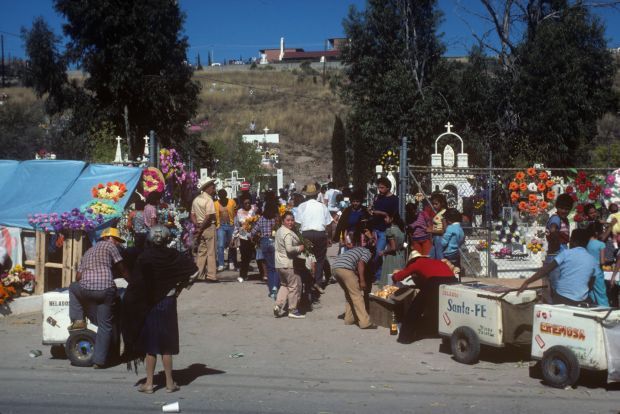
It is Nov. 1, the day before All Souls Day. For a week, harvesters have been working in the fields near Magdalena, Sonora, picking vast quantities of marigolds – cempazúchiles, the flower of the dead in Aztec Mexico. These arrive in truckloads to be sold in Nogales, outside of the cemeteries.
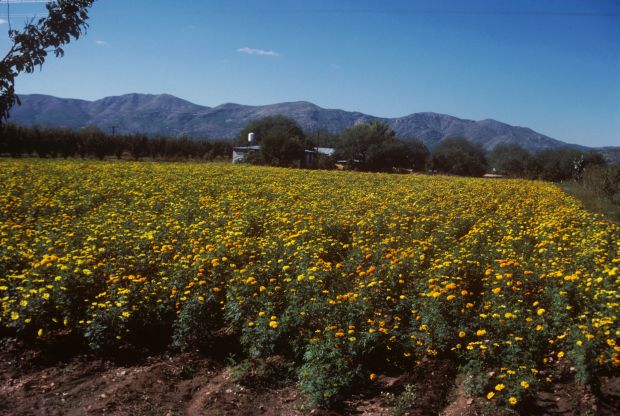
Field of marigolds near Magdalena, Sonora.
Within the cemeteries there is a lot of activity. Here’s what it was like at the Panteón Nacional on Nov. 1, 1984, slightly edited from my field notes.
Hundreds of people were inside the cemetery, cleaning, repainting, mounding earth, scrubbing slabs, applying flowers. One man was chiseling something off a tombstone, another man was lettering a new nameplate that had recently been painted black over light blue.
The central pathway was the scene of a steady procession toward and away from the gate: men and women carrying shovels, brooms, hoes, coronas (wreaths) and crosses, flowers — both potted and in bunches, paint buckets and brushes, pails and tin cans, and plastic milk jugs of water. Small boys chased each other, carried pails of water, and offered their services cleaning graves. A balloon vendor strolled through the cemetery.
People visited, worked and ate. There was little noise — no radios, no musicians — except for the loudspeaker of a car in the street blaring the headlines of a local newspaper, which involved a drug-related killing in Calle Buenos Aires.
Outside the cemetery gates, vendors sold sodas, carne asada, corn on the cob, churros, sugarcane, yellow and white flowers, and home-made paper wreaths. Small groups of people walked up the road, some carrying wreaths and flowers, past the blacksmith shop where men were welding in the yard and newly painted, wrought-iron crosses shone black in the afternoon sun, past the dusty mamolerías where grave markers were being cast, past the trucks from Ímuris and La Mesa, each bearing its owner’s name and hometown in elegant, shaded letters on the door, each backed up to the street to display white margaritas, yellow cempazúchiles, and coronas of home-made paper flowers.
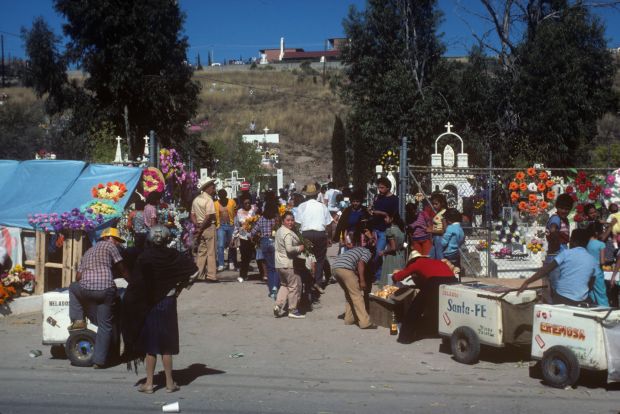
Entrance to Panteón Nacional, Nogales, Sonora, Nov. 1, 1984.
And this, I was told, was nothing compared to the crowds that would be there the next day, on Nov. 2, el mero día de los muertos!
Panteón Nacional is Nogales, Sonora’s largest public cemetery. Similar scenes, but usually of lesser intensity, are taking place all over our region. In the next blog we’ll take a look at the results of the sort of activity I have just described.

