


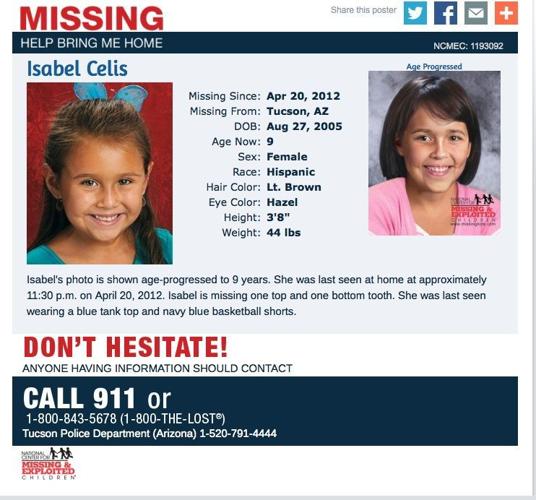
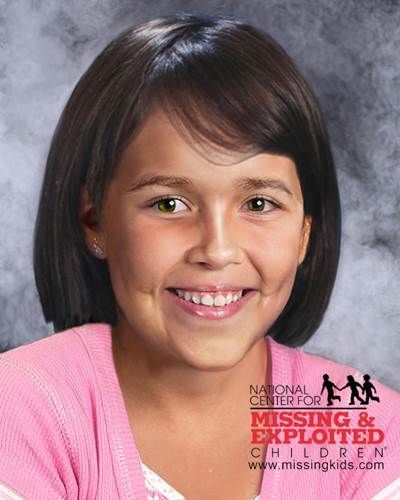

An age progression composite of Isabel Celis looks strikingly different from her appearance three years ago when she was snatched from her bedroom in her family’s midtown home when she was 6 years old.
The National Center for Missing & Exploited Children released the photo of what Isabel might look like at age 9 — dressed in a pink top with short hair — in hopes that it sparks recognition in the mysterious case.
“It is hard to look at because it is Isa,” said Becky Celis, 38, using her daughter’s nickname for Isabel.
“We appreciate the fact they are doing this and we hope it wakes up anyone who has seen Isa and has information,” said the mother, a nurse at Tucson Medical Center. The image “is very different” from what she believes her daughter may look like, explaining that she believes the age progression is too drastic.
“I assume she isn’t going to change as much. It seems like too much change,” Celis said. “But they are the experts. It has her eyes. It has her chin. The image can only be positive because it will get people talking about her.”
In coming up with the current image, photos of Isabel’s mother, father, Sergio Celis, 44, and her two brothers, Sergio, 17, and Julian, 14, were used when they all were ages 9 or 10, said Steve Loftin, a forensic artist with the center’s forensic imaging unit. Loftin went to work using a computer and Adobe Photoshop to create the image.
“Heredity is the key in this,” Loftin said in a phone interview. “It is a subjective process. I took from those images the like characteristics they all shared and created the image. There is no scientific basis.”
“It is based on what the artist draws from it. It is a composite, and you hope you captured enough likeness that this image would spark some recognition, and it all depends on who sees it,” Loftin, 66, said.
Loftin, a former police officer with the Fairfax Police Department in Fairfax County, Virginia, where he also worked as a composite artist, said there is no software available to do age progression images.
“It is a manual process that takes from four to eight hours,” he said, adding that part of his training included facial imaging studies at the FBI National Academy in Virginia.
The team of four forensic artists at the national center have done more than 6,000 age progression images, and out of that number 1,300 long-term missing children have been recovered, said Loftin, who has done more than 1,000 age progression composites during his 18 years at the center.
When the team receives a recovery photo of the missing child, it compares the composite with the recovery photo.
“It is just phenomenal, and the most rewarding feeling when we get a recovery and the age progression composite played a part in it,” Loftin said.
The age progression image of missing children will be updated every two years up to when the child turns age 18, and then it is updated every five years after that until the family or investigative agency requests that it no longer be done, Loftin said.
Isabel’s case remains an active, open investigation, and there is no new information to release about the case, said Sgt. Pete Dugan, a Tucson Police Department spokesman.
In an April interview, Tucson Police Lt. Matt Ronstadt, head of the family and sex crimes section, said two detectives are the primary investigators who have worked the case since day one. A team of eight detectives, who have in-depth knowledge of the case, are called in as needed.
It remains a mystery who took Isabel, and why.
The child disappeared during the night while the family slept.
She was reported missing on the morning of April 21, 2012, by her father, who discovered her gone when he went to wake her.
Becky Celis had already left for work.
About 250 law enforcement officers from multiple agencies scoured the neighborhood area near Park Place mall. They fanned out into sections of the city and county.
Tracking dogs, FBI profilers, behavioral analysts and an evidence-recovery team were also used.
An 88-CRIME reward is offered in the case.

