

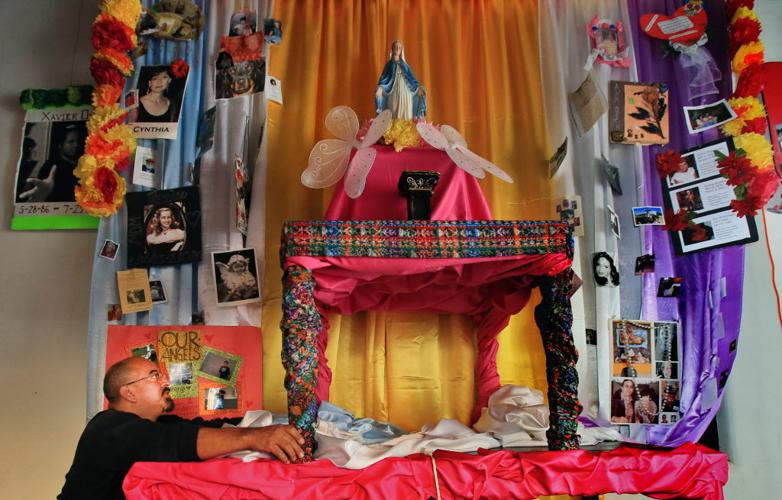



He erected his first Day of the Dead altar, filled with candles, pictures and flowers, 15 years ago. It was in memory of friends who had died of HIV-related causes.
Since then, José Duran has erected a public altar every year at this time for Día de Muertos, the celebration marked by decorated altars to remember and celebrate the lives of the dead.
It connects his self-expression, spirituality and creativity, he said. And the altars remain a conduit to his late grandmother, Nana Librada Andrade, of Nogales, Sonora, who put up altars in her home that continue to inspire Duran.
“I carry her spirit with me,” Duran said a couple of days before he began creating an altar at Mercado San Agustín on West Congress Street.
As Día de Muertos, an ancient Mesoamerica tradition that predates European colonization also known as Día de los Fieles Difuntos, is increasingly commercialized, often in trivial ways, Duran keeps it real. And while the tradition has been culturally appropriated and removed from its roots, Duran connects to others the solemn practice of honoring the dead.
An altar represents inclusion, he said. Festooned with keepsakes and personal reminders of the dead, it draws in people, regardless of their faith, ethnicity and history, said Duran, who works as a medical and nursing assistant for a private contractor in the state prisons.
In the past six years that he has put up his altar at the Mercado, Duran has witnessed more people each year respond by placing their “ex votos,” items, big and small, as an offering of thanks or remembrance.
The altar will remain on display through the week and will come down after the All Souls Procession Sunday, November 8, that ends in the empty lot next to the white-walled commercial square. The altar will be dedicated at 6:30 p.m. Monday, on the Day of the Dead, at the Mercado.
In addition to the Mercado altar, Duran created another at Tohono Chul Park near West Ina and North Oracle roads.
But altars are not seasonal for Duran.
He maintains altars year-round in his Barrio Santa Rosa home, in the neighborhood where he up. The altars honor his older deceased siblings, Martha and Ernie, his late father Ramón and his maternal nana.
“I hold the spirit of remembrance,” said Duran, 52, a 1980 graduate of Tucson High School and who spent three years in a Los Angeles seminary for Catholic priests.
What he remembers the most about his grandmother’s altars is that they changed continuously. She included every aspect of her life. They were alive.
The beauty of Day of the Dead altars is that there is no “right way” to create one. A candle and a photo on a small stand or table can be a simple but meaningful way to welcome the dead. More elaborate altars, erected on three levels — representing heaven, earth and the underworld — contain numerous photos and candles, marigold flowers, pan de muerto, sugar skulls, items associated with the dead, drapes, papel picado, fresh food, bottled beverages, and a host of other objects.
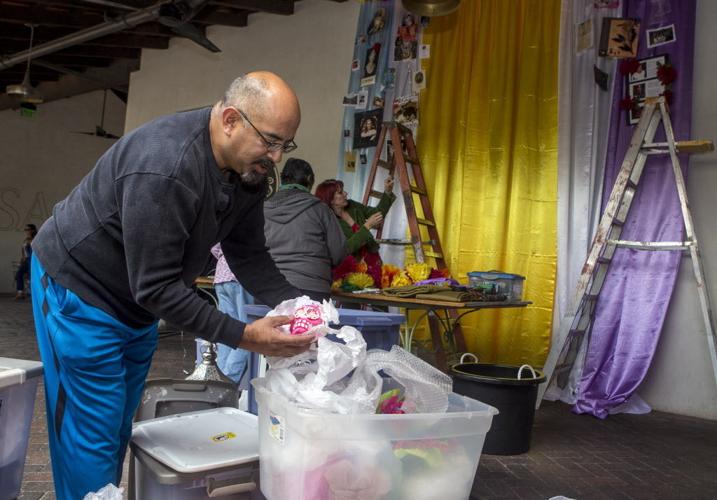
Duran changes his public altars every year and doesn’t plan them, allowing for spontaneity to be the driving creative force.
He doesn’t work alone. His angels, Lupe Maldonado, Josie Pedregon, Ahly Mueller, Cecilia Trujillo and Dora Torralba, helped over the weekend because they, too, want to preserve this cultural tradition.
Duran remains faithful to the altars because he remains loyal to his friends and families who have died. He is grateful to them for the memories they gave him and he feels blessed that he can honor them.
“If I can create one night to expose my culture and allow people to feel part of the larger community,” he said, “I feel I have accomplished something.”

