

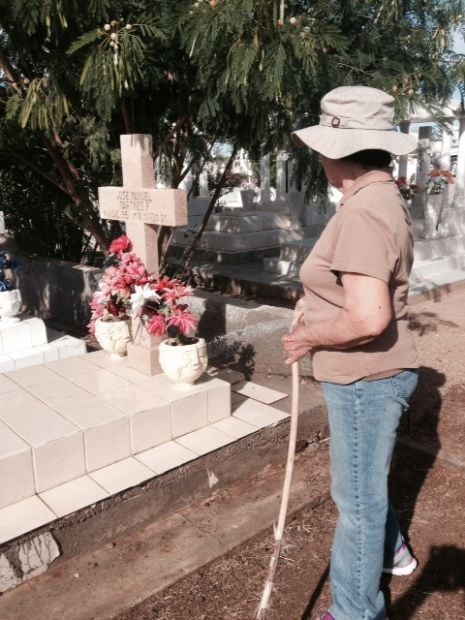

A day before last Sunday’s Día de Los Muertos, Cecilia Cañez Amado was washing away the light dirt and small leaves that accumulated over her half-brother’s grave.
The next day the small cemetery would come alive with fresh marigolds, mums and gladiolas. Her family, as well as other families, would come together in a festive celebration of memories around the tombstones, of various shapes and sizes, resting in the shadow of the white-washed church in Oquitoa, Sonora.
Amado was born in the small town, along the Altar River about a three-hour drive from Nogales, but has lived in Tucson for 45 years. Despite the time and distance, Amado returns to this quiet rural town to visit her mother and to return to her roots.
I met Amado that late morning while she hosed down the tumba, during a short visit, along with my wife and a busload of tourists, most of whom were from Tucson but others from Phoenix, California and two from Holland. We had visited the Sonoran towns of Tubutama, Átil, Pitiquito, Heroica Caborca, San Ignacio and Magdalena de Kino, where the colonial missionary and explorer Eusebio Francisco Kino established missions in the late 1600s among the O’odham and Opata.
Some of the graves in Oquitoa date back 300 years, but people have lived in the Sonoran Desert for thousands of years. And despite the creation of a border in 1854, separating Southern Arizona and Northern Sonora and increasing militarization on both sides of the border, families continue to criss-cross, maintaining ties and traditions.
“In Oquitoa,” Amado said, “there isn’t a family that doesn’t have a family member in Tucson.”
Like Jorge Almazan, a native Tucsonan, whose family stretches back to the mid- 1800s, at least on paper.
His grandfather Luz Almazan was born in Oquitoa and his grandmother María Jesús Federico de Almazan was born nearby.
And who knows, maybe their parents and grandparents were also born in the town or nearby. But the documents don’t exist.
What does exist are years and years of bonds, forged in the small, quiet communities, known for their agricultural goods, cattle and appreciation of the past.
Almazan’s parents, Tomás and Teresa Almazan, were born in Oquitoa but moved north to Tucson where their five sons were born. But Jorge Almazan and his brothers would visit Oquitoa every year and would stay for weeks.
They would bathe in the acequias, the irrigation canals, work in the fields and tend to the animals, “the traditions that we couldn’t find in Tucson,” said Almazan.
“It was a tremendous education, to live with our grandparents,” he said.
The lure of Oquitoa was so great that Almazan and his wife, Irma Cruz Almazan, whose parents were born in the region, bought a small house in Oquitoa, where they often spend time.
“It’s not a house, it’s a home,” Almazan told me.
Amado doesn’t have a house in Oquitoa, but she considers the town her home because her grandparents were born there, as well as her mother’s grandparents.
Despite the love that residents have for their towns, changes have forced many to leave over the years. The Altar River Valley was a rich wheat growing area, but high production costs, lowering water table and big growers in Mexico and the U.S. made it impossible to grow wheat.
Amado’s father used to work in the flour mill in Oquitoa, whose shell can be seen from the church on the hill.
And in recent years, drug-related violence chased more residents away. But the violence has subsided, making it safer for residents and visitors to travel. And those who have left have not forgotten.
“The majority of people who have left continue to help their families who have remained,” said Amado.
Almazan said he never worried about the violence. There was something more powerful than the threats: The heritage of the region and his family’s history.
“I would be lost without it. I love my ancestry, my heritage,” he said. “I am an American but with a Mexican heart.”

