

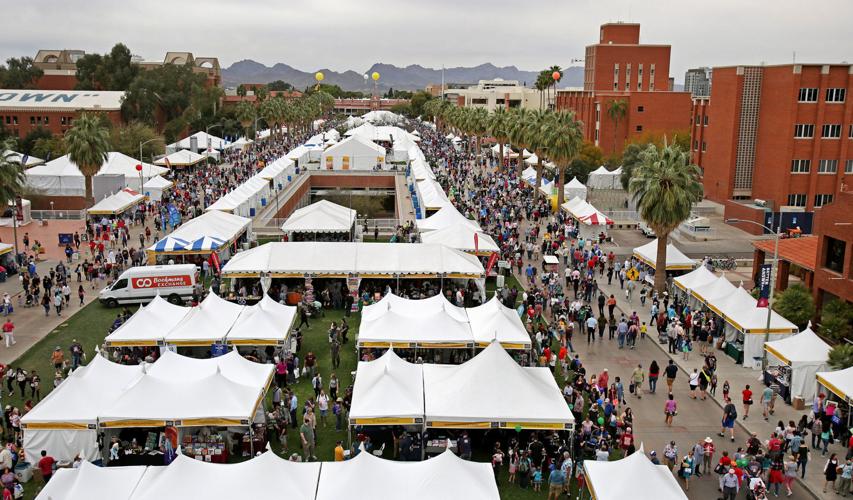
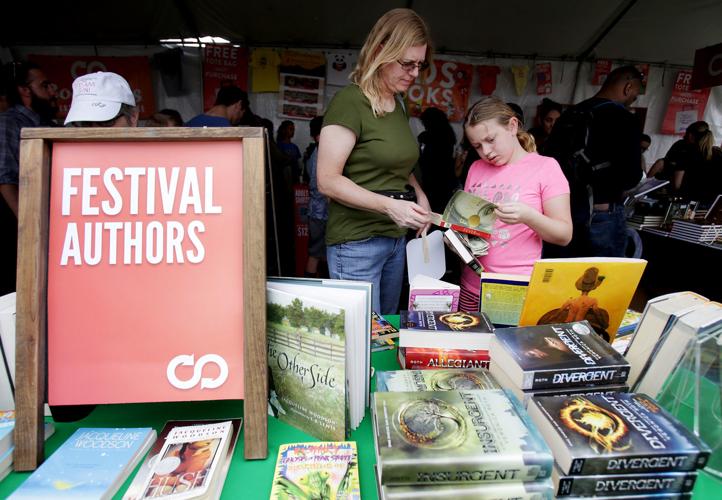
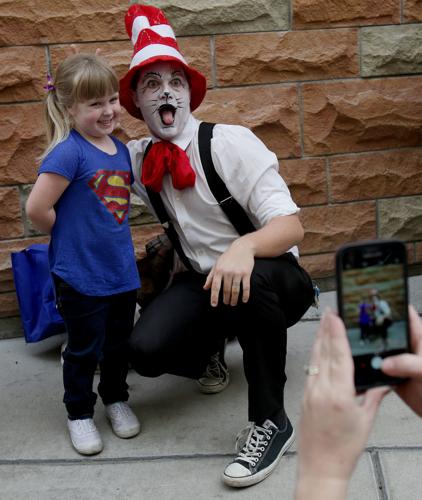




At the Tucson Festival of Books, celebrated and best-selling authors talk each year with eloquence, candor and humor about how they found their voices.
At this year’s festival, some writers saw parallels between that process — of learning to express their truths — and the way waves of women found their voices in recent months through the #MeToo movement, coming forward to share that they’ve been sexually assaulted or abused.
“It’s about getting rid of a lot of the assumptions you have about yourself, and that other people have about you, and finding out what is really true,” said Amy Tan, author of best-selling novels, including “The Joy Luck Club.”
“I am ‘me too’ five times,” Tan told an audience Saturday at the University of Arizona, where the book festival features hundreds of authors and is expected to draw about 135,000 visitors this weekend.
“I am ‘me too,’ too. Every woman is, to one degree or another,” added Tan’s co-presenter, poet Mary Karr, who wrote in her 1995 memoir “The Liars’ Club” that she was raped before she was 10.
Not unlike the vast emotional territories of their books, Tan and Karr’s repartee Saturday moved seamlessly between painful memories, on to black humor, back to childhood traumas, then to profane and funny competition about whose family was the most dysfunctional.
The two confided they’ve recently added some “#MeToo” lyrics to songs they perform with the all-star-author band Rock Bottom Remainders. Some of Tan’s, about a grabby guy’s pickup lines, cracked up their audience but can’t be repeated here. Tucsonans who got to see the band’s free concert Saturday night on the UA Mall probably heard them, though.
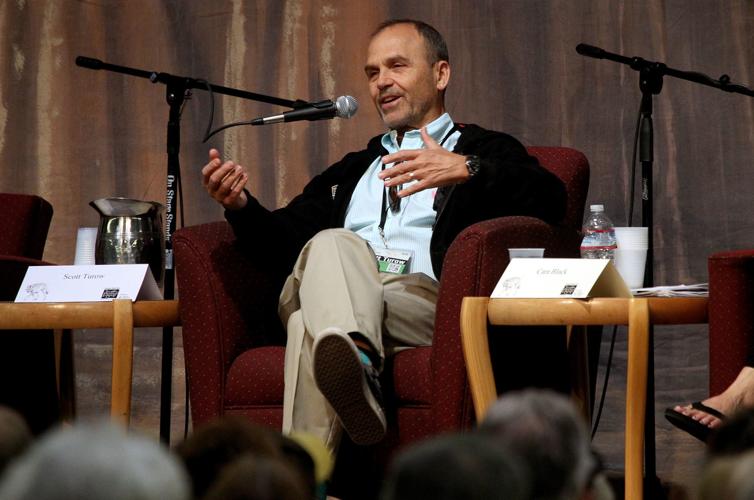
Two others in that band, big-name mystery writers Scott Turow and Greg Iles, were asked about the social movement during their presentation Saturday morning to a UA Student Union ballroom crowd.
Turow, author of “Presumed Innocent,” “The Burden of Proof” and other best-sellers, said he’s heard so many stories from women in his own life — about being groped, or being told they won’t be promoted if they don’t sleep with the boss — to know “this isn’t fiction.”
“Women, even in a sophisticated culture like our own, have been grossly mistreated over the years by certain predatory men,” Turow said, to applause.
Iles, who’s been called “Faulkner for the ‘Breaking Bad’ generation,” said it’s stunning how long it took for something that’s “always been with us” to turn into the social movement of 2017-’18.
“It’s going to change the books that are bought and the movies that are made,” Iles predicted.
That’s not all it is changing. CNN morning anchor Alisyn Camerota, author of the cable TV-themed novel “Amanda Wakes Up,” said the sexual banter sprinkled throughout her book was ubiquitous in cable newsrooms just one year ago. Now, she said, such chatter has evaporated.
Luis Alberto Urrea, a Pulitzer Prize finalist for his novel “The Devil’s Highway,” was asked during his presentation Saturday how he writes powerful female characters.
“I was raised by women, powerful women,” answered Urrea, who grew up on the border in Tijuana. “The males in my life were mostly absent — mostly because they were out meeting other powerful women,” he added, to laughter.
Later, on his way to sign books, when asked about #MeToo, Urrea said he sees it as “women finding a way to own things they’ve had to sit on forever.”
That sounds remarkably similar to the way many authors, men and women, who’ve spoken during the 10 years of the Tucson Festival of Books have dealt with all manner of buried issues that bubble up through their works.
“Damage is good, for defining who you are later in life, as a writer,” is how Tan put it.
“Pick the point that’s most intense or relevant and go back and forth from it as a writer,” said Tan, whose new book is, “Where the Past Begins: A Writer’s Memoir.”
Tom Perrotta, whose books have been made into movies including “Election” and shows including HBO’s “The Leftovers,” said his evolution to becoming a writer about “human anxieties, human desires” started with “being part of a family that kept a lot of secrets.”
That taught him “the power of truth — it’s so dangerous, nobody can know about this, or this,” he observed.
“We were closeted heterosexuals — we weren’t allowed to talk about sex or get any information,” Perrotta said, adding that if the internet had existed when he was a kid, “I’d never have left my room.”
Billy Collins, a poet laureate of the United States, said he found his voice as “an only child, not interested in other people.”
Poets don’t have to be interested in other people, only themselves, he quipped at Friday night’s authors dinner, where he received this year’s Tucson Festival of Books Founders Award.
Iles, who writes of “the unvarnished truth about race in America” in “Mississippi Blood,” the third book in a trilogy, quoted Stephen King as saying a writer’s subconscious is like the basement of a house, with crates filled with ominous things you don’t want to open all at once.
Jacqueline Woodson, author of “Brown Girl Dreaming,” a three-time National Book Award finalist and the National Ambassador for Young People’s Literature, spoke last week at Tucson’s Manzanita Elementary School in conjunction with her appearance at the book festival. There she saw one African-American girl in her audience.
“I knew she was the one I was doing the work for today,” said Woodson, who knew since age 7 she wanted to be a writer.
“You are doing the work for people out there,” she told writers Friday night in her keynote address for the authors dinner. “Because we’re writing not just to tell stories. We’re writing to change narratives,” said Woodson, adding, “When we come out of a book, we come out differently when we leave that book than when we went in.”
Woodson shared the African-American community ritual of “calling the ancestors back into the room, to know that we’re not walking through this world alone.”
Urrea said he sees part of his job as representing the beauty in the lives of "people who are looked down on," including “Mexicans, the working class.”
A former Tucsonan who has participated in the book festival all 10 years so far, Urrea had his publisher change the release date of his new book, “House of Broken Angels,” so it came out this weekend.
“This book happened because of TFOB,” Urrea said, explaining that three years ago, just before the festival, his brother died of cancer. At the festival that year, the author Jim Harrison (who has since died) said to him, “Tell me about your brother’s death.”
Urrea shared a humorous account of how his brother, at what the family knew was his final birthday party, “presided over his own wake, getting everyone to tell him how great he was,” being feted like Don Corleone in the wedding scene of “The Godfather.”
“Imagine,” Urrea recounted, turning serious, “when you think you’ve messed up all your life, finding out in your last week of life that you changed the world,” that you were loved by so many people.
“Sometimes God hands you a novel,” Harrison responded. “You’d better write it.”

