

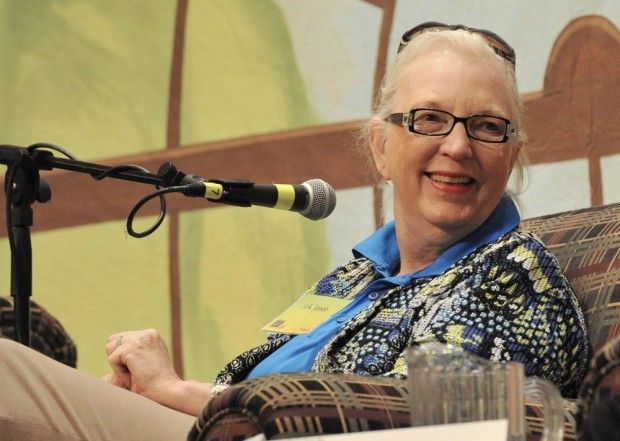
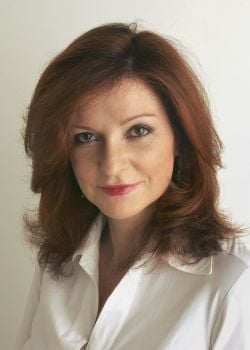

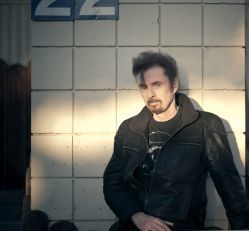

The nearly 600 readers who packed in to hear New York Times columnist Maureen Dowd, like the 400 turned away from her full UA venue on Saturday, were primed to cheer her insider zingers against President Trump.
And Dowd, who professed her love for Arizona cacti because “I identify with them,” delivered barb after barb. Asked to predict how long Trump will stay in the job, she averred, “I don’t think he would quit or give up,” then quipped: “I think he will be there as long as he isn’t in handcuffs.” Also, this, from the Pulitzer Prize-winning columnist and author of 2016’s “The Year of Voting Dangerously,” who has covered Trump since 1987: “The Russian thing is the weirdest thing any of us have ever seen covering politics, period.”
But it hardly mattered where you listened Saturday at the Tucson Festival of Books on the University of Arizona campus: Current U.S. politics bubbled to the surface, whatever the advertised topic.
Grace Lin, author of “When the Sea Turned to Silver,” a literary novel for young readers that weaves in traditional Chinese myths and fairy tales, knowingly evoked laughs when she chose to read this passage: “The new emperor is forcing people to build a wall.”
T.C. Boyle spoke about his novel “The Terranauts,” an imagining of what went on (think: sex, in part) inside the sealed glass dome of Biosphere 2 near Oracle. He was asked about Steve Bannon’s role at Biosphere 2 in the 1990s. Bannon, chief strategist and senior adviser to Trump, was once the acting director at the futuristic project.
Boyle, a PEN/Faulkner Award-winning novelist, and the recipient of the Tucson Festival of Books’ 2017 Founders Award, explained that he isn’t a journalist and didn’t interview any people involved in the Biosphere. “I wasn’t aware of Bannon’s connection until people started tweeting to tell me about it” after the book came out. “And, what can I say? I have deep regrets that he exists.”
Colson Whitehead’s novel “The Underground Railroad” envisions “a literal subway beneath the earth” through which runaway slaves travel in the 1850s, and each allegorical state they go through “is a different state of American possibilities.” It won the prestigious National Book Award for fiction last year. Whitehead was asked Saturday what its protagonist, a fleeing slave named Cora, would think of “Trumpland.”
“Turns out when you write about race in the past, you write about race in the present,” Whitehead answered. “I woke up in November with a renewed sense of white supremacy in America.”
Asked to elaborate, Whitehead continued, “If you’re a black person in America, I think it’s something you think about a lot in the last three months.” He told his audience that he had wanted to turn to a lighter genre after immersing himself in the horrors of slavery, but he couldn’t because of the gravity of current events in the news. Instead, he revealed, he is seven pages into writing his next book, about “white supremacy and institutional racism, as a distraction from living with both.”
It wasn’t all as serious as that, though. Some themes that came through in a cross-section of author events Saturday at the festival, which continues Sunday, March 12, at the university:
Current politics
You know you want more from Dowd, so here you go:
She took plenty of devastating shots at Hillary Clinton, too — over being “her own worst enemy,” such as by taking big money for speeches to Goldman Sachs at a time that she and Bill were worth millions; for the Clinton machine being “very arrogant”; and for failing to campaign in Wisconsin, among other criticisms.
But the victor owns the day, so:
“The way you can tell he’s a malignant narcissist is he has no empathy. … When he has decimated someone, he doesn’t understand why they won’t come back and be really loyal to him.”
“With his ego arithmetic, everything is about the numbers.” When Dowd asked Trump early on why he wanted to run for president, he replied, “Because I get the highest rating on Larry King, and the most number of men hit on Melania.”
Republican leaders turning a blind eye to the ties to Russia have made “a Faustian deal because they want their Supreme Court guy, their budget.”
But then, this: “To me, it was scarier covering Dick Cheney because he was dismantling checks and balances behind the scenes,” while retaining the respect of official Washington.
The spoken word
A book festival is a homage to what’s written on the page, of course — of language, imagination, history and ideas — but it’s also a celebration of the spoken word, as author after author read from their works in musical timbres and cadences, their voices mellifluous, as when Charles Johnson, 1990 National Book Award winner for “Middle Passage,” intoned that “conflict is what it means to be conscious.”
Sense of place
Best-selling mystery writer J.A. Jance shared that she always writes about real places, such as a mountain outside her childhood town of Bisbee shown on the map as Gold Hill but known to her friends as Geronimo, which figures in her latest Joanna Brady book, “Downfall.” Jance said she climbed it only once, when she was 12, and was astonished that at the top it was no bigger than a living room, and yet it “loomed so large in my childhood.” As for the real places in her books, the prolific author warned: “I make up restaurants with wild abandon, which annoys readers when they go to those places.” She also noted that when people die in her mysteries, she fudges the addresses of their deaths.
Boyle, a Californian who slipped into the Tucson area two years ago to check out Biosphere 2, shared that he was thrilled to see his first javelina there, “right outside” the glass dome.
Technology
Jance’s latest is an Artificial Intelligence character, and in her book the person creating the A.I. “is a wannabe serial killer.”
Technology also is the “newest obsession” of Boyle, in the form of gene editing and vivisection that he imagines cobbling animals into people and creating new “transgenic creatures.” In his new short story, “Are We Not Men?” those creatures include profane Crowparrots, maraschino-cherry-colored pit bulls, “baby dogcats on special” at the pet store, and 6-foot-tall 11-year-olds with traits chosen by their parents at GenLab, including IQs of 162.
And, no getting away from Twitter, and the tweeter-in-chief. To quote Dowd: “There’s a theory at Shabbat that when Jared and Ivanka go away for 24 hours, that’s when he goes nuts.”
Tips for writers
Want to know why publishers of best-sellers want them to have 100,000 words? “It’s so they’ll fit in a standard shipping box,” Jance said.
Not all influences are literary giants. National Book Award winner Whitehead said he grew up wanting to write because of Marvelman, Spider-Man, X-Men and Stephen King, as well as Gabriel Garcia Marquez and Ralph Ellison.
A tip for readers
When writing his most recent historically based fiction, Whitehead said, he decided: “I wouldn’t stick with the facts, but I would stick to the truth.” So, he said, “don’t get too hung up” on which events really happened precisely that way.
“Go along for the ride and Google later.”

