

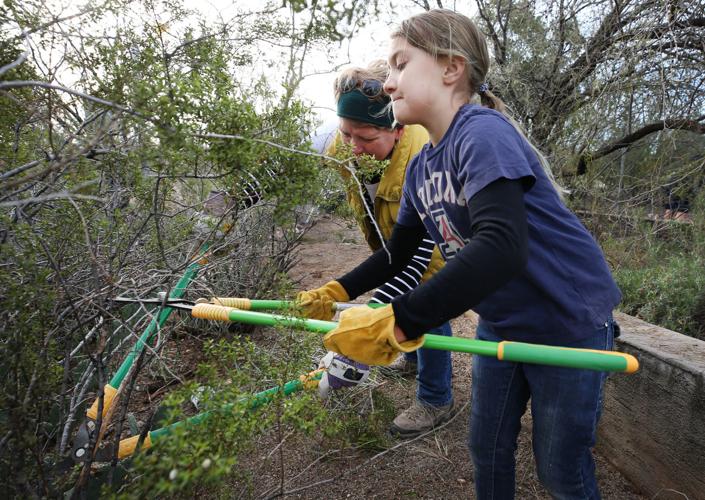
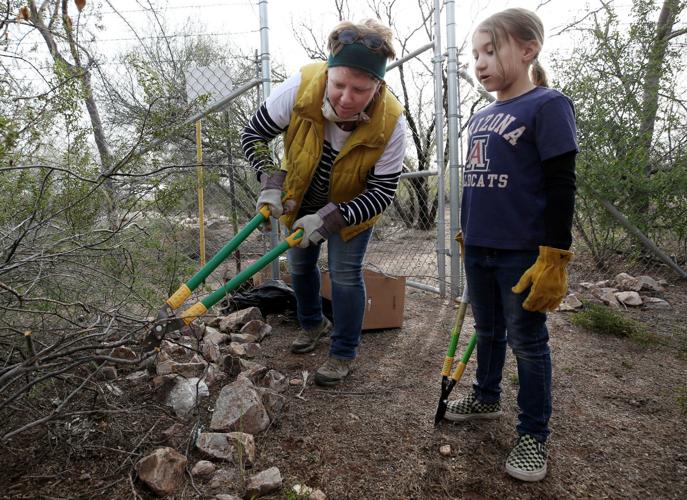


The University of Arizona’s Community and School Garden Program has grown to support efforts at 19 school campuses across Tucson, offering students from elementary to high school the opportunity to get their hands dirty as part of their regular studies.
The program does everything, from providing workshops to sending UA students to help with the gardens at schools as well as assisting with grants to fund more projects.
Sallie Marston co-founded the garden program in 2009, but said she didn’t realize how large it would eventually become.
“I was a regular faculty member and I had a student approach me that wanted to do an independent study that involved a school garden and I agreed to do it,” said Marston, the program’s director. “Then more students found out about it and wanted me to include them and other gardens. Then the food bank got in touch with me. The origin was not intentional. It just kind of happened.”
By 2012, the independent study had become a regularly offered class at UA, with about 30 students. Today, Marston said they have to cap the class at 60 students per semester. The students then go to help at schools, from elementary to high schools.
“What we do in the class is we train the students ... once a week in a 90-minute session to be the support personnel for the school gardens,” Marston said. “So they learn everything from how you plant a healthy garden to how to maintain it, to how to take small groups of children outside to do teaching with them.”
Moses Thompson, Tucson Unified School District and UA school gardening coordinator, said the program is remarkable due to the close partnership between TUSD — where most of the schools in the program are located — and the university, as continued buy-in and deep support is what most school garden organizations struggle to get.
“I honestly think it’s pivotal and it represents change within the institution and investment within the institution,” Thompson said. “The UA Community and School Garden Program isn’t just an outside service that comes in and leaves. It’s an embedded partnership where the district is a deeply invested stakeholder.”
The importance of school gardens goes far beyond fresh vegetables, Thompson said.
“It enriches the school day experience. It’s another feature in the school that gets kids excited to come to school. It’s an outdoor space that might feel therapeutic, a natural space that the kids can get engaged in,” Thompson said. “I think that it is a way for different types of learners to benefit. It gives context to what’s taught inside of the classroom.”
It’s not just the TUSD students who benefit, either. The UA interns learn just as much, Thompson said.
“We’ve been working with interns for almost 10 years now and all of the interns talk about the therapeutic aspect of it, the social emotional benefit of how it feels to serve in a community, how it feels to connect with a neighborhood or a part of Tucson they might not otherwise,” Thompson said.
Those connections can have far-reaching impacts, like showing TUSD students in low-income schools, who are underrepresented in higher education, that college is a possibility, Thompson said.
“The University of Arizona is something that everybody in Tucson gets excited about,” Thompson said. “The university is in close proximity to a lot of these schools, but still that experience seems out of reach for a lot of students in the schools that we serve. For them to see university students ... it opens up that horizon as a pathway.”
At Borton Magnet Elementary School, one school in the program, the many levels of learning a garden can provide are on full display alongside the several vegetable gardens, desert tortoise habitat, chicken coop, rainwater cisterns and adobe oven.
Stephanie Pederson, garden coordinator at Borton, 700 E. 22nd St., said the school was ecologically minded to start, and each student at Borton gets access to the garden.
“Sometimes in schools it’s always this task, a paper and pencil task at hand, then that’s over, where out here the learning is always happening in a multitude of ways,” Pederson said. “Failure is real out in the garden ... and then we can do it different, and that’s a beautiful thing.”
Classes work garden tasks like weeding and planting, but they also conduct experiments that align with Arizona’s teaching standards. This year, fourth-graders worked on Arizona history by using creosote oil to make lotions, and on weather by making observations in the garden.
“We installed a weather station, an official one, on top of a portable, and students made their own barometers and little weather stations,” Pederson said. “Now we’re working on information panels on how to communicate what we’ve learned.”
While each class applies learning in different ways in the garden, every student learns about nutrition. Pederson said she often uses the eggs from the chickens and garden produce to cook healthy meals in classrooms, as the garden is certified by the Arizona State Department of Health.
“Continuing to foster the love of the outdoors is really what is on my agenda,” Pederson said. “I just want them to love to be out here and not be afraid of it.”
For Challenger Middle School teacher Veronica Huizar, the school’s gardens are a place to build pride and community.
“It’s kind of like the kids own (the garden),” Huizar said. “We grow what they want to grow and it gets them to eat their vegetables too, because they’re like, ‘I grew that. I want to taste it.’”
The garden is managed by Huizar’s Student Wellness Advocacy Team class, with support from the UA interns. The SWAT students come out nearly every day to pull weeds, water and clean up the garden. The SWAT class also helps create a healthier lunchroom, harvesting the food they grow and putting on taste-testing events.
“They enjoy it, anything that gets them out of the classroom,” Huizar said. “You should see them the days we don’t go out.”
Huizar is working her way down a list of projects at Challenger, 100 E. Elvira Road, in the Sunnyside Unified School District, from putting up a pergola she was able to purchase with a grant to finishing a small greenhouse.
“My hope is that more classes can come out here and enjoy it too, and build community not just with my classes but the campus community,” Huizar said.
At Borton, Pederson has big dreams for the garden program, from integrating academics more deeply into the garden to getting a greenhouse. She said overall, she feels lucky that her school values the garden program.
“It’s not like there’s extra money coming from somewhere” Pederson said. “It’s a choice in how our school and our families choose to spend the money.”

