


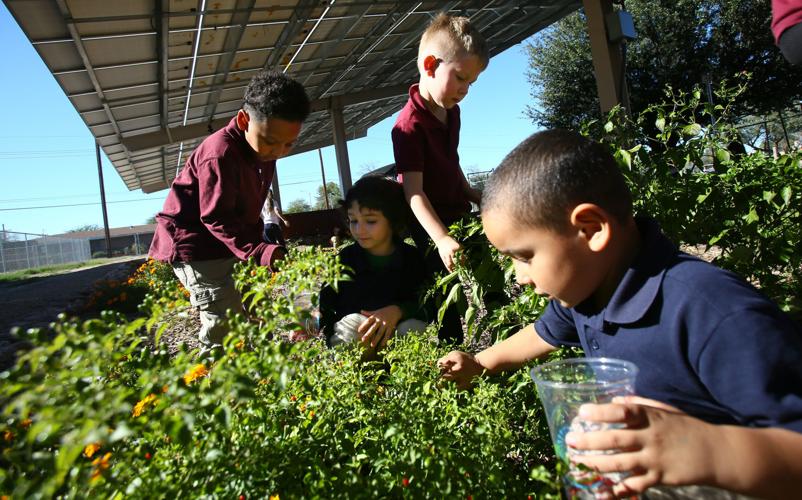
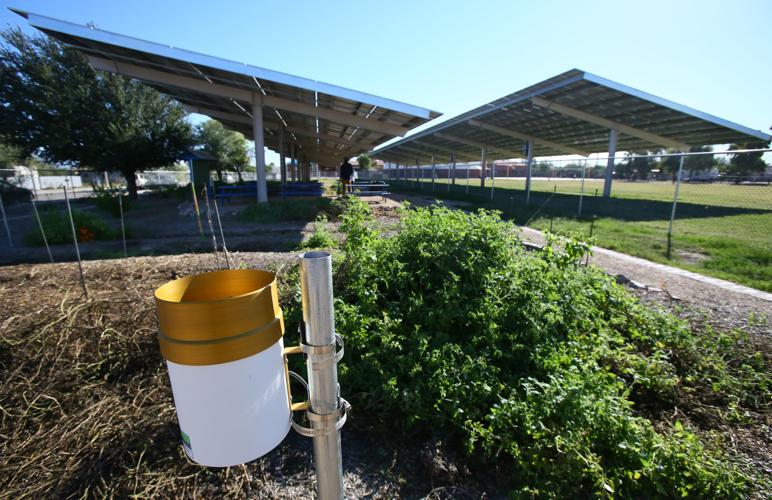


Neat rows of plants grow tall in the partial shade underneath elevated solar panels at a west-side Tucson school.
Multiple sensors record air temperature, soil temperature and soil moisture. In a sunny spot next to the panels, slightly wilted crops are also being closely monitored.
Biosphere 2 scientists north of Tucson analyze the data coming from Manzo Elementary School where students are helping with an agrivoltaics project. Agrivoltaics is the practice of growing plants — including food crops — underneath solar panels.
Greg Barron-Gafford, an associate professor of biogeography and ecosystem science at the University of Arizona and at Biosphere 2, said the benefits are immense. They range from lowering the temperature of the solar panels, which increases their efficiency, to providing a way for agricultural land to survive on city edges.
Plants growing under solar panels show less stress, less insect damage, have more crop production and use less water compared to traditional, full-sun methods of growing crops. Last year, tomatoes protected under the panels produced fruit all winter. Barron-Gafford said as this kind of experimentation is so new, more avenues of study open up all the time.
“We’ve been able to see how much longer water can be retained in the soil, so some of these more marginal lands could actually become productive lands, but that’s one of the things I’m really curious about,” Barron-Gafford said. “Could it sustain this level of agriculture? We need to find out. Could it sustain just grassland restoration?”
With so many questions, that’s where the students at Tucson Unified School District come in. Having multiple test sites — there’s a third testing program at Rincon/University High School — is crucial. But Barron-Gafford has a team of only about three people working, so they couldn’t take all the measurements themselves.

The study found plants growing under solar panels show less stress, have more crop production and use less water than their full-sun counterparts.
“Weekly, and sometimes multiple times a week, the different classes know they’re supposed to walk around with a soil moisture probe and check different places,” Barron-Gafford said. “It’s great for us, because we’re getting real, bona fide scientific data.”
All the instruments are paid for by grants, so as to not burden the school district, and the data the students take ends up in research papers, which Barron-Gafford said adds to the students’ experience.
“They know the work is going into a science product and so they’re more careful than they were in the first studies,” Barron-Gafford said. The goal of the study is to see how well plants grow underneath solar panels.
While there were originally challenges with students eating the harvest before it could be weighed, Barron-Gafford said it’s all about slowing the students down enough that they do a good job. Now, the biggest challenge is balancing his experimental needs with what the students want to do.
“One of the challenges we run into with Manzo being a real research site is how many opinions there are,” Barron-Gafford said. “At the Biosphere, it’s really research and outreach to the public, but the public doesn’t have a big say in what we’re doing. Down here, it feels much more democratic. The kids have opinions about what we’re growing.”
And sometimes, they push back, like when Barron-Gafford said they had to pull up all their tomatoes, even though they were still growing, so they could plant winter crops and stay on a normal growth cycle. The students didn’t understand why they were purposefully killing plants they had raised — until Barron-Gafford explained it. Then, they were on board.

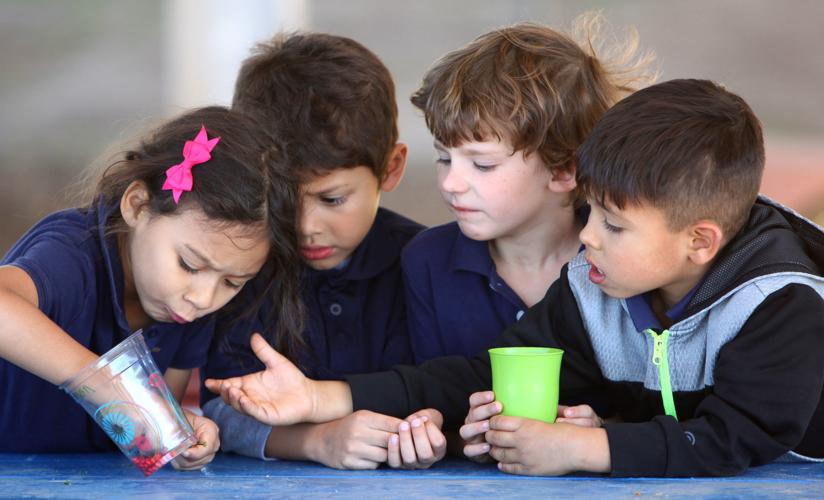
Manzo Elementary students count chiltepin peppers harvested from under solar panels behind the school. The students don’t just grow the food — they also get to eat and sell it.
“They’re recognizing that their silly ideas could actually be something. Making that connection early on, it’s exciting,” Barron-Gafford said. “What will the fifth-grader now turn into when they’re my age? What crazy ideas are they going to be able to generate?”
Blue Baldwin, ecology program coordinator at Manzo, said the students love to be outside, helping the researchers.
“We love the opportunity to have the kids do real science, and the kids seem to like doing real science, too,” Baldwin said.
Joel Garcia, a fifth-grader, said the program gave him many ideas about things he wanted to try.
“There’s this thing that I learned — my ecology teacher said they had these two apples, I think it was a golden apple and a red apple. They say if you put the two seeds mixed up together in one hole it will make a red and gold apple,” Joel said. “So I want to see if I can do that with other fruits and vegetables.”
As for Kyana Villa, also a fifth-grader, she wants to push sustainability a little further. “I want to try to put a cistern on the solar panels,” Kyana said. “But it’s hard, because you can’t have it cover the panels.”

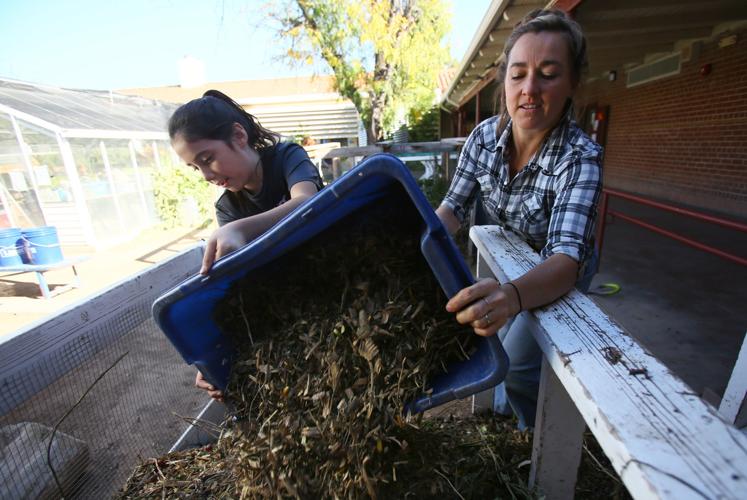
Blue Baldwin, ecology program coordinator at Manzo, right, assists a fifth-grader with composting. “We love the opportunity to have kids do real science,” Baldwin says.
The students at Manzo don’t just grow the food — they also get to eat and sell it. About once a month, they hold Manzo Market, where they pass out the produce they’ve grown to the community. The school also sells tilapia fish grown in its on-campus aquaponics system.
The garden is also certified by the State Department of Health Services, according to Baldwin, so the food grown can be served in TUSD cafeterias.
“I like the salads, those usually come from the garden and are sent to the cafeteria,” Joel said.
Manzo was the first school in Pima County to achieve that certification, and only the second in the state at the time, but Baldwin said the previously arduous process has gotten easier in the past few years.
“The attitude prior had been fight, fight, fight … there’s been a massive sea change at that level, which is really exciting,” Baldwin said. “Now we have a dozen TUSD schools that are certified.”
While the students many not quite realize how revolutionary the program is, or the scale of what they’re helping with, they know they’re part of something special.
“Most schools, you would just be inside, but that’s what I like about here, we have our patio that’s in the sun and we have our garden. It’s like a little farm,” Joel said.

