




PHOENIX — Partisan members of the Independent Redistricting Commission are making last-minute efforts to draw maps that would help their political parties through the 2030 election.
Each is doing so under the banner of balancing populations among congressional and legislative districts. And they are rushing against a Wednesday, Dec. 22, deadline to have final plans.
The alterations have definite implications.
For example, Republican commissioners David Mehl and Douglas York demanded that a corner be chipped out of what was Legislative District 23, which runs from Yuma along the international border to Tucson and north into Goodyear, and put into adjacent LD25.
About 600 people live there. One of them is state Sen. Sine Kerr, a Republican whose house is in the area.
The change moves Kerr from having to run for reelection in what would be a district with about a 15-point Democratic voter registration edge, to one where Republicans have a 25-point edge.
On the congressional side, Republicans also want to move Democratic areas in Maricopa County from CD1, that could be considered competitive, into CD3, which already has a 3-1 Democratic registration edge. They balance that by moving Republicans from CD8, where the GOP leads, into CD1.
Democrats are doing the same sorts of things and finding ways to give their own party’s candidates more of a chance of getting elected, whether to Congress or the Arizona Legislature.
The big flash point for them is how to divide Tucson between CD7 on the west side and CD6 on the east side.
A split needs to take place, because of the population. But the question becomes where to draw that line.
Democrats have been pushing for a line that starts at the Rillito River and runs south along Campbell Avenue to Broadway, then turns east out to Pantano Road, then south to Golf Links Road, before going west.
That would put more Democrats living in midtown Tucson into CD6.
They aren’t needed in CD7, where Democrats already have a 2-1 edge. But they could make all the difference in CD6, which would become a competitive district.
Republicans prefer pushing midtown Tucson into CD7.
The district is expected to get a lot of attention from candidates because Democratic U.S. Rep. Ann Kirkpatrick, who has represented close to the same area, is not seeking reelection. That creates an open seat and opportunities for either major party.
Other changes pushed by Democratic commissioners appear not to have direct partisan implications.
Shereen Lerner said the Pascua Yaqui reservation does not belong, as proposed, in the same legislative district as the Tohono O’odham Nation. She wants it to be part of the district that includes downtown Tucson.
Both areas already are heavily Democratic.
Lerner also wants other changes, like the line between south Scottsdale and Tempe, to create more competitive districts.
Otherwise, she said, the legislative map favors Republicans in 17 of the 30 districts, which she said should not be the case given the closeness of party registration numbers.
Mehl, however, said he doesn’t read the numbers that way. He said five of the legislative districts could be considered “highly competitive,’’ with voter registration margins within four points.
Erika Neuberg, who chairs the panel, said that’s important. “The narrower the vote spread, the more opportunity for a candidate to break out and win.”
Neuberg, the sole independent on the five-member commission, said even if a district tends to lean in one direction or the other, the fact that registration is close means lawmakers have to remain “accountable’’ to all residents, not just those of their own party.
Neuberg brushed aside consideration of the potential effects on the overall makeup of the state House and Senate for the coming decade.
“That’s not something that’s within our constitutional purview,’’ said Neuberg.
Racial considerations are, however. A preliminary version of the plan, backed by Republicans, would legislatively separate Laveen, an area of southwest Phoenix, from the rest of south Phoenix, arguing that the former has more in common with agricultural areas to the west.
But Democrats say the move would divide the Black community which, if left in the same district, would constitute 19% of the vote.
Some changes are being pushed for potentially less obvious reasons.
Still in flux is whether Casa Grande belongs in CD6 — the one that runs from midtown Tucson to the southeast border of the state — or is a better fit with CD2.
That district encompasses Florence and Coolidge. But the sprawling district also takes in Gila, Apache, Navajo, Coconino and Yavapai counties.
One of the last issues likely to be resolved has to do with the legislative district that encompasses six tribes in northern and eastern Arizona.
No matter how the district is drawn, it is likely to send Democrats to the state Capitol. But the question becomes which Democrats.
Neuberg pointed out that when lines were drawn after the 2000 election, the district also included Flagstaff. That enabled “white liberals’’ living off the reservation, she said, to nominate candidates of their choice, such as Tom Chabin and Kirkpatrick, who represented that part of the state at that time.
A decade later, the redistricting process moved Flagstaff into a district with Sedona and the Verde Valley, with the White Mountain communities added instead to the district with tribes. That led to the nomination and election of Democrats living on the Navajo reservation.
Mehl and York favor keeping Flagstaff in the tribal-dominated district.
But there is a potential legal impediment. The federal Voting Rights Act prohibits election changes that would prevent minorities — in this case, tribal members — from having the opportunity to elect someone of their choice.
Neuberg, who holds the swing vote, said if leaving Flagstaff in the district undermines the ability to elect Native Americans, she cannot support it.
She said congressional lines need to be finished by the end of Tuesday. That gives Wednesday to make minor adjustments to comply with federal laws that require virtually identical populations of 794,600 in each of the nine districts.
Legislative districts are supposed to each have about 238,000 residents. But commissioners have more leeway in those lines, particularly when they create population disparities to comply with other needs such as protecting minority voting rights.
Then and Now photos of Tucson, Southern Arizona
Then and Now: Tucson Airport terminal
Updated
The terminal building at the Tucson Municipal Airport, now known as the Tucson International Airport, ca. 1940s. Passengers waited in the shade of a long porch that extended from the terminal before walking to an airplane and climbing portable stairs to board the plane. The old terminal is still standing, and is located on the airport's west ramp.
Then and Now: Tucson Airport terminal
Updated
The former terminal at Tucson Municipal Airport in Tucson on March 23, 2017.
Then and Now: Tucson Airport tower
Updated
Members of the Tucson Airport Authority head for the new control tower and operations building at Tucson’s Municipal Airport for their annual meeting around January 13, 1958. The new structure is more than 11 stories tall and is expected to be occupied by May 1958.
Tucson Airport tower
Updated
The iconic Tucson International Airport Executive Terminal, which served as the main control tower until it was replaced in 2016 by a new tower across the runway.
Then and Now: Tucson Airport RONtel hotel
Updated
An undated photograph of the RONtel at the base of the Tucson Airport tower.
Then and Now: Tucson Airport RONtel hotel
Updated
The Rontel Office Building, at 7075 S. Plumer Avenue, was once a motel but has been converted to office space near the Executive Terminal at the Tucson International Airport on March 15, 2017.
Then and Now: Tucson Airport RONtel hotel
Updated
A swimming pool at the base of the tower in this undated photograph at the Tucson International Airport.
Then and Now: Tucson Airport RONtel hotel
Updated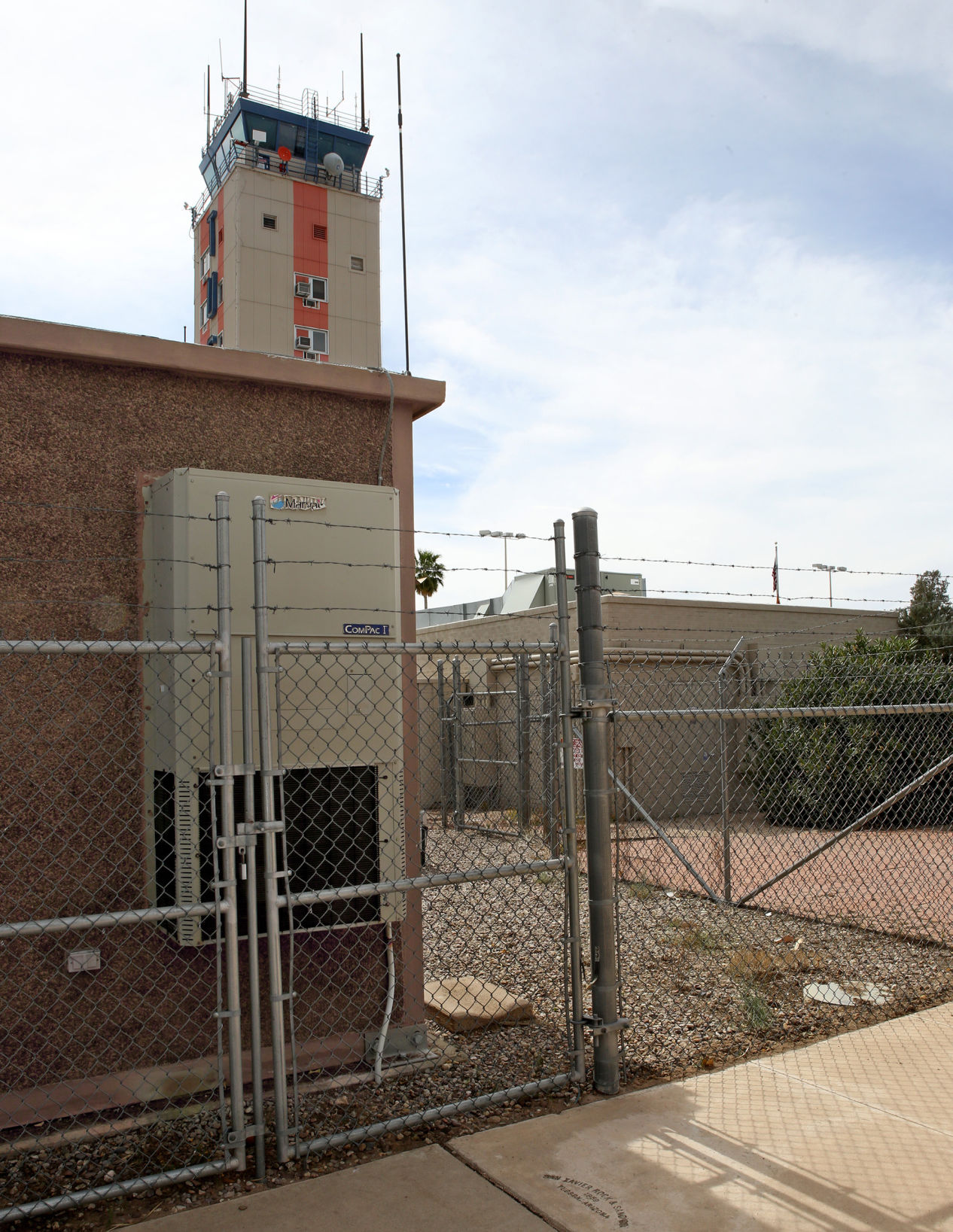
The southwest end of the old RONtel building, at 2075 S Plumer Ave., once had a swimming pool that may have been filled in between 1987 and 1989 but it is long gone in Tucson on March 15, 2017. Part of a backup generator for the old executive tower is in its place.
Then and Now: Kinsley's Lake
Updated
A couple of cars stop on the side of the road at Kinsley's Lake along the Old Nogales Highway in Arivaca Junction in this undated photo. Rancher Otho Kinsley built the lake which is located across the road from the Cow Palace restaurant, a long-time landmark in the area.
Then and Now: Kinsley's Lake
Updated
Kinsley's Lake, or what remains of it, was part of the Otho Kinsley's Ranch in Arivaca Junction, Ariz., south of Tucson on March 21, 2017. Kinsley dug out the area to make the lake across the Old Nogales Highway from the Cow Palace restaurant.
Then and Now: Kinsley's Lake
Updated
A man walks along the bottom of the remains of Kingsley’s Lake in Arivaca Junction in this undated photo. Across the Old Nogales Highway is the Cow Palace restaurant, a long-time landmark.
Then and Now: Kinsley's Lake
Updated
Kinsley's Lake, or what remains of it, was part of the Otho Kinsley's Ranch in Arivaca Junction, Ariz., south of Tucson on March 21, 2017. Kinsley dug out the area to make the lake across the Old Nogales Highway from the Cow Palace restaurant.
Then and Now: Main Gate
Updated
The Anderson Chevron gas station at 745 N. Park Ave. was located near the University of Arizona main gate at Third Street on June 25, 1971.
Then and Now: Main Gate
Updated
North Park Avenue, near the University of Arizona Main Gate, features a US Marine recruiting center, a Jimmy Johns, several other assorted restaurants, boutiques and an occasional passing street car in Tucson on March 15, 2017.
Then and Now: Halfway Station
Updated
The old Halfway Station just south of Elephant Head Road, around 27900 S Old Nogales Highway, as it was on October 1, 1980. It has long been considered to be the half way point between Tucson and Nogales.
Then and Now: Halfway Station
Updated
The old Halfway Station, given that name because of its location in Amado, Ariz., has seen better days but still stands on March 21, 2017. The old station, as well as the area near Arivaca Junction, got its name from its location along the Old Nogales Highway, halfway between Tucson and Nogales.
Then and Now: Peña Blanca Lake
Updated
Boats are lined up along the bank of the boat landing at Pena Blanca Lake in March 1959. Winter rains and snow pack filled the lake behind the dam. The lake was created for recreational purposes by stocking it with fish and allowing rowboats, canoes and sailboats on the water.
Then and Now: Peña Blanca Lake
Updated
The boat ramp at Peña Blanca Lake, which was created in 1957 by the state game and fish department, makes it easier for boats to enter and exit the lake. It is located northwest of Nogales, Ariz., on March 21, 2017. Mercury contamination, possibly from the old mines in the area, necessitated its closure and dredging in the past. It has been reopened and is stocked with Rainbow Trout but it also has Channel Catfish and Largemouth Bass.
Then and Now: Peña Blanca Lake
Updated
A little girl gets her photgraph taken along the edge of Peña Blanca Lake near Nogales, Ariz., around March 21, 1958. Winter rains and snow pack has started to allow the lake to fill behind the dam. The lake is expected to be used for recreational purposes by stocking it with fish and allowing rowboats, canoes and sailboats on the water.
Then and Now: Peña Blanca Lake
Updated
Oak and mesqute have increased in size along the banks of Peña Blanca Lake, which was created in 1957 by the state game and fish department. It is located northwest of Nogales, Ariz., on March 21, 2017. Mercury contamination, possibly from the old mines in the area, necessitated its closure and dredging in the past. It has been reopened and is stocked with Rainbow Trout but it also has Channel Catfish and Largemouth Bass.
Then and Now: Peña Blanca Lake
Updated
The boat ramp at Peña Blanca Lake, which was created in 1957 by the state game and fish department, makes it easier for boats to enter and exit the lake. It is located northwest of Nogales, Ariz., on March 21, 2017. Mercury contamination, possibly from the old mines in the area, necessitated its closure and dredging in the past. It has been reopened and is stocked with Rainbow Trout but it also has Channel Catfish and Largemouth Bass.
Then and Now: Peña Blanca Lake
Updated
Support facilities, such as a motel and restaurant were built at Pena Blanca Lake in March 1959. Winter rains and snow pack filled the lake behind the dam. The lake was created for recreational purposes by stocking it with fish and allowing rowboats, canoes and sailboats on the water.
Then and Now: Peña Blanca Lake
Updated
Boats are tied up along the dock at the boat landing at Pena Blanca Lake in March 1959. Winter rains and snow pack filled the lake behind the dam. The lake was created for recreational purposes by stocking it with fish and allowing rowboats, canoes and sailboats on the water.
Then and Now: Peña Blanca Lake
Updated
The parking lot at Peña Blanca Lake allows for vehicles to park above the boat ramp and lake. It is located northwest of Nogales, Ariz., on March 21, 2017. Mercury contamination, possibly from the old mines in the area, necessitated its closure and dredging in the past. It has been reopened and is stocked with Rainbow Trout but it also has Channel Catfish and Largemouth Bass.
Then and Now: Pioneer National Title Insurance Building
Updated
The Pioneer National Title Insurance Building, on 45 W Pennington at North Church Ave, was renamed from the Tucson Title Company on Mar 1, 1971.
Then and Now: Pioneer National Title Insurance Building
Updated
The southwest corner of the park, near the Joel D Valdez Main Library, is adjacent to the Old Pima County Courthouse at West Pennington Street and North Church Avenue in Tucson on March 15, 2017.
Then and Now: Pirate's Den
Updated
Still under construction on July 9, 1971, the new Pirate’s Den, at 6475 E Golf Links Rd., is starting to take shape. At one time the popular nightclub became a venue for entertainers such as Chubby Checkers, Fabian and the Platters.
Then and Now: Pirate's Den
Updated
The Raiders Reef Show Club is now an adult entertainment club, at 6475 E Golf Links Rd., in Tucson on March 15, 2017.

