


PHOENIX — Arizona’s Independent Redistricting Commission appears ready to redraw proposed congressional maps to help keep more of Tucson together and to separate the largely non-Hispanic areas of Yuma from the rest of that city.
The result is likely to increase the ability of Hispanic voters to elect Congress members of their choice in two districts.
But the trade-off, to be considered Thursday, could be to move a proposed congressional district that would run from midtown Tucson into southeast Arizona, an area currently represented by Democrat Ann Kirkpatrick, firmly into the Republican column.
The process is complicated. Each change in the lines of one district requires changes in other districts to keep populations equal. That led to discussions of moving Prescott out of Congressional District 2, a district with Native American tribes, into a district with Lake Havasu City and Kingman.
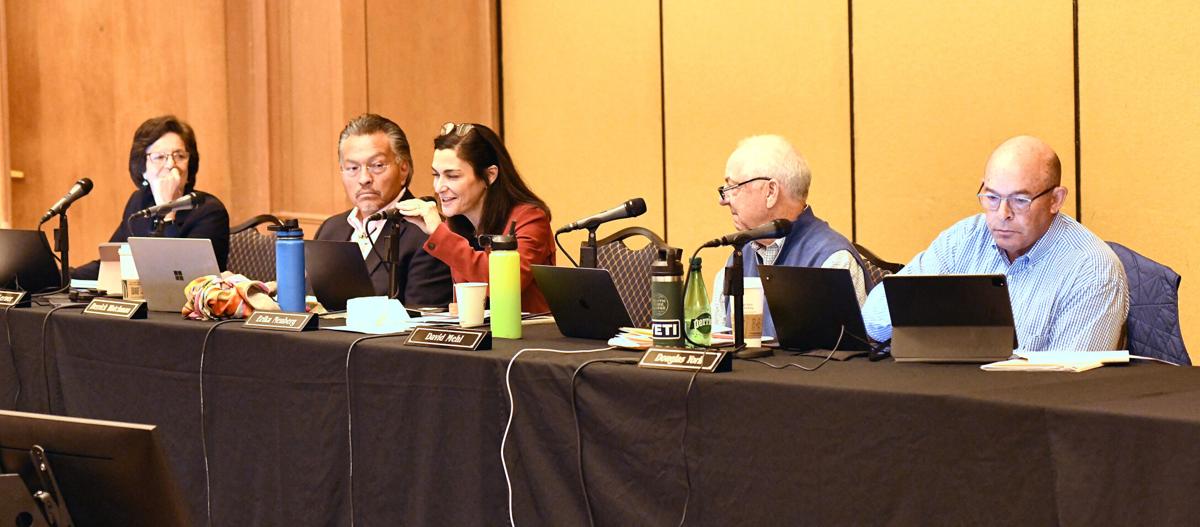
That, in turn, would have ripple effects to the point where Marana would find itself in CD2, a suggestion that did not sit well with Republican commissioner David Mehl of Tucson.
“If Marana ends up in District 2, I might not be able to go home,” he said at Monday’s commission meeting.
The panel will face conflicting choices between now and Dec. 22 — when it is supposed to adopt final maps — to comply with the various constitutional requirements for how districts must be drawn.
Commissioners are trying to figure out how to comply with the federal Voting Rights Act, which forbids dilution of minority voting strength. But that, in turn, works against creating as many competitive districts as possible.
That’s because, in general, Hispanics are more likely to vote Democratic. And packing more Hispanics into the same districts, by definition, leaves fewer Democrats to spread into other districts.
And there’s another reality that’s becoming obvious.
Each tweak to the map to satisfy one concern or the other changes the number of people in each district. But the law requires congressional districts of virtually equal population of 794,611; there is a bit of wiggle room for legislative districts, which each are supposed to have about 238,000 residents.
Map changes that add population in one area of a district require removing an equal number of people from another area in the district. The effects ripple into adjacent districts.
And the final maps are extremely important, because they will govern Arizona’s nine congressional districts and 30 legislative districts through the 2030 elections.
All that was borne out in the efforts to try to finalize CD7 in southwest Arizona.
Yuma Mayor Douglas Nicholls and the Arizona Latino Coalition for Fair Redistricting want the lines to concentrate the Hispanic sections of Yuma into that district. That would move about 19,000 people living in the more Anglo and Republican areas of the city into CD9, a district that stretches up the Colorado River to Lake Mead and east into the western Phoenix suburbs of Avondale and Tolleson.
That, then, would require adding more people into CD7.
In turn, that would help a bid by Tucson Mayor Regina Romero to have the eastern edge of the district stretch at least to Campbell Avenue as well as take in Hispanic areas south of Broadway in Tucson.
Right now, the draft map has the line along Sixth Avenue, effectively putting downtown Tucson into CD7 and the area around the University of Arizona into CD6.
But Mehl wants to go even farther, stretching it to Alvernon Way.
That also could mean putting Green Valley and Sahuarita, currently in the comfortably Democratic CD7, into the more Republican CD6.
Mehl also wants to move the area around Davis-Monthan Air Force Base into CD6, saying it makes more sense to have it in the same district as Fort Huachuca.
At the same time, commissioners face the question of whether Avondale and Tolleson really belong in CD9 or should be put into CD3, the other largely Hispanic congressional district that includes Glendale and much of downtown Phoenix.
Conversely, the commissioners also were having second thoughts about the draft plan they approved in October, which also put much of largely Anglo Peoria into CD3.
There’s an entirely separate issue involved in creating a district that provides a somewhat more favorable congressional district for Native Americans.
The problem becomes the 794,611 population goal, with nowhere near that many people living on reservations in Northern and Eastern Arizona. So the draft plan for CD2 adopted in October includes not just several reservations, running all the way from the Navajo Nation through the Gila River Indian Community, but also Prescott, Flagstaff and part of Florence.
Erika Neuberg, the nonpartisan chair of the panel, said she’s sympathetic with the goals, and the fact that prior maps have sought to help concentrate Native American populations.
But, she said, “we have to redistrict based on our population today. Minority communities do deserve recognition, and I want to focus and empower them as much as possible.”
The numbers don’t justify it, however, Neuberg said, as Native Americans make up just 22% of the district.
Shereen Lerner, one of the Democrats on the panel, said there’s a way of fixing at least part of that.
She said the current lines make CD9 — the Colorado River district — really a Maricopa County district. In fact, two-thirds of its population would be in Maricopa County, effectively ending any chance that the river communities would be able to elect someone of their choice.
Mehl, however, said there’s no way to fix that, with insufficient population in the river communities to justify being a majority in any district.
That’s true, said Lerner. But she said a better alternative would be to move the Prescott area from CD2 — the one with the reservations — into CD9.
Only thing is, the ripple effects would then leave CD2 short of population. That led to a commission consultant commenting that the difference could be made up by moving Marana, on the northern edge of Pima County, into CD2, the option that did not sit well with Mehl.

