Tucson is asking the Arizona Supreme Court to void a 2018 state law that tries to force the city to scrap its odd-year election schedule.
The measure approved by the Republican-controlled Legislature fails to recognize that Tucson voters adopted a charter as they are allowed to do under the Arizona Constitution, an attorney for the city said in new court filings.
That puts matters of “strictly local concern” like how to run elections out of reach of state lawmakers, said the attorney, Jean-Jacques Cabou.
He also dismissed state officials’ claim that they have a legitimate interest in promoting increased voter turnout.
Hanging in the balance most immediately is whether Tucson’s scheduled 2021 election for council members in three of its six wards goes off as scheduled.
But the justices’ ultimate ruling also will determine how much latitude the state’s 19 charter cities have in deciding how and when to choose their leaders without legislative intervention.
The justices are scheduled to consider the issue in December.
Republican lawmakers have been trying for years to force cities to conform their election dates to the state schedule.
The first effort, a 2012 law, was struck down by the state Court of Appeals as the judges said charter cities have a constitutional right to decide issues of local concern. Other proposals also failed to pass legal muster.
In 2018, legislators tried an end run, declaring it is “a matter of statewide concern” to consolidate election dates. That law contained a trigger, saying charter cities could keep their own schedule only if turnout at local elections did not fall more than 25% below the local turnout in the most recent statewide races.
Tucson did not meet the test, with its 2019 election turnout at 39.3% versus 67% of Tucson voters who cast ballots in 2018. But city leaders chose to ignore the law and scheduled the next election for 2021.
Find more Barrio Viejo homes at tucson.com/barrioviejo (Video by Gloria Knott, Arizona Daily Star)
Republican Attorney General Mark Brnovich said the city was acting illegally and asked the Supreme Court to intercede.
In the new legal filings, Cabou told the justices this new version is no more legal than prior efforts.
“Our state is among a very few in which the powers of charter cities stem not from acts of the legislature, but instead from the same constitution that created the legislature itself,” Cabou wrote.
He said that courts, in prior legal fights between Tucson and Brnovich, ruled charter cities have autonomy in structuring their own governments, including “the method and manner of conducting elections in the city.”
The 2018 law didn’t change any of that, even with the triggers about voter turnout, Cabou said.
“The legislature impermissibly seeks to substitute its policy choices for those of the city,” he wrote.
He pointed out that the Tucson City Council put a measure on the November 2018 ballot asking city voters if they wanted to go to even-year elections. The measure was defeated with 42.2% in favor and 57.8% opposed.
Cabou does not dispute the lower turnout in the most recent city election, but he called it irrelevant. “The state simply lacks an interest in the turnout for elections in charter cities,” he said.
There are good reasons for having separate local elections, he told the justices.
“Removing all other county, state and federal elections from the ballot thus allows the city to obtain the full focus of the electorate and insulate its electoral processes from the influence of partisan issues that are inevitably interwoven with federal, state, and county elections,” he said. “With this full focus, the local community and electorate are more informed on the local matters coming up for a vote at the city’s election.”
If Tucson elected its council members at the same time as federal and state candidates, they would all end up at or near the bottom of the long ballot, he said.
Cabou also pointed out the Arizona Constitution bars enactment of special laws regarding the conduct of elections.
What is legal, Cabou said, are laws that can be applied not only to all situations but that also are “elastic.” That means any city that finds itself subject to the law has a way of extracting itself by changing policies or anything else so it no longer meets the conditions.
Here, however, Cabou noted that the law is permanent: Once a city’s turnout drops below a trigger point, the city can never get back its local election dates, even if future turnout improves.
Finally, Cabou said implementing the law would mean the mayor and some people now serving on the council would have their terms extended to five years as part of the transition to an even-year cycle, overruling the decision of voters to put them in office for just four years.
Photos: Take a virtual tour of these Barrio Viejo homes in Tucson
Barrio Viejo virtual home tour
Updated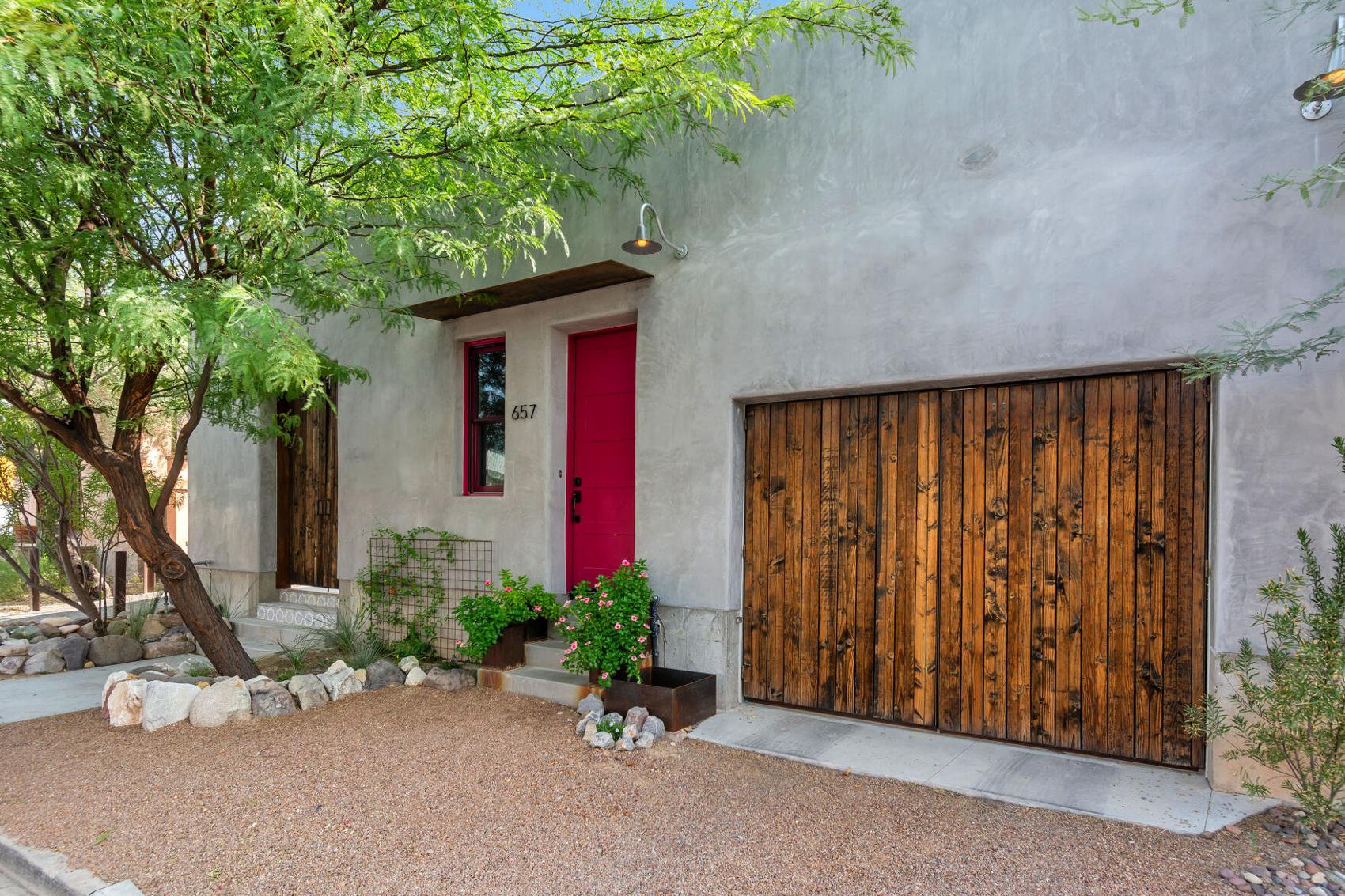
Welcome to the Barrio Viejo virtual home tour, benefitting the neighborhood’s Lalo Guerrero elder apartments. More about that later, but let’s get started with the tour, which features homes built from the 1880s right up until last year.
Barrio Viejo virtual home tour
Updated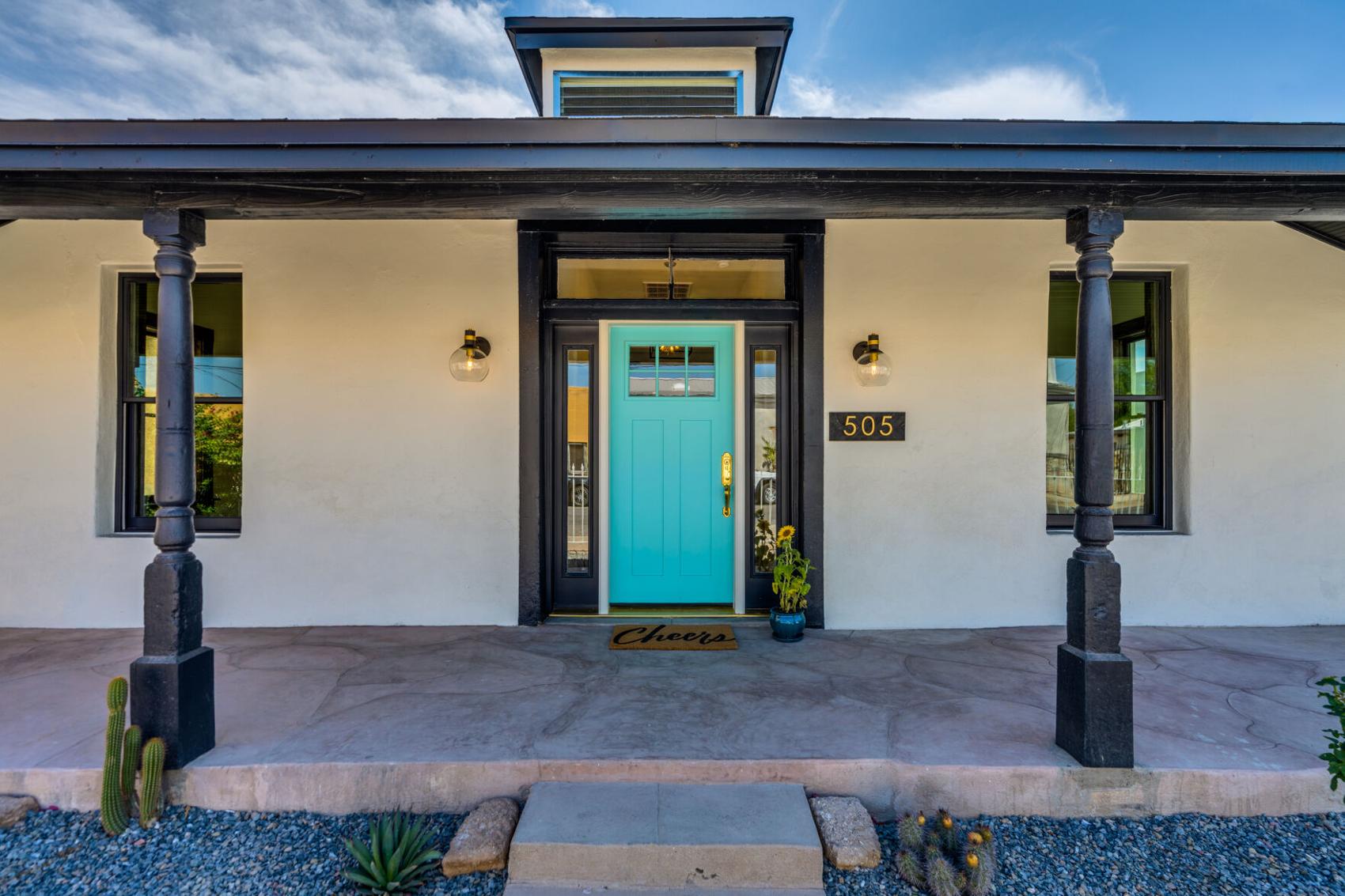
This recently restored 1911 adobe on South Meyer Avenue was the childhood home of Eduardo “Lalo” Guerrero, the father of Chicano music. He lived most of his adult life in Los Angeles, but a barrio complex of apartments for seniors was named in his honor in 2003. This Barrio Viejo virtual home tour benefits the neighborhood’s Lalo Guerrero elder apartments. Find the fundraiser here.
Barrio Viejo virtual home tour
Updated
Owners Amanda and Luke Kippert replaced the home’s roof and electrical system, installed air conditioning and made other major improvements in an Art Deco style. Danny Quihuis of Quihuis Architecture Co. helped with the project.
Barrio Viejo virtual home tour
Updated
Guerrero, in the two photos on the left, was born Christmas Eve 1916. He learned to play the guitar when he was nine and by 17 wrote and performed what would become one of his most famous songs, “Canción Mexicana.” The 1936 musician comedy “The Gay Desperado” was filmed on South Meyer Avenue in a part of the barrio later torn down for construction of the Convention Center.
Barrio Viejo virtual home tour
Updated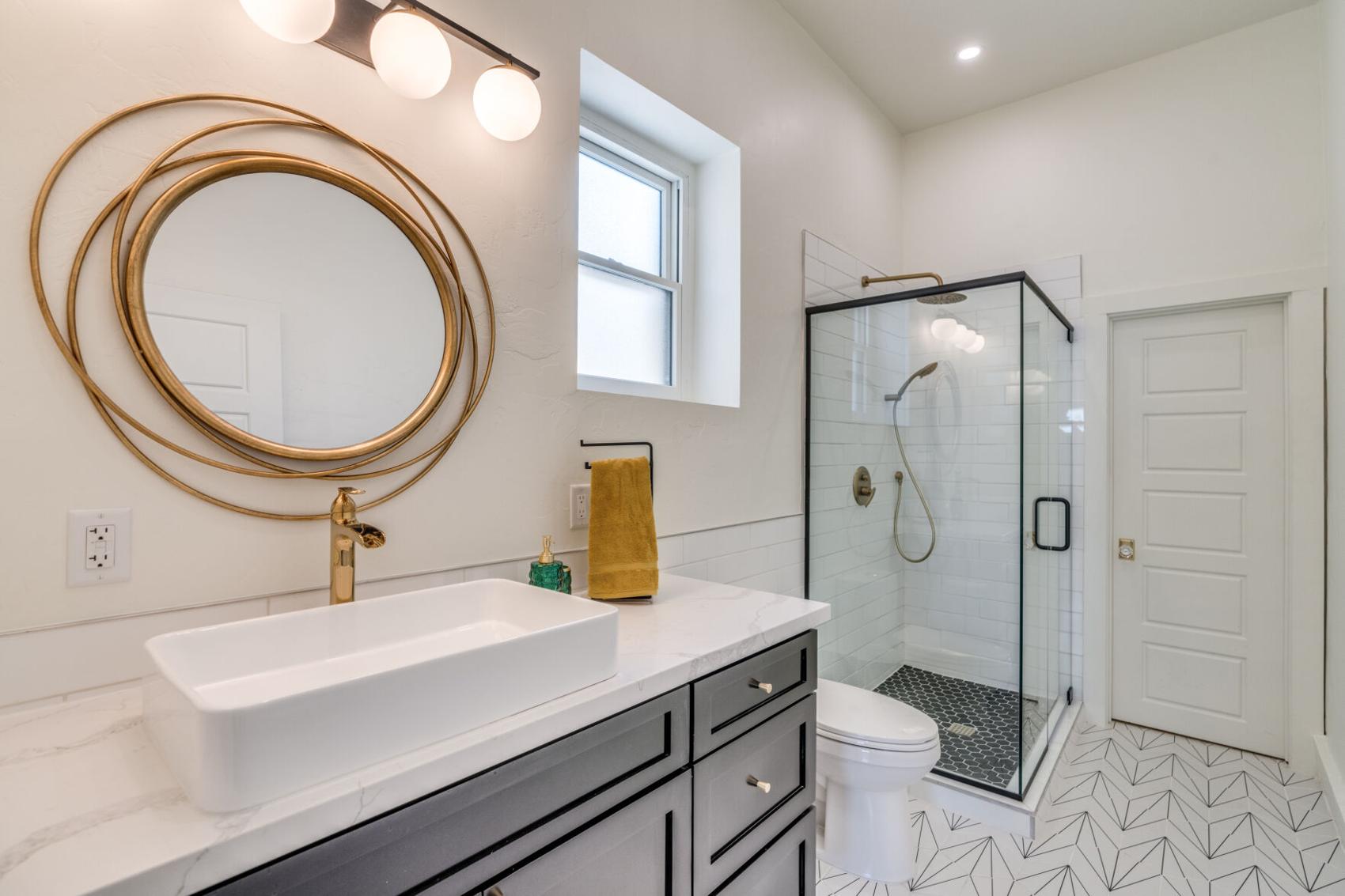
Pops of gold throughout the house give it glamour.
Barrio Viejo virtual home tour
Updated
Notice the fancy gold feet on the old bathtub?
Barrio Viejo virtual home tour
Updated
The pièce de résistance of the Lalo house is the patio mural by Sal Sawaki of Wagon Burner Arts.
Barrio Viejo virtual home tour
Updated
“Hot Pink Neighbor” by Ron Kenyon. He is a member of the Tucson Barrio Painters, a group of “plein air” painters who have long appreciated the architecture of the city’s barrios. Three years ago, as they noticed accelerating changes, they decided to make a more organized effort to capture the barrios on canvas.
Barrio Viejo virtual home tour
Updated
This house, built in the 1880s, had become a near-ruin by the time it was restored over three years in the early 1980s. Walls had to be rebuilt, and the original dirt, clay and manure roof removed. The cabinets were salvaged from the long-gone Damsky Cigars shop on East Congress Street.
Barrio Viejo virtual home tour
Updated
Many old barrio homes are built on the lot lines, leaving no front or side yards. But shady back patios are common.
Barrio Viejo virtual home tour
Updated
Notice the thickness of the adobes that case the windows. The ceilings are saguaro ribs.
Barrio Viejo virtual home tour
Updated
“Four doors” by Denyse Fenelon. “Barrio communities should be nurtured and appreciated for the architecture, lives and stories that have happened here. It’s hard to save what you can’t see so we’re attempting to preserve, in our way, the story of Tucson,” writes Fenelon, organizer of the Tucson Barrio Painters.
Barrio Viejo virtual home tour
Updated
Several dozen homes have been built in the barrio in the past 15 years, either on lots where houses had been demolished years before or on land that had always been vacant. This house was built in 2017 by a couple that already had family connections to the barrio.
Barrio Viejo virtual home tour
Updated
The living room and kitchen are part of an open-concept area designed for family gatherings.
Barrio Viejo virtual home tour
Updated
The kitchen takes advantage of the home’s high ceilings. That’s another nod to the design of many of the barrio’s oldest buildings.
Barrio Viejo virtual home tour
Updated
Luis H. Ibarra of Saavy Inc. was the general contractor.
Barrio Viejo virtual home tour
Updated
A Tucson-made patio bench gives the home a sense of place. “Be Kind” is the motto of the beloved Ben’s Bells project.
Barrio Viejo virtual home tour
Updated
From the street, the home hews to a traditional Sonoran style. It is built on the lot lines and has a flat roof. But the patio shows that is a modern structure.
Barrio Viejo virtual home tour
Updated
Watch now: Peek inside this Barrio Viejo home near downtown Tucson
UpdatedFind more Barrio Viejo homes at tucson.com/barrioviejo (Video by Gloria Knott, Arizona Daily Star)
Barrio Viejo virtual home tour
Updated
Barbara Mulleneaux recently painted this long-vacant building at West Kennedy Street and South Meyer Avenue.
Barrio Viejo virtual home tour
Updated
This pre-1888 front room opens to the kitchen and dining area, then a laundry with an adjacent bathroom, and finally the rear bedroom and a doorway to the central courtyard. Years ago this type of design was referred to as a shotgun because the rooms line up like the long barrel of a shotgun. Brick floors have replaced the original wood floors, but the variegated light & dark gypsum interior plaster is a longtime Old Pueblo tradition.
Barrio Viejo virtual home tour
Updated
This chandelier highlights the rough-sawn fir joists and old-growth planks a full 2 inches thick. Ceilings nearly 12 feet high kept hot air high in the summers when many Tucsonans slept outdoors on canvas cots or improvised hammocks.
Barrio Viejo virtual home tour
Updated
Till the 1990s this adobe room had two feet of dirt above its fir joists and packing crate planks. That was its original roof. One of the planks still visible today is addressed to "Geo. Martin", Arizona's second druggist.
Barrio Viejo virtual home tour
Updated
A clean, sleek bedroom for this old house.
Barrio Viejo virtual home tour
Updated
Large skylights with white domes provide soft, diffused light for this kitchen, which has no windows. The room originally opened to a long porch 7 feet in depth, but early 20th century additions closed off even that bit of light, so skylights were an adaptation.
Barrio Viejo virtual home tour
Updated
This iron fence recycles old gas and water pipe salvaged from a large complex of former apartments restored from 1998-2000. Some of the adobe walls had collapsed, and the property was condemned. Designer-builder David Carter's material costs for the fence totaled just under $19 for the caps on the posts. Welder Jim Fredd was the fabricator.
Barrio Viejo virtual home tour
Updated
José Trujillo built this market in the western part of the barrio in the 1920s. It eventually became apartments -- including home to motorcycle riding tenants who changed oil in the living room -- an addiction-counseling center, a bed-and-breakfast and a home. This painting is by Dina Jasensky.
Barrio Viejo virtual home tour
Updated
Joyce Nelson painted “Las 4 Esquinas,” one of the most iconic buildings in the barrio. Grocers or general shops were at three of the four corners at West Simpson Street and South Convent Avenue as far back as 1888. It isn’t clear when the building was first called Las 4 Esquinas, but it carried that name by 1917 at the latest. It was operated by Don Wah and his wife, Fok Yut Ngan, both Chinese immigrants.
Barrio Viejo virtual home tour
Updated
This 900-square-foot adobe was built before 1920. This is how it looked until about two years ago.
Barrio Viejo virtual home tour
Updated
The new owners who restored the house say they were inspired by homes in San Miguel de Allende, Mexico.
Barrio Viejo virtual home tour
Updated
Many interior items, such as lights and this sofa, were second-hand finds.
Barrio Viejo virtual home tour
Updated
A kitchen right out of Mexico.
Barrio Viejo virtual home tour
Updated
The homeowners’ next project is to build a new sister structure on the same property. Follow their work on Instagram at weboughtanadobe.
Barrio Viejo virtual home tour
Updated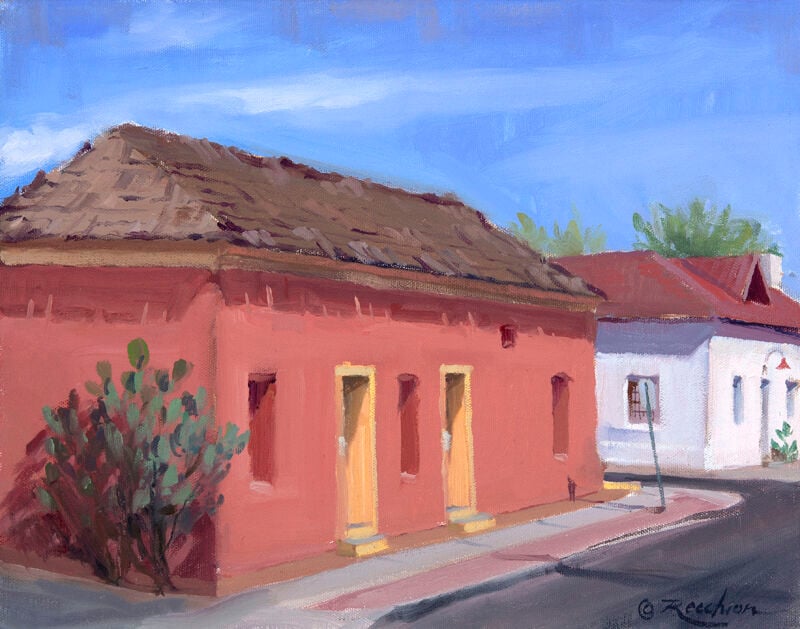
Russell Recchion painted this building at Convent and Simpson.
Barrio Viejo virtual home tour
Updated
The vigas (wood beams) in this house were salvaged from trees burned in the 2002 Mount Lemmon fire. The home was built 10 years ago. The painting shows Miguel Hidalgo y Costilla, the father of Mexican independence. It was salvaged nearly 40 years ago from the Los Reales landfill.
Barrio Viejo virtual home tour
Updated
Niches are common elements in older Mexican homes.
Barrio Viejo virtual home tour
Updated
The homeowners were walking in Guadalajara, Mexico, when they spotted workers installing a new roll-up garage door. The old iron gates were piled next to the street as trash. Shipped to Nogales by rail, they are now part of the back patio.
Barrio Viejo virtual home tour
Updated
This brick barrel vault was erected in three weeks without any formwork or other support. Every brick was set in place over thin air. Not till each row received its last brick was that row an arch -- a substantial structure.
Barrio Viejo virtual home tour
Updated
Norm Sherwood painted the long-unused Teatro Carmen at 348 S. Meyer. It was built in 1915 by Carmen Soto Vásquez and was an elegant theater seating up to 1,400. Performers came from as far as Mexico City to appear in plays and operas. By about 1920 it became a movie theater and also hosted dances and boxing matches. It later became a garage and then the Black Elks Lodge.
Barrio Viejo virtual home tour
Updated
This home was designed by Sonya Sotinsky of FORS architecture + interiors as envisioned by its owners and built in 2015 on a vacant lot by Jamie Olding of Building Excellence, LLC.
Barrio Viejo virtual home tour
Updated
Mike Runde of The Runde Company built the Rumford fireplace, which is tall and shallow to reflect more heat. Homeowner Joe Patterson started the painting on the right, of John Street in Hartford, Conn., in about 1987. It was not quite finished, but his spouse, Kathleen McNaboe, framed it anyway. After they moved to the barrio, Joe removed the frame and completed his piece.
Barrio Viejo virtual home tour
Updated
Mike Tanzillo of Tanzillo and Son built cabinets and millwork work the house, which has a modern interior with steel counters and polished concrete floors.
Barrio Viejo virtual home tour
Updated
The kitchen is part of the light-filled great room.
Barrio Viejo virtual home tour
Updated
The office looks into a courtyard with a variety of fruiting trees.
Barrio Viejo virtual home tour
Updated
High ceilings help make the bedroom spacious
Barrio Viejo virtual home tour
Updated
This bathroom is tucked behind the bedroom.
Barrio Viejo virtual home tour
Updated
David Rojo of Rojo Construction LLC built the home’s metal planter boxes. The outdoor tile art is by Carly Quinn of Carly Quinn Designs.
Barrio Viejo virtual home tour
Updated
The home’s exterior celebrates the rich history of the barrio with hard troweled hand plaster and wood gates and shutters.
Barrio Viejo virtual home tour
Updated
“Two Minutes to 5 Points,” by Terri Gay refers to the five-way intersection of 18th Street and Stone and Sixth avenues.
Barrio Viejo virtual home tour
Updated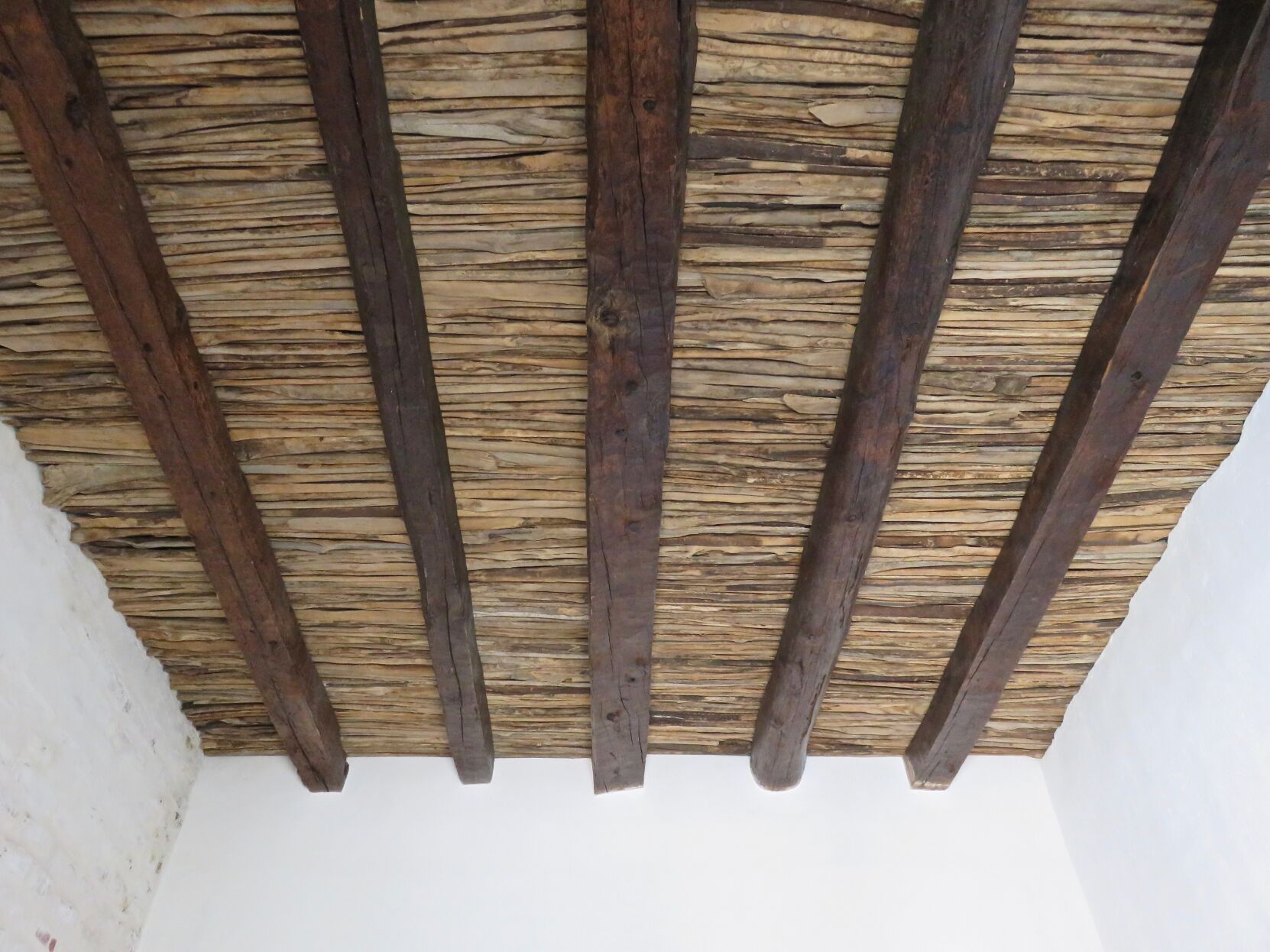
Back in 2014, the Star’s Tom Beal chose saguaro ribs as one of 100 objects that define Tucson. Here’s how he explained it: “Saguaro ribs were functional in early Tucson, where wood and metal were hard to come by before the railroad arrived in 1880. The ribs of the saguaro cactus, with an insulating layer of grass and native dirt piled atop them, served to fill in the spaces between roof beams hauled from nearby mountains. In Spanish, the beams are called “vigas” and the lateral pieces “latillas.” The ceilings of sleeping rooms were often covered with a sheet of muslin to keep the dirt from falling into your mouth as you snored away at night. You’ve no doubt seen the durable ribs on dead saguaros after the flesh falls away.” Ribs are still found in many of the barrio’s oldest homes.
Barrio Viejo virtual home tour
Updated
Integral color was mixed with gypsum and perlite to create this variegated plaster.
Barrio Viejo virtual home tour
Updated
Barrio painter Peter Farrow’s take on Las 4 Esquinas.
Barrio Viejo virtual home tour
Updated
This is one of four homes developed by Warren Michaels on the site of what had been a bakery. Rob Paulus was the architect and Dave Taggett the builder. The walls are Mikey Block, a lightweight but strong material with high thermal value.
Barrio Viejo virtual home tour
Updated
The “Tucson” letters are from the old Greyhound bus station. The homeowners, Laura Walton and Dave Hamra, found them at Gather, A Vintage Market.
Barrio Viejo virtual home tour
Updated
La Fortuna, the original bakery on this South Meyer Avenue site, was started by the Figueroa family in the 1920s.
Barrio Viejo virtual home tour
Updated
Artist Poe Dismuke of SamPoe Gallery in Bisbee created the high-flying cicada.
Barrio Viejo virtual home tour
Updated
The patio is designed after traditional barrio gardens with pomegranate and figs trees, and a ramada of mesquite and ocotillo supporting gravevines. It also includes a modern water-harvesting system.
Barrio Viejo virtual home tour
Updated
Johanna Martinez honors the property’s history with the La Fortuna mural.
Barrio Viejo virtual home tour
Updated
“Simply Green” by Barbara Mulleneaux. The home is on South Meyer Avenue.
Barrio Viejo virtual home tour
Updated
This is one of nine condos in a complex built in the 1880s as a livery and bunkhouse for the Palace Hotel, which was seven blocks north in the heart of downtown. In those days, when visitors came to town on horses, it wouldn’t do to keep animals right next to a nice hotel.
Barrio Viejo virtual home tour
Updated
The complex’s fireplaces weren’t built to today’s code standards, so they are decorative rather than functional.
Barrio Viejo virtual home tour
Updated
Designer Linda Robinson, winner of the Master of the Southwest award from Phoenix Home & Garden, advised the homeowner on the interiors.
Barrio Viejo virtual home tour
Updated
Many of the furnishings and lights are from Adobe House Antiques and Arte de la Vida. The home’s custom window hardware is by Perry Luxe.
Barrio Viejo virtual home tour
Updated
Picture-rail moulding along the walls means there’s no need to drill into the plastered adobe to hang art.
Barrio Viejo virtual home tour
Updated
Terri Gay painted this vacant house at West Cushing Street and El Paso. Most members of the Tucson Barrio Painters have social media accounts or web sites. Search individual names for more information about their art.
Barrio Viejo virtual home tour
Updated
The Lalo Guerrero apartments at West 18th Street and South Convent Avenue are on the site of the original Samuel Drachman Elementary School. It was built in 1901 as a four-room school but expanded over the years. Fire destroyed 80 percent of it in 1948. It was rebuilt but had fallen into disrepair by 1997 when a new school was constructed three blocks south.
Barrio Viejo virtual home tour
Updated
All but the central facade of the school was demolished just before its 100th anniversary. Federal and state grants and loans paid for construction of the 62 apartments now on the site. Pio Decimo and Barrio Viejo Elderly Housing Inc, non-profit corporations, operate the apartments on behalf of their residents.
Barrio Viejo virtual home tour
Updated
Eduardo “Lalo” Guerrero attended Drachman in the 1920s and also the dedication of the apartments in 2003. World famous as a singer, songwriter and guitarist, he died in 2005.
Barrio Viejo virtual home tour
Updated