


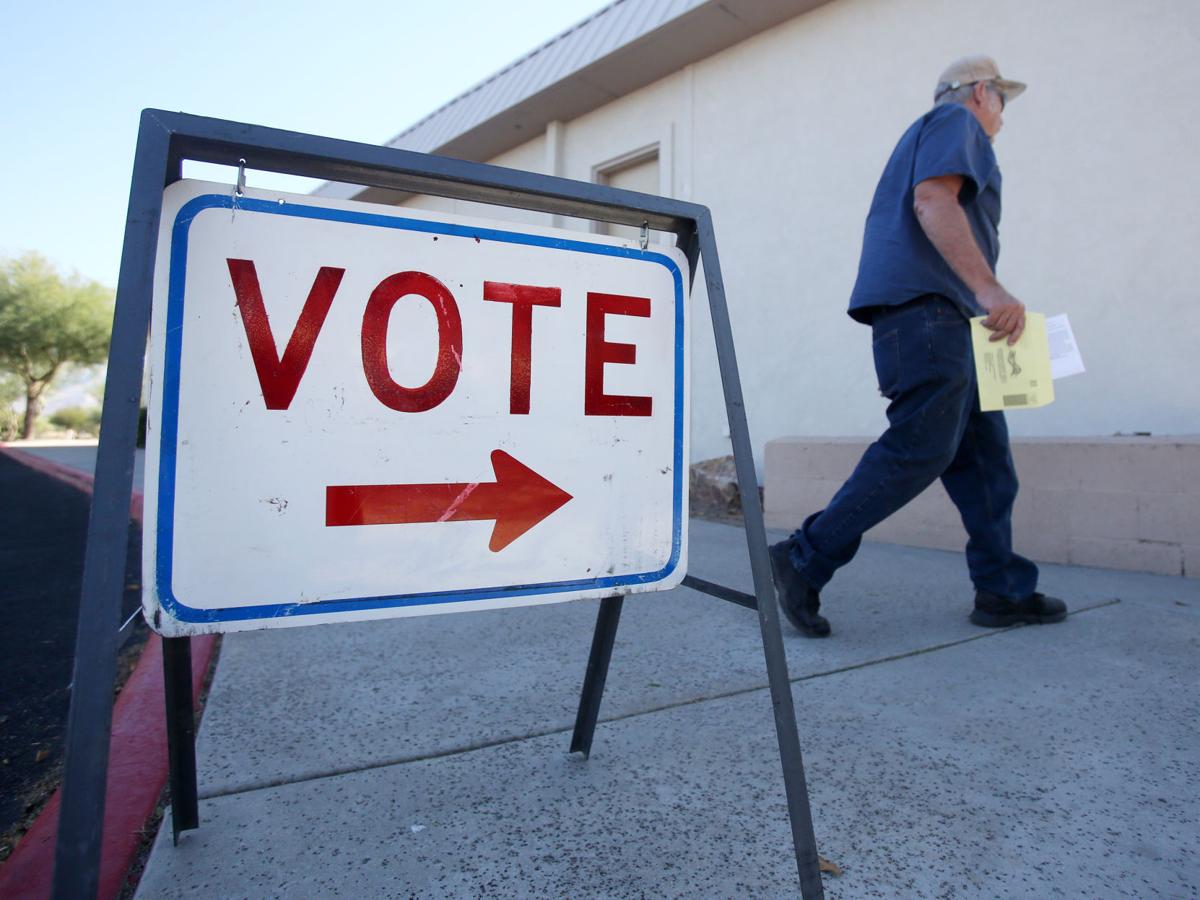
PHOENIX — Cities that maintain their own election dates despite lower turnout are violating state law, Attorney General Mark Brnovich has concluded.
And now his office plans to sue Tucson at the state Supreme Court to force it to repeal its odd-year election ordinance.
The Arizona Constitution gives the state’s 19 charter cities the right to regulate matters of “purely local concern,” Linley Wilson, the state’s deputy solicitor general, acknowledged in a 20-page analysis Friday.
Wilson, who works for Brnovich, noted that the state’s high court has, in fact, overruled prior efforts to force Tucson to conform its election schedule to even-numbered years.
Wildfires such as the Bighorn Fire north of Tucson leave the ground charred and unable to absorb water, which can increase flood risks. “Even a light rain can produce devastating flash floods and mudflows, often with little warning,” Pima County officials warned. In this July 2020 video, a debris flow oozes down the Cañada del Oro Wash.
But Wilson pointed out the latest bid by the Republican-controlled state Legislature to rein in Tucson and other charter cities says that increasing voter turnout through consolidated elections “is a matter of statewide concern.”
And based on that, she said the Attorney General’s Office has concluded this new version of the state law is constitutional and enforceable.
Wilson also said lawmakers had another legitimate reason to step in. He said there is evidence that low-turnout elections tend to favor special interests.
But she conceded this conclusion isn’t a slam-dunk. In fact, she said, based on prior state Supreme Court rulings on local elections, “it is not unreasonable for the city to argue, relying on (those rulings), that the ordinance governs a matter of purely local concern and therefore supersedes state law.”
So rather than demand that Tucson rescind the ordinance or face the loss of more than $100 million in state aid, Brnovich’s office will file suit to ask the Supreme Court to decide, once again, how much leeway charter cities have in setting their election dates.
“This is another attempt by our state Legislature to micromanage and undermine our ability to self-govern as a city,” said Tucson Mayor Regina Romero. “Our city elections are a matter of local concern, which has been reaffirmed by Tucson voters on several occasions.”
The issue of maintaining off-year elections was put to voters in November 2018. City voters approved it by a margin of 58%-42%.
Tucson City Attorney Mike Rankin said the issue was likely to wind up before the Supreme Court eventually even if Brnovich were not doing his own inquiry.
Rankin pointed out that the city preemptively filed its own complaint last month asking a Pima County Superior Court judge to rule that Tucson, as a charter city, has the authority to set its own election dates. And whoever loses that case in trial court is likely to appeal.
State lawmakers have tried for years to exert their will on not just Tucson but all charter cities, including through a 2012 law requiring consolidated election dates. But in a legal fight with Tucson, the state Court of Appeals barred enforcement of that law, at least as it applied to charter cities, concluding they have a constitutional right to decide issues of local concern and lawmakers had no statewide interest in interceding.
That led to a 2018 revision of the state law. It sought to get around the earlier ruling by declaring “it is a matter of statewide concern to increase voter participation in elections, including elections for cities.” That law also had a trigger, forcing even-year elections if turnout at a local-only election was 25% less than the most recent statewide election.
Turnout in Tucson’s 2019 election was 39.3%, versus 67% of Tucson voters who had voted in 2018. But city officials ignored the law, setting the next election for 2021.
The decision to set a 2021 election led to a complaint to Brnovich by Sen. J.D. Mesnard, R-Chandler, asking him to rule that Tucson had overstepped its bounds and should be forced to repeal its election-date ordinance or forfeit state aid.
Wilson said Mesnard is correct.
“Election dates are not a matter of purely local concern because they implicate the statewide interest in increasing voter turnout, among other interests,” she wrote. “The state has an interest in protecting the right to vote of its citizens by ensuring that cities encourage voter turnout through the alignment of election dates.”
Beyond that, Wilson argued that consolidated elections — and the higher turnout — are necessary “in safeguarding the integrity of elections.”
He cited a 2010 study published in the University of Chicago Law Review which addressed what the researchers called the higher “marginal cost to voters” of local-only elections.
“Consequently only those voters with the greatest stake in the electoral outcome turn out, a phenomenon we label ‘selective participation,’” the authors wrote. “When there is selective participation in a low turnout election, policy outcomes will be more favorable to special interests than they would be if the same government were elected in a high turnout election.”
Photos: Community Food Bank hosts Drive-up Farmer's Market
Santa Cruz River Drive-up Farmer's Market
Updated
Andreas Anderson, community foods coordinator, places an order in the trunk of a customer's car during the Santa Cruz River Drive-up Farmer's Market by the Community Food Bank of Southern Arizona near the Mercado District on July 16, 2020.
Santa Cruz River Drive-up Farmer's Market
Updated
Victor Ceballos, garden education coordinator, says he loves to chat with customers as they wait to place an order for produce during the Santa Cruz River Drive-up Farmer's Market by the Community Food Bank of Southern Arizona near the Mercado District on July 16, 2020.
Santa Cruz River Drive-up Farmer's Market
Updated
Rick Rosenberg plays "It's You I Like" by Mr. Rogers on his ukulele as he waits to place an order for produce during the Santa Cruz River Drive-up Farmer's Market by the Community Food Bank of Southern Arizona near the Mercado District on July 16, 2020.
Santa Cruz River Drive-up Farmer's Market
Updated
Andreas Anderson, community foods coordinator, hands a bag of produce through a customer's car window during the Santa Cruz River Drive-up Farmer's Market by the Community Food Bank of Southern Arizona near the Mercado District on July 16, 2020.
Santa Cruz River Drive-up Farmer's Market
Updated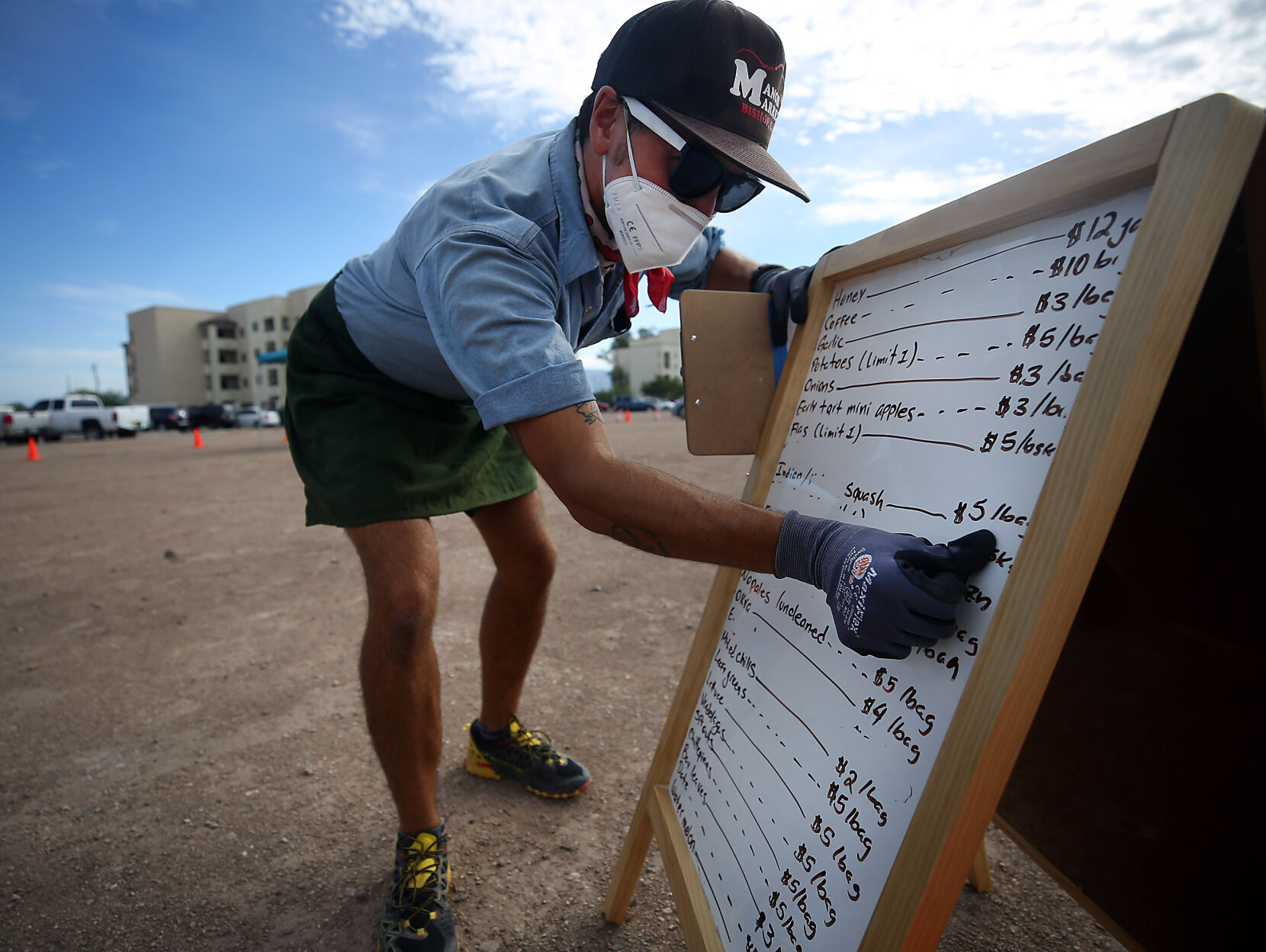
Andreas Anderson, community foods coordinator, erases tomatos from the white board after running out of them to sell during the Santa Cruz River Drive-up Farmer's Market by the Community Food Bank of Southern Arizona near the Mercado District on July 16, 2020.
Santa Cruz River Drive-up Farmer's Market
Updated
Andreas Anderson, right, community foods coordinator, takes an order from a customer during the Santa Cruz River Drive-up Farmer's Market by the Community Food Bank of Southern Arizona near the Mercado District on July 16, 2020.
Santa Cruz River Drive-up Farmer's Market
Updated
Cora Varas, a volunteer, double checks the order with a customer during the Santa Cruz River Drive-up Farmer's Market by the Community Food Bank of Southern Arizona near the Mercado District on July 16, 2020.
Santa Cruz River Drive-up Farmer's Market
Updated
Cora Varas, a volunteer, works on fulfilling a customer's order and then bringing it to their car during the Santa Cruz River Drive-up Farmer's Market by the Community Food Bank of Southern Arizona near the Mercado District on July 16, 2020.

