




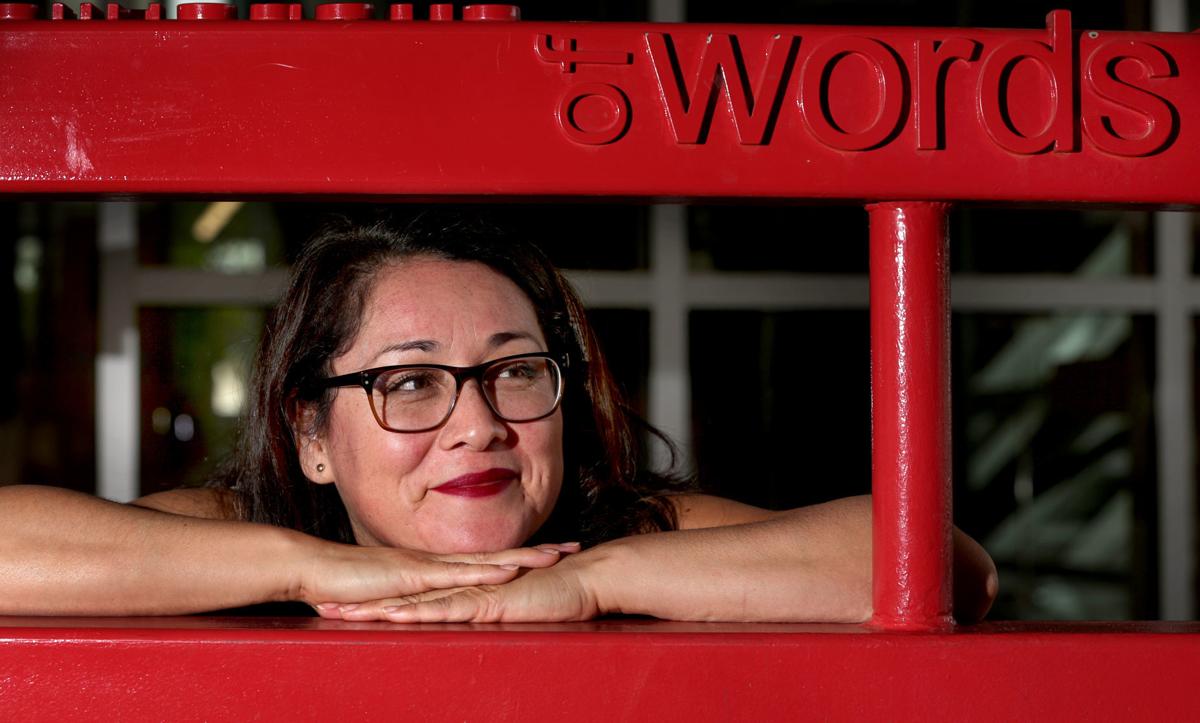
It shocked her at first, but the words from her professor did not deter Diana Delgado.
Delgado was nearing the end of her undergrad work in poetry studies at the University of California-Riverside when she talked to one of her professors about applying to the graduate writing program at Columbia University in New York City. He told her not to bother.
What he left unsaid was clear: Chicano/as need not apply. For people of color looking to move forward, these kinds of obstacles are not unfamiliar. It’s like a rite of passage.
His words, however, only reinforced her Chicana resolve. “I didn’t get angry,” she said. Delgado simply went on to prove the professor wrong and graduated from Columbia with a master’s of fine arts degree.
Today, Delgado is the new literary director at the University of Arizona Poetry Center, at the corner of North Vine Avenue and East Helen Street. She brings with her writing skills and gusto for words, her determination to connect her new community with the beauty of poetry, her experiences of growing up in Los Angeles and the seven years she studied, worked and lived in New York City.
“Tucson is a good fit,” said Delgado whom I visited in her Poetry Center office that remains virtually empty of books. She started her job less than a month ago.
“I haven’t had time to put up the books that are my reflection,” said Delgado.
“Reflection” is a word she used several times in our hour-long plática. Reflection for the 42-year-old Delgado also means inclusion and diversity. She looks for reflection in the books she reads, in the words she writes, in the world that she inhabits.
“This role,” she said in reference to her new position, “is reflective of my writing.”
As literary director, Delgado will have a hand in planning the center’s visiting writers series, creating mentoring programs for poets and for expanding the center’s community outreach programs. It’s a priority, she said.
The vibe she has felt since her arrival is promising, she said.
“I’ve never started a job where I’ve been so welcomed,” she said. “This job is so right.”
Delgado received the 2017 National Endowment for the Arts Literature Fellowship in Poetry and authored “Late Night Talks With Men I Think I Trust” in 2015. Her first full collection of poetry, “Tracing the Horse,” will be published next year.
The collection took her years to write. The poems reflect her working-class Mexican-American family growing up in La Puente, California, and the challenges and issues that many families like hers confront, she said.
And like other poets and writers, she fell in love with the power of words by accident.
She was enrolled at a junior college, wanting to study landscape architecture. A class she needed to take was unavailable so, on a fluke, she enrolled in a Mexican-American literature class. It was an instant, visceral connection, Delgado said.
Reading the works of writers like Helena Viramontes, Lorna Dee Cervantes and Gary Soto spoke to her directly.
“They reflected my experiences back to me the I had felt but was unable to articulate,” she said. She immersed herself in literature and poetry, discovering herself and her voice in the confusion at the intersection of two worlds (Chicano and Anglo) and two ends (U.S. and Mexico).
There is clarity now as Delgado delves into Tucson’s diverse community, with its writers and poets, and its mountains and monsoons.
“I like that I came at the most difficult time,” she said. She was referring to the heat. “I’m actually enjoying it.”
In addition to working at the poetry center, Delgado is looking forward to her next writing projects under the influence of the Sonoran Desert. She welcomes the colors and sensations that will come as she explores the desert valley, the barrios, the university community, our history. It is part of her continuing journey of self-discovery.
“What does it mean to be a Tucson writer?” she said.
She’s gonna find out.

