

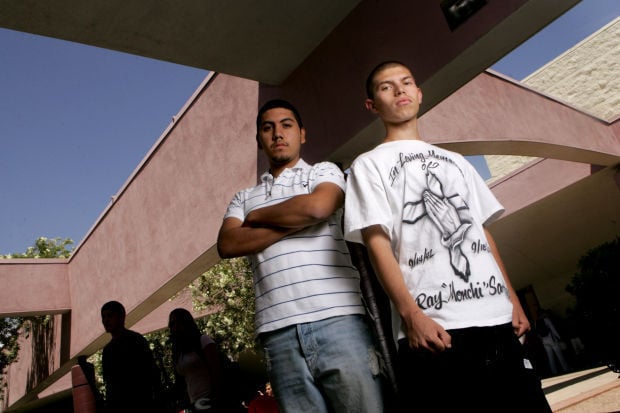


For 15 years, Southern Arizona high school students have studied, analyzed, and written a form of poetry unique to the borderlands.
They are poetic stories, often put to music. These ballads chronicle the lives of family members, and of important and everyday events. Sometimes they are about horses and heroes, or maybe a memory.
These corridos are entered each year in the High School Bilingual Corrido Contest sponsored by the University of Arizona Poetry Center.
Next spring, the one-of-a-kind contest will come to an end. But not the corridos.
The Poetry Center announced last week that it will create an online archive with 15 years worth of corridos, including videos, to be used by teachers and future corrido writers. The archives include a recording and book, “A Decade of Young Corridistas,” a collection of corrido lyrics and music from the first 10 years.
The center took a broad look at the project and its scope, and decided to retire it. The center will refocus on creating a “deeper and sustained” connection with students and teachers, said Tyler Meier, the center’s executive director.
“We had run the course with the corrido model,” he said.
I’m a big fan of corridos and the contest. I served as a judge several years ago and attended several of the award ceremonies. While I lament the end of the contest, knowing that the students’ works will be available is gratifying. The collection will be an invaluable source for future study and enjoyment.
Through this this art, the students can express themselves, document family history and connect themselves with a cultural form that has existed along the borderlands for more than a 100 years.
In our neck of the Sonoran Desert there are many corridos well known and still heard. Two stand out.
One is about a train engineer, Jesús García, who died while saving Nacozari, Sonora, from destruction when he drove the burning, dynamite-laden “maquina 501” out of town. The other is the “Moro de Cumpas,” which tells the story of a much-anticipated horse race between Moro and Relámpago, two proud horses who faced off in the border town of Agua Prieta, across from Douglas.
Celestino Fernandez, a UA professor of sociology and corrido author, lauded the contest.
“It was critical to understanding real-life events, a good way for students to analyze events and people in their lives,” he said. He added that the contest had “a favorable impact on the community.”
For some students the impact was direct.
In 2010 I wrote about Julianna Echerivel Prieto, whose corrido in 2003, “El Rancho de Los Pinos,” a poem about her idyllic family gatherings at the family ranch, won first place.
I talked to Prieto, who had attended Sunnyside High School, not long after she had earned a master’s degree in policy organization and leadership from Stanford University.
She said writing and winning the corrido contest filled her with confidence, and introduced her to university life and mentors.Araceli Valenzuela Then there was Araceli Valenzuela, who in 2010, while a student at Pueblo Magnet High School, wrote a winning corrido about her grandfather Alfredo Valenzuela, the longtime mariachi instructor at Davis Bilingual Elementary Magnet School.
Fernandez, who has himself conducted corrido contests for the annual Tucson Meet Yourself Festival, called the corrido “a viable form.”
“To have young people participate and connect them to the university, all of that has a great impact,” he said.
But no event is forever, he added.
Renee Angle, education programs coordinator at the Poetry Center, said the end is bittersweet. She is buoyed by the future for the archived corridos and a new effort to enjoin students and teachers with poetry.
The center will establish a residency creative-writing program to promote multilingual literature and connect poets and writers to students and teachers, Angle said.
It sounds promising. And the promise remains that the corridos will continue live on.

