

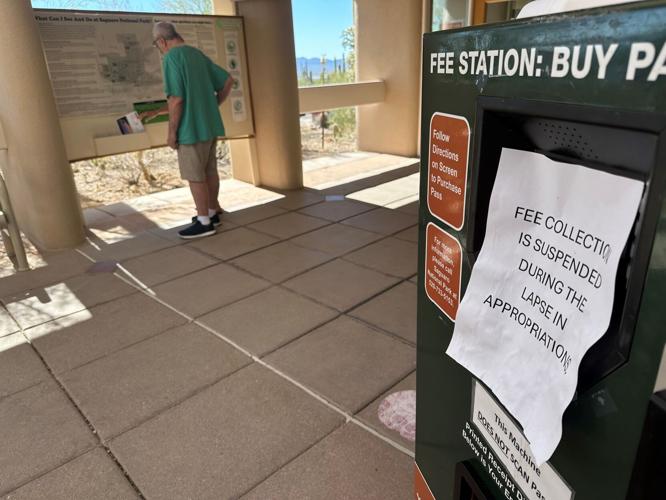



The federal government has been shut down all month, but you can hardly tell the difference on the west side of Saguaro National Park.
At the Red Hills Visitor Center off Kinney Road in the Tucson Mountains, you can browse the exhibits, watch the park movie, buy a souvenir and use the restroom. You can even chat with a ranger. The only thing you can’t do is pay the park entrance fee, which isn’t being collected during the shutdown.
The west-side visitor center is open for business from 9 a.m. to 5 p.m. seven days a week, thanks to operational funds provided by Western National Parks, a nonprofit fundraising partner of the National Park Service.
“This is new for us, and we’re happy to be able to do this at a couple of sites,” said Marie Buck, president and CEO of the Oro Valley-based group.
Western National Parks is also covering the government’s costs for visitor-center operations at White Sands National Park in New Mexico, Great Sand Dunes National Park in Colorado, Pinnacles National Park in California and two sites in Texas and Montana.
The only other attraction in Arizona currently being kept open by the organization is Hubbell Trading Post National Historic Site on the Navajo Nation in the northeastern part of the state.

Visitors check out a sign on Tuesday at Saguaro National Park's Red Hills Visitor Center, which is open during the government shutdown thanks to donated operating funds from the nonprofit group Western National Parks.
The Red Hills Visitor Center initially closed when the shutdown began on Oct. 1, but it reopened a week later when the nonprofit entered into a donor agreement to cover the wages of one full-time ranger and one maintenance worker there. Buck said the unprecedented arrangement was allowed under new guidelines from the Department of the Interior.
“In this shutdown, our parks are being asked to be as open and accessible to the public as possible,” she said. By offering at least some services — especially at a site so near and so important to an urban area like Tucson — “it helps protect the park, it serves the visitors and it’s good for the community.”
A very different scene is unfolding on the east side of the 93,000-acre park. The Rincon Mountain Visitor Center remains closed, as does the fee station and the popular scenic loop along Cactus Forest Drive. Motorists trying to enter there from Old Spanish Trail are being turned away by a closed gate, though construction work continues nearby on a major expansion of the visitor center parking lot that just got underway and is expected to take about a year to complete.
With few other exceptions, the roads and trails throughout Saguaro remain open to hikers and bicyclists. That is in keeping with shutdown directives from the Interior Department calling for national park sites to maintain public access wherever possible, except for buildings requiring staffing. Restrooms, trash collection and limited emergency aid are the only services still being provided with government funding.
According to the notices on their websites, Casa Grande Ruins National Monument and Tumacácori National Historical Park currently have “no amenities or services available.” The visitor center and mission grounds at Tumacácori are closed, though a segment of the Anza Trail through the park remains open.
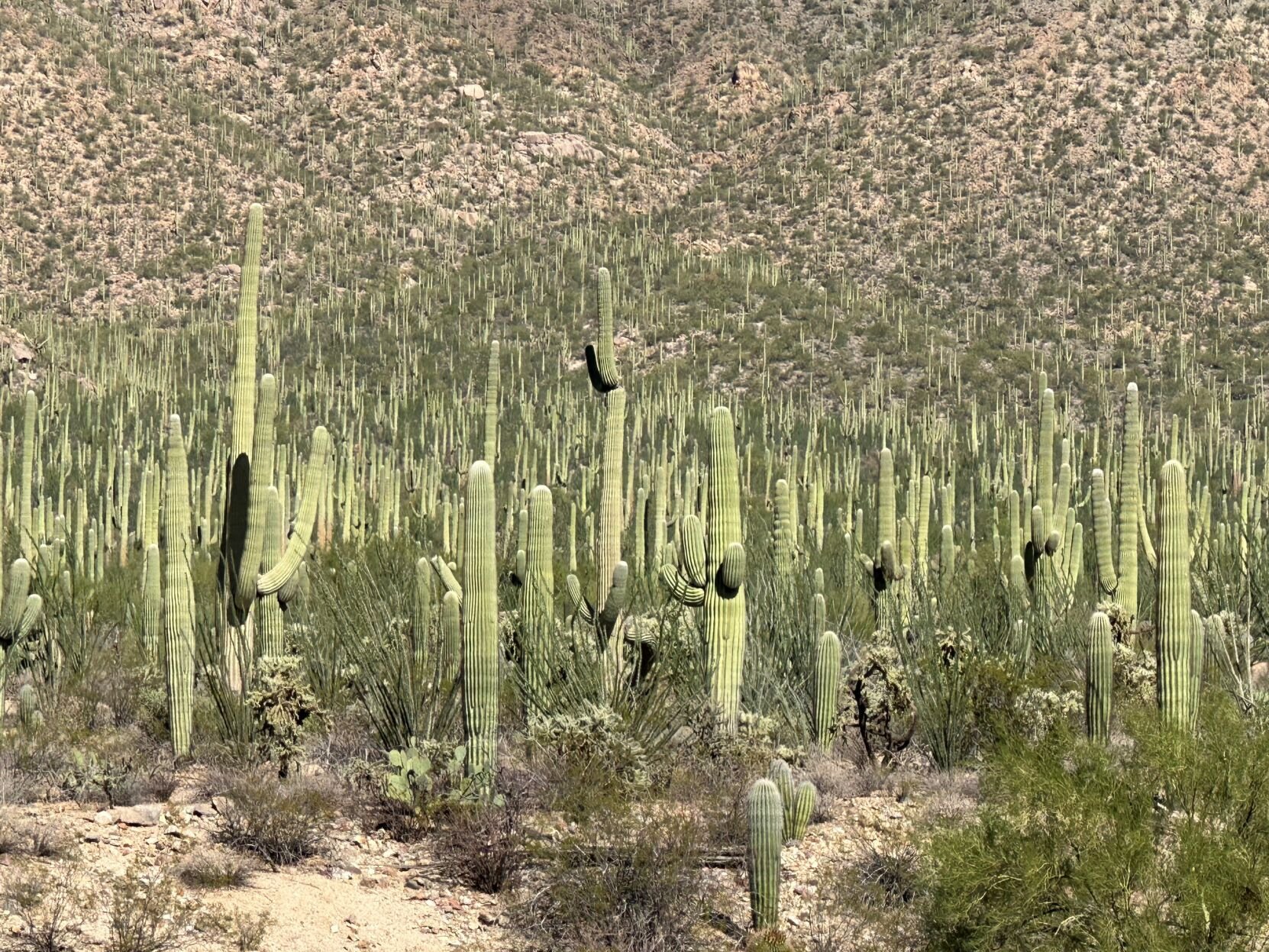
A forest of cactus spreads out toward the Tucson Mountains from the overlook at Saguaro National Park's Red Hills Visitor Center.
It’s unclear what is or isn’t open at other Park Service sites in Southern Arizona. The websites for Coronado National Memorial, Fort Bowie National Historic Site and Chiricahua National Monument all have the same generic warning about limited or unavailable services during the shutdown, as does Organ Pipe Cactus National Monument, where calls to the visitor center went unanswered.
Now in its fifth week, the current shutdown already ranks as the second longest in U.S. history. This marks the third time government funding has been allowed to lapse under President Donald Trump, whose sweeping cuts to the federal workforce earlier this year also disrupted visitor services at Saguaro.
Fred Stula is executive director of Friends of Saguaro National Park, another fundraising and advocacy group that supports the preserve and the people who work there.
He said the nonprofit’s philanthropic partnership agreement with the Park Service and the agency’s own rules prohibit the Friends from providing direct financial assistance to furloughed park employees who have gone without pay since Oct. 1.
But the group invited Saguaro staff members to attend several events this month aimed at helping their “mental and physical well-being,” Stula said. Those included the Friends’ annual dinner and auction at Tangue Verde Ranch, free sunset yoga classes at Las Milipatas Community Farm, and a “first cheers” event with Crooked Tooth Brewing to celebrate a limited-release beer called “Friends of Saguaro National Park Mesquite Amber.”
Stula said the group is planning a barbecue for park employees and supporters next week.
Buck declined to disclose exactly how much money Western National Parks is spending to keep the Red Hills Visitor Center open at Saguaro, except to say that it’s “nowhere near what the park needs” to be fully operational.
She said the group will not be reimbursed by the government once federal funding has been restored.
Since Western National Parks was established as a nonprofit fundraising entity in 1938, it has provided more than $162 million to the Park Service. Its headquarters is located off Innovation Park Drive near Rancho Vistoso Boulevard in Oro Valley, where the group also operates a large gift shop called the National Parks Store. The proceeds from items purchased there — or from any of the visitor-center bookstores it operates at Saguaro and other parks — go to support 72 park sites in 12 Western states.
Buck said Western National Parks has helped fund a wide range of projects at Saguaro, including new exhibits, visitor center renovations, scientific research grants and the Next Generation Ranger Corps, a recruitment program for young people interested in careers with the Park Service.

A forest of saguaros grows on the western slope of the Tucson Mountains.
But this is something else altogether, she said. Never before has the charitable organization donated money expressly to keep park rangers at their posts during a shutdown.
“We’re committed to doing it for as long as we can, but it’s definitely not sustainable,” Buck said. “The parks have to reopen, and the federal government has to fund them.”

