


University of Arizona students will return to campus this month to find security upgrades, like doors that can be locked automatically, and improved mental health services, officials say.
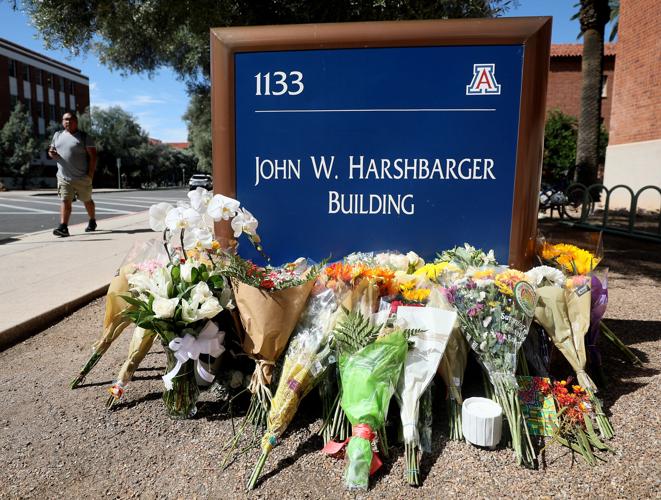
The upgrades follow the shooting death of Thomas Meixner, a UA professor shot and killed on campus in October. His alleged killer is a former, disgruntled student. They are part of several recommendations made by the PAX Group, LLC, the crisis management consulting firm the UA used to investigate factors in the professor’s shooting.
The report was released March 27. PAX gave the University 33 suggestions to improve safety. But Steve Patterson, vice president and chief safety officer of the UA’s public safety office, says they’ve grown that to “over 200 tasks, plans and safety related items that we’re going through.”
“The toughest pill to swallow is that a professor was murdered, by a student, basically on UAPD’s watch,” said UAPD interim police chief Chris Olson. “Moving forward, a lot of these changes are a great way to provide higher-level service and honor Dr. Meixner’s legacy by working extremely hard to make sure this never happens again.”
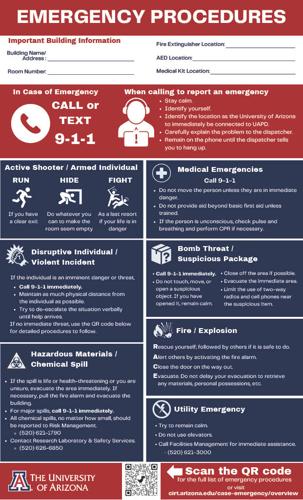
About 75% of classrooms on campus now have new door locks installed and “all-hazards” posters displayed in buildings that tell people what to do in various emergencies.

New posters, which will be displayed in every classroom, will provide individuals with vital information and will also display what individuals should do in the event of various emergencies.
Campus buildings will remain open as they’ve always been when classes resume Aug. 21, but exterior doors can now be locked “at the push of a button” in the event of an emergency, Patterson says. Classrooms also can now be locked from the inside as well.
New posters, which will be displayed in every classroom, will provide individuals with vital information and will also display what individuals should do in the event of a bomb threat, chemical spill or utility emergency, among other emergencies.
The UA also updated more than 170 building emergency plans, which will only be made available to students and faculty with a registered university account, called NetID.
Since the creation of the Office of Public Safety in May, upgrades have been made throughout the summer at a cost of “millions.” Patterson says that the school is still “about 18 months” away from completion.
“This work has been going on for years,” he said.
Additionally, the University formed the Campus Safety Commission in May, announced work to “bolster” their Threat Assessment Management Team in April and a mobile crisis team that was announced in May as well.
“The campus community was very supportive of the work the PAX Group did and by-and-large very supportive of the changes we’ve made,” said Patterson. “We’ve been actively engaged with the campus community… I would say in general the campus community has been very positive on the changes we’ve made.”
UAPD has also created a mental health support team as part of a regional partnership with Tucson Police Department, Oro Valley Police Department as well as Pima County Sheriff’s Department.
“It first starts as an investigative assisting tool, where when we get referrals or calls and we begin investigations into concerning behavior . . . that we actually try and find the root cause of the behavior,” said Olson. “The mental health support team officer helps us to analyze and understand the different types of conduct we’re seeing.”
In addition to agency training, campus administration and faculty have had their own throughout the summer, including walkthroughs and table-top exercises.
Patterson and Olson say they believe the campus is as safe as ever.
“If you look at the PAX report it actually demonstrates the University of Arizona campus is comparatively safe to other places ... It does indicate the over the last couple years there’s been a slight increase in certain crimes,” said Olson. “Just telling (students) it’s going to be safe, I don’t think does enough. We have to demonstrate that ... they need to see our officers out there, not just in cars but out on foot, walking around, talking, engaging with the students.”
“There certainly is a renewed sense of awareness on safety, not to say the university didn’t in the past, but we certainly are refreshing some areas post-COVID where we need to refocus on, certainly on the physical side but the awareness piece, as well,” said Patterson. “University of Arizona is a very safe place to be, doesn’t mean that there aren’t potentially dangerous situations that do occur and that’s why we’ve had these mechanisms in place to ensure that the campus stays safe.”

