

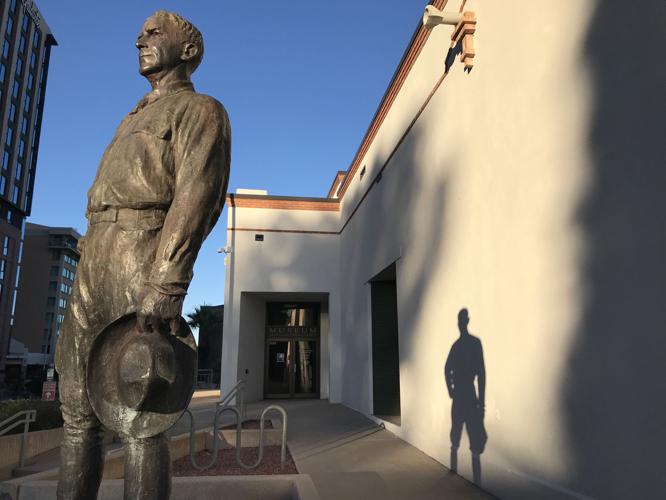
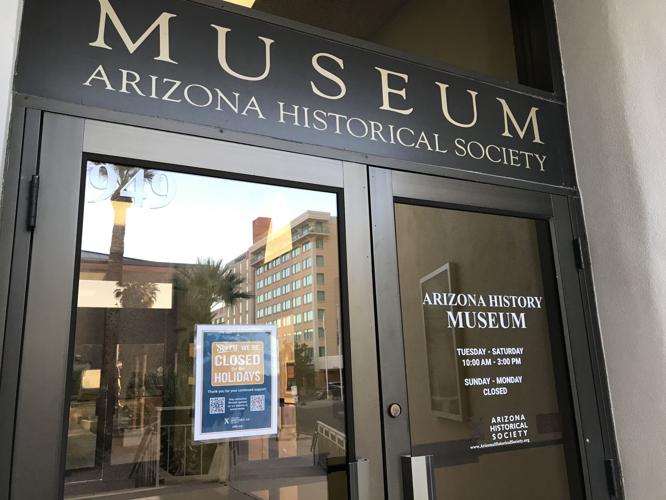

The Arizona History Museum in Tucson is closed to the public until Jan. 23 as part of what Arizona Historical Society officials are calling a “reset” for all its facilities around the state.
But the move comes as the member-supported nonprofit state agency weathers a reset of its own.
Persistent financial troubles have prompted the society to reduce operations and shed several historic properties in recent years.
Now AHS officials are seeking a $1.45 million boost in state funding — roughly 45% above its current allocation — to cover rising costs, a maintenance backlog and pay raises for employees.
According to the historical society, its repair and maintenance budget is only about one-third of what is needed at some sites, while the salaries it offers to professional staff lag as much as $10,000 behind equivalent employers in Arizona, including other state agencies.
“Several of AHS’ historically-registered properties are in an ‘at-risk’ state where they are no longer safe for occupancy and will soon be at risk of collapse,” the society warns in its budget request to Gov. Katie Hobbs. “Staff are stretched thin in their current capacities and cannot take on additional tasks.”
Starting Nov. 21, AHS announced it was “closed for the holidays” at Tucson’s Arizona History Museum at Second Street and Park Avenue, the Arizona Heritage Center in Tempe and the Sanguinetti House Museum and Gardens in Yuma.
The society’s Pioneer Museum in Flagstaff was already shuttered, as it has been for much of the past several years, due to inadequate staffing.
Arizona Historical Society executive director David Breeckner said this new, roughly two-month closure is not the result of a funding shortfall.
The shutdown is designed to give the organization time to perform maintenance work, renovations and changes to exhibits that are difficult to do when the museums are open.
The pause is a welcome break for staff members “after three years of working nonstop,” Breeckner said. “We’ve been very busy.”
He acknowledged that such a closure is unusual but “not unprecedented.” He said it comes during what is traditionally a quiet time at AHS facilities. According to Breeckner, visitation tends to decline between Thanksgiving and New Year’s, then picks back up again in February along with the uptick in school field trips, facility rentals and other activities.
Financial issues have forced AHS to significantly reduce its presence in Tucson and around the state over the past three years.
In January, the historical society sold the Sosa-Carrillo House to Rio Nuevo under a deal designed to fund the preservation of the 19th century adobe building at the Tucson Convention Center.
The city’s tax-supported urban improvement district stepped in because AHS could not afford the $1.3 million needed to renovate the historic structure in Tucson’s oldest Mexican-American barrio.
In 2020, the society pulled out of its long-time operating agreements for the Fort Lowell Historical Museum and the Downtown History Museum in Tucson and Riordan Mansion State Historic Park in Flagstaff.
At the time, then-AHS board treasurer James Snitzer warned that the society’s budget could reach “shutdown level” in as little as two years, without improved revenue and major operational changes.
The Downtown History Museum closed for good, but the Tucson Presidio Trust for Historic Preservation reopened the museum in Fort Lowell Park earlier this month, after $335,000 in renovations paid for with city bond money.
AHS officials are now discussing the possibility of turning the Sanguinetti House over to a local historic preservation group in Yuma, a move that could save the society about $275,000 a year in operating expenses.
That would leave the organization with just six museums and historical sites statewide, down from the 10 it owned or operated at the end of 2019.
And even bigger challenges loom. The society’s latest capital improvement plan lays out as much as $65 million in new construction needed to expand exhibit and archive space at the society’s two largest facilities in Tucson and Tempe alone.
AHS’ struggles are not unique. The COVID-19 pandemic caused visitation to crash and budgets to shrink at history institutions nationwide, according to the American Alliance of Museums, a nonprofit advocacy group.
Alliance data shows that only one-third of museums across the U.S. have seen their visitation return to pre-pandemic levels. For the other two-thirds of museums, visitor volume is still off by an average of about 30%.
The Arizona Historical Society actually saw its visitation exceed pre-COVID numbers during the 2023 fiscal year, with over 34,000 visitors statewide. But as far as AHS board president Linda Whitaker is concerned, the impact of COVID-19 is “not in our rearview mirror.”
She said Arizona has lost nearly half of its museums since the pandemic, leaving those that remain to shoulder the responsibility of preserving the past.
“Simply stated, there are fewer cultural organizations doing the work,” said Whitaker in AHS’ annual report for 2023. “Yet here we are. Changed, but doing the work.”
And she knows just who deserves the credit for that.
“AHS staff and board members have been asked repeatedly to make tough decisions and to work long hours in the face of uncertainty,” she said. “They had to innovate and take risks with no guarantee of success.”
Thanks to them, “we have moved well beyond mere survival,” Whitaker said.
Get your morning recap of today's local news and read the full stories here: tucne.ws/morning

