



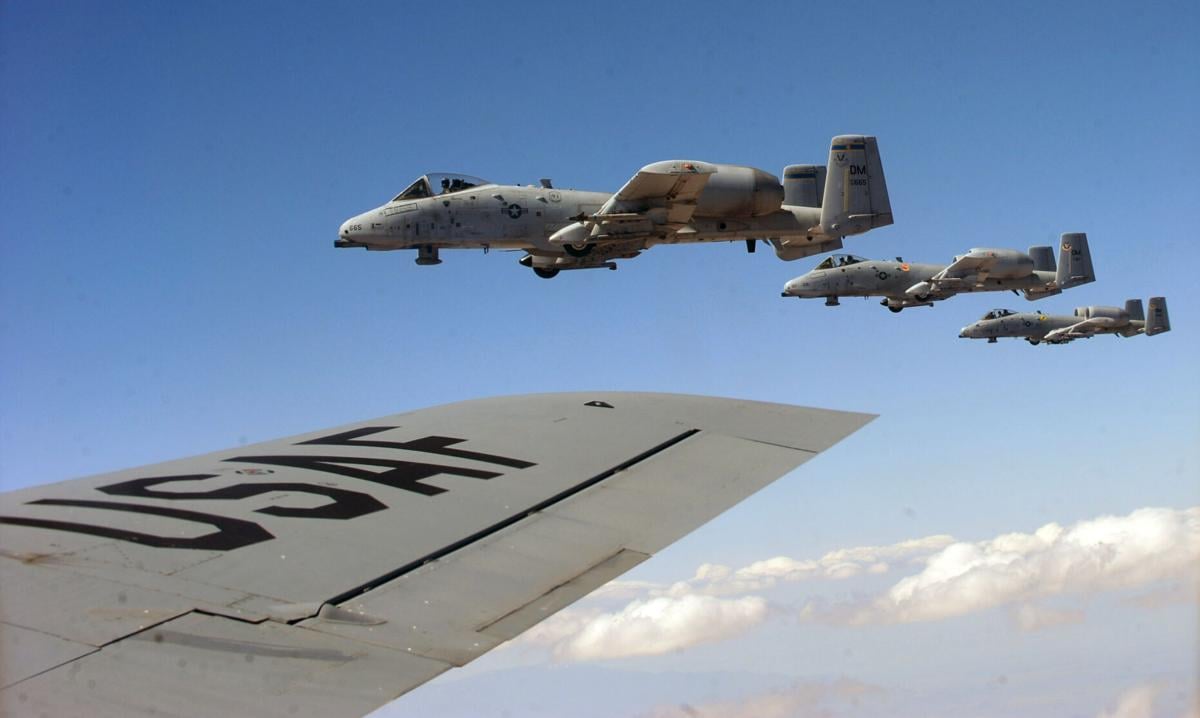
A key Senate committee has moved to block the Air Force’s plan to retire 42 A-10 “Warthog” ground-attack jets — a main mission at Davis-Monthan Air Force Base — in the nation’s annual defense-policy bill.
And that has prompted the Air Force to put on hold plans to shift several combat search and rescue units to D-M from another base — raising concerns from local D-M backers who support that plan.
The Senate Armed Services Committee adopted the prohibition on A-10 retirements as part of its markup on Thursday of the National Defense Authorization Act for fiscal 2022.
Arizona Sen. Mark Kelly, chairman of the Senate Armed Services Committee’s Subcommittee on Emerging Threats and Capabilities, said he helped secure a prohibition on retirement of A-10 “Warthogs” for the upcoming fiscal year in the NDAA, as well as a requirement that the Air Force maintain certain mission-capable rates in the fleet.
But in response to the Senate’s amendments, the Air Force on Friday said it is “pausing” plans to move several combat search and rescue and weapons-training units from Nellis Air Force Base in Nevada to D-M starting next year, to eventually make the Tucson base a “center of excellence” for rescue training.
That plan, announced June 30, depends on congressional approval of its plans to retire 42 older A-10s, including 35 now at D-M, the Air Force noted.
The head of the DM50, a local support group for Davis-Monthan, said the group is very supportive of the move to create a center for combat rescue training at D-M and is concerned that keeping all the A-10s at the base could jeopardize a more sustainable new mission.
“We are incredibly supportive of consolidating the rescue units down here,” said Linda Morales, president of the DM50 and CEO of The Planning Center. “The DM50s mission has always been to support any mission at the base that will keep the personnel numbers up and keep the economic benefit, and this mission does that.”
Morales noted that the changes between D-M and Nellis will result in little change to the staffing levels at the Tucson base, and A-10s based elsewhere will continue to fly for years to come.
“We all love the A-10, but the problem with keeping those squadrons here is, without being able to move them out, there’s not going to be enough room and not enough maintainers – there’s not enough people to work on these planes and the new stuff,” Morales said. “It’s putting things on hold and it’s jeopardizing the future of D-M with this rescue mission, in favor of keeping an aircraft that is eventually going to go away.”
Morales said the rescue mission is a good fit for Tucson, citing the brand-new rescue helicopter fleet D-M will gain under the mission shift.
“We think it’s a great long-term move, and it’s a good fit with the community, it’s a very quiet aircraft,” she said.
Previous Air Force proposals would have replaced the A-10s at D-M with louder F-16 fighter jets, and the base has been studied and passed over twice as a potential base for the even noisier F-35 joint strike fighter.
Morales said the DM50 plans to brief Kelly and other members of the Arizona congressional delegation on its support of the D-M mission shift next week.
A spokeswoman for Kelly said the senator, a former Navy combat pilot, “remains opposed to retiring A-10s without a suitable replacement to carry out the close air support mission that is critical to our national security and protecting American troops.”
The House Armed Services Committee plans to begin working on amendments to the 2022 NDAA in subcommittees next week but doesn’t plan a full committee markup until Sept. 1.
Shortly after the Air Force released its 2022 budget plan in late May, a group of seven Arizona legislators — Democrats Kelly and Sen. Kyrsten Sinema, and Democratic Reps. Ann Kirkpatrick, Ruben Gallego, Tom O’Halleran and Greg Stanton, along with Republican Rep. Debbie Lesko vowed to oppose any A-10 retirement plans. They cited the A-10’s unique role in close air support of ground troops and lack of any near-term replacement for that mission.
The Air Force has been trying to retire the entire A-10 fleet since 2014, arguing the money to sustain them is better spent on newer platforms like the F-35.
Though some A-10s have been retired and squadron sizes shrunk, Congress has largely blocked the Pentagon’s phase-out plan and instead appropriated new funding for wing replacements needed to keep many of the remaining A-10s flying.
The Air Force said it plans to modernize and maintain 218 of its current fleet of 281 combat-capable A-10s, and that with avionic upgrades, the remaining A-10s will be able to fly well into the 2030s.

