



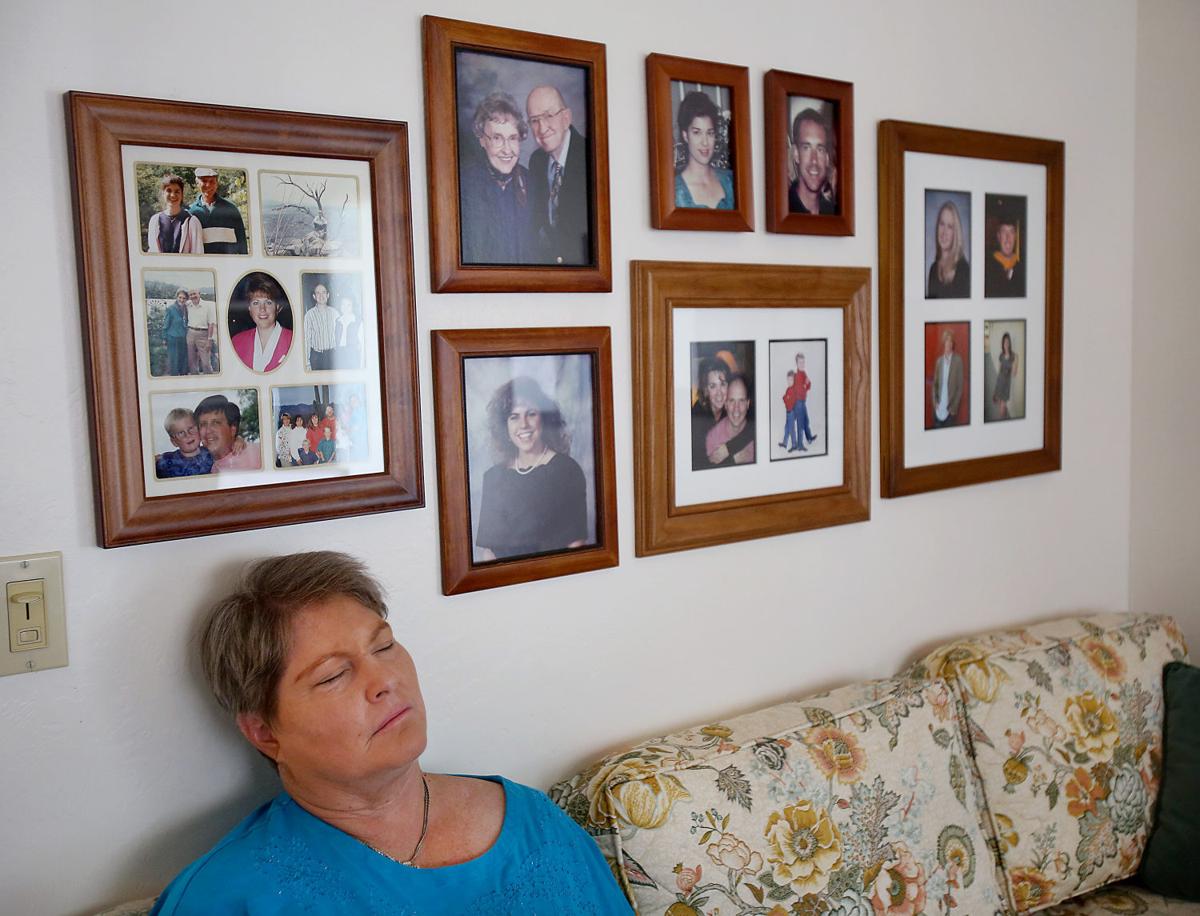
At age 29, Kyle Baril expects he has at least 12 good years ahead of him.
After that, the odds are 50-50 that Alzheimer’s disease will take hold of his brain.
The disease many Americans fear more than anything has attacked Kyle’s family for generations. The early-onset hereditary Alzheimer’s that affects his family is rare, yet some scientists say it could hold a key to preventing the disease as a whole.
Like his three siblings, it’s as likely as not that Kyle has a gene mutation passed down on his mother’s side of the family. Barring any breakthrough, anyone who has the mutation is virtually assured to develop autosomal dominant, or early onset, familial Alzheimer’s. An estimated 5,000 to 10,000 people worldwide have this form of the disease, representing less than 1 percent of Alzheimer’s cases.
In Kyle’s family, those who have the mutation typically develop short-term memory problems in their 40s. Their symptoms progress until they need diapers and lose the ability to talk, walk, or feed themselves. Most die by 51.
Kyle’s mother, Cheryl, was diagnosed at age 47 and can no longer read or sign her name. Cheryl’s brother and sister already have died of the disease.
Kyle, who works at a Tucson sales and marketing firm, is the second oldest child in his family. A simple blood test would tell him definitively whether he inherited the genetic mutation. It could help him decide whether to to risk having children.
He’s thought a lot about getting the test. If there were a way to prevent or cure the disease — or even to slow its progression — his decision would be easy.
“It’s a completely different beast from cancer, HIV/AIDS or addiction,” he said. “Right now, it’s 100 percent hopeless.”
Though the family’s knowledge of their ancestors is incomplete, they believe at least four generations have been affected by Alzheimer’s. They have traced the illness as far back as Kyle’s great-great grandmother Emma Lydia Hayworth Smith. Emma, who had nine children, died in a mental institution of what is now assumed to be early-onset familial Alzheimer’s disease.
One of her children — Kyle’s great-grandmother — was Clarabel Smith, a gentle Quaker from Pennsylvania who married a dynamic, headstrong lawyer named Frank Stuyvesant Minarik. They lived in New York City and moved to Arizona in 1925 due to Frank’s arthritis.
Clarabel died in a sanitarium in Phoenix in 1947 when she was 46. Her family says the death was due to complications from non-sedated shock treatments. Back then, there was no name for what was taking away her mind. The family at the time would say she suffered from an affliction that affected females in the family around menopause.
Clarabel’s son, Smith “Smitty” Minarik, was nine when his mother died. Smitty, a gentle person like his mother, was Kyle’s grandfather. He grew up in Tucson and went on to become a social studies teacher at Palo Verde High School.
Smitty and his wife, Mary Kay, had three children — Cheryl, Beth and Steve, born between 1960 and 1965.
Smitty died in 1988 at age 51 of complications from Alzheimer’s. All three of his children, unaware of the family’s genetic roulette as they grew up, started having memory problems in their 40s.
Beth, a former Tucson High School physical education teacher, and Steve, who was a teacher in Tucson, Prescott and South Korea, both succumbed to Alzheimer’s disease — Beth at 50 and Steve at 49.
At 55, Kyle’s mother, Cheryl Minarik Baril, has outlived expectations. She was diagnosed in 2008 but, until this past year, her disease showed few advances. Now she’ll start to say a word — swimming, for example, or graduation — but can’t finish it.
She often puts on her shirts backwards or inside out, and rarely can tie the laces on her sneakers.
Kyle, along with his siblings and cousins, has watched this progression with a combination of grief at losing a parent and fear at what the future might hold.
Cheryl’s four children range in age from 23 to 32. Steve’s sons are 17 and 19.
Scientific advances make them the first generation in the family to face the decision of whether to be tested for the genetic mutation while they are still young and healthy.
They’re the first to know that, should they decide to have children, they could pass the gene along. It’s not just a theoretical discussion: Kyle’s older sister, Krista Baril Buelna, is married with three children of her own.

