

Wet weather last year and the predicted hot, dry spring and summer will result in a “very extreme’’ potential for wildfires this year.
The situation is complicated by the fact the state is having trouble hiring people to fight those fires once they break out.
“The above-normal rainfall we had through the monsoon season, and the above-normal rainfall we had in December, have put a lot more vegetation and a lot more growth onto our vegetation,’’ John Truett, Arizona’s fire management officer, said Thursday.
“Then we had the drier-than-normal conditions the last three months, which now has dried out all those fuels to be available for wildland fires.’’

John Truett, the state fire management officer, details the factors he said could lead to a particularly dangerous fire season as Gov. Doug Ducey listens.
Even the areas that were burned in the last two years — 900,000 acres in 2020 and 500,000 in 2021 — are not immune from being at risk again, Truett said.
“All those have gotten a lot of grass growing in them,’’ he said. “So they could actually re-burn now.’’
Competition for firefighters
At the same time, Truett noted, the extreme drought throughout the West has left Arizona in “heavy competition’’ with other federal, state and local agencies to find qualified people to fight such fires.
“We’re having a hard time filling our vacancies,’’ he said. “We go out and recruit. We just don’t have enough folks that are willing to come out and do the job that we do.’’
He said the state currently has more than 80 firefighters, declining to say how many vacancies remain in his Department of Forestry and Fire Management.
It isn’t just the permanent jobs that matter, Truett said, but also the seasonal positions the state is trying to fill now.
Prevention first
That’s part of why it’s crucial to try to stop fires from starting in the first place, he said.
Some of that involves the normal warnings about not burning on windy days, making sure if you’re towing a trailer that the chain is not scraping the ground and causing sparks, and not pulling a vehicle into high grasses where the hot catalytic converter could ignite materials.
On a more proactive level, the state is trying to reduce hazardous vegetation.
Arizona has historically tried to “treat’’ about 4,000 to 5,000 acres a year and has a goal this year of hitting 20,000 acres. That does not count similar programs run by the U.S. Forest Service.
Funds for crews
One thing helping to meet that goal is that the state is training low-risk inmates to do some of this thinning.
On Wednesday, the Arizona Department of Corrections, Rehabilitation and Reentry graduated its latest crew of more than 100 to help with that job.
Gov. Doug Ducey said he is proposing an additional $36 million for the Healthy Forest Initiative in his budget for the coming fiscal year for continued expansion of inmate crews and other programs to help clear hazardous vegetation, bringing the total allocated to more than $42 million.
State corrections officials said the program, which involves inmates operating equipment and machinery used in the timber industry, can get them skills that will help them find employment after they complete their sentences.
The governor said he also is putting another $17 million into a revolving fund that would be used to reimburse local fire departments that help respond to wildfires.
A look back at the Bighorn Fire in photos
Bighorn Fire in the Santa Catalina Mountains, 2020
Updated
A DC-10 air tanker or VLAT (Very Large Air Tanker) dumps thousands of gallons of retardant on the Bighorn Fire burning along Pusch Ridge in Coronado National Forest east of Rams Canyon subdivision on June 6, 2020.
Bighorn Fire - Arizona
Updated
A Chinook heavy lift helicopter passes smoke from the Bighorn Fire burning along Pusch Ridge in Coronado National Forest north of Tucson on June 6, 2020.
Bighorn Fire in the Santa Catalina Mountains, 2020
Updated
Smoke from the Bighorn Fire shrouds granite formations of Pusch Ridge in Coronado National Forest north of Tucson on June 6, 2020.
Bighorn Fire - Arizona
Updated
People watch the aerial ballet of helicopters and air tankers on the Bighorn Fire from the safety of Oro Valley Marketplace on June 7, 2020.
Bighorn Fire - Arizona
Updated
A DC-10 air tanker spreads a line of retardant high atop Pusch Ridge as fire managers tried in vain to keep the the Bighorn Fire confined to the West end of the Santa Catalina Mountains in Coronado National Forest north of Tucson on June 6, 2020.
Bighorn Fire - Arizona
Updated
The Bighorn Fire burning above Catalina State Park in the Santa Catalina Mountains in Coronado National Forest north of Tucson on June 7, 2020.
Bighorn Fire - Arizona
Updated
Dark smoke from the Bighorn Fire in the upper elevations of Pima Canyon obscures the rising sun above the Santa Catalina Mountains in Coronado National Forest north of Tucson on June 9, 2020.
Bighorn Fire in the Santa Catalina Mountains, 2020
Updated
A helicopter dips into Rose Canyon Lake for water while fighting the Bighorn Fire still burning in the west end fo the Santa Catalina Mountains on June 9, 2020.
Bighorn Fire - Arizona
Updated
The Bighorn Fire consumes thick vegetation in crags above Pima Canyon within the Santa Catalina Mountains in Coronado National Forest north of Tucson on June 9, 2020.
Bighorn Fire in the Santa Catalina Mountains, 2020
Updated
A Chinook helicopter drops a load of water on the Bighorn Fire as is moves into the top of Finger Rock Canyon and up Mount Kimball, on June 10, 2020.
Bighorn Fire in the Santa Catalina Mountains, 2020
Updated
The Bighorn Fire burns up into juniper, mesquite and heavier fuel as it approaches Mt. Kimball in the Santa Catalina Mountains, Tucson, Ariz., June 10, 2020.
Bighorn Fire - Arizona
Updated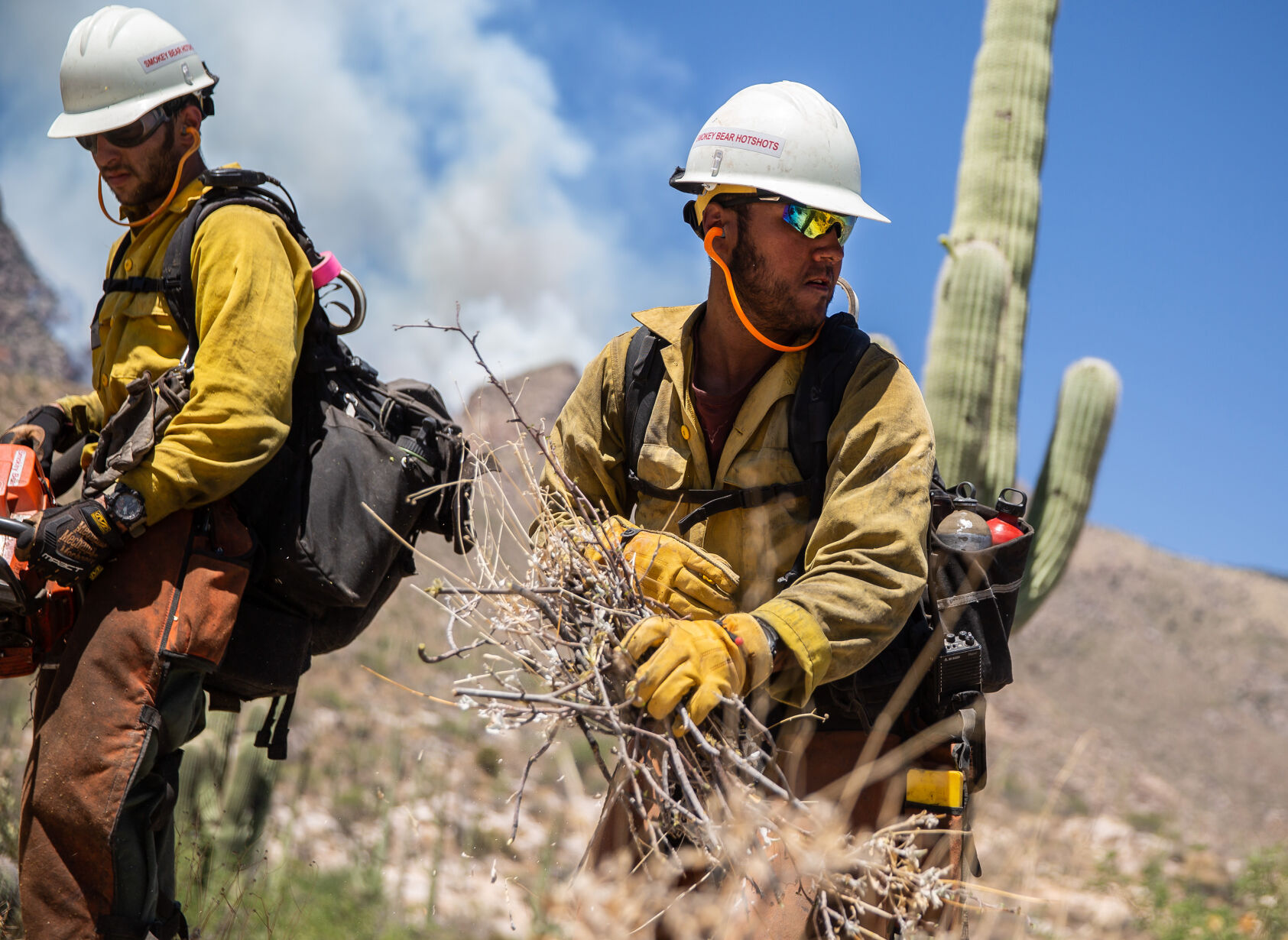
Adam Hutton with the Smokey Bear Hotshots of Ruidoso, New Mexico tosses away brush being cut near the mouth of Finger Rock Canyon as a precaution against the growing Bighorn Fire being fought in the Santa Catalina Mountain Range, on June 10, 2020.
Bighorn Fire in the Santa Catalina Mountains, 2020
Updated
The Bighorn Fire breaks onto the southern slopes of the Santa Catalina Mountains and burns over a pair of homes in the foothills just west of the Finger Rock Trailhead, Tucson, Ariz., June 10, 2020.
Bighorn Fire - Arizona
Updated
The Bighorn Fire churns through brush, creating a smoky mess in Pima Canyon and Finger Rock Canyon in the Santa Catalina Mountains north of Tucson on June 11, 2020.
Bighorn Fire in the Santa Catalina Mountains, 2020
Updated
A DC-10 air tanker (VLAT) drops fire retardant behind homes in the Cobblestone Estate during the Bighorn Fire in the Santa Catalina Mountains on June 11, 2020.
Bighorn Fire in the Santa Catalina Mountains, 2020
Updated
Residents watch a Neptune Aviation air tanker drop fire retardant behind the Santa Catalina foothills north of Tucson, Ariz. on June 11, 2020.
Bighorn Fire - Arizona
Updated
A hot shot fire crew hikes a ridge near Finger Rock Canyon in the Santa Catalina Mountains during the Bighorn Fire on June 11, 2020.
Bighorn Fire in the Santa Catalina Mountains, 2020
Updated
Keith Lencke of the Blue Ridge Hotshots watches the air attack on the Bighorn Fire in the Cobblestone Estates neighborhood in the Santa Catalina foothills on June 11, 2020.
Bighorn Fire in the Santa Catalina Mountains, 2020
Updated
Qin Chen talks with Tom Lemmons of the Pima County Sheriff's Office Auxiliary, about "Go" orders given to evacuate her home in the Cobblestone Estates neighborhood due to the Bighorn Fire in the Santa Catalina Mountains on June 11, 2020.
Bighorn Fire in the Santa Catalina Mountains, 2020
Updated
A Chinook helicopter dumps water on a slope during the Bighorn Fire in the Santa Catalina Mountains on June 11, 2020. Pinkish-red fire retardant coats the rock faces of the mountain range.
Bighorn Fire - Arizona
Updated
A DC-10 air tanker (VLAT) drops a line of retardant on a ridge above homes east of Pima Canyon in the Santa Catalina foothills during the Bighorn Fire on June 11, 2020.
Bighorn Fire in the Santa Catalina Mountains, 2020
Updated
A DC-10 VLAT makes a final drop in the fading light over the homes in the area between Swan and Alvernon during the daylong struggle to keep the Bighorn Fire out of the neighborhoods of the Santa Catalina Mountain foothills, Tucson, Ariz., June 11, 2020.
Bighorn Fire in the Santa Catalina Mountains, 2020
Updated
People watch from Oracle Road just north of the entrance to Catalina State Park as Chinook helicopters drop water on the Bighorn Fire which is burning for its seventh day in the western Santa Catalina mountain range, on June 12, 2020.
Bighorn Fire in the Santa Catalina Mountains, 2020
Updated
Smoke billows from the Bighorn Fire burning in the Pusch Ridge Wilderness, on June 12, 2020.
Bighorn Fire in the Santa Catalina Mountains, 2020
Updated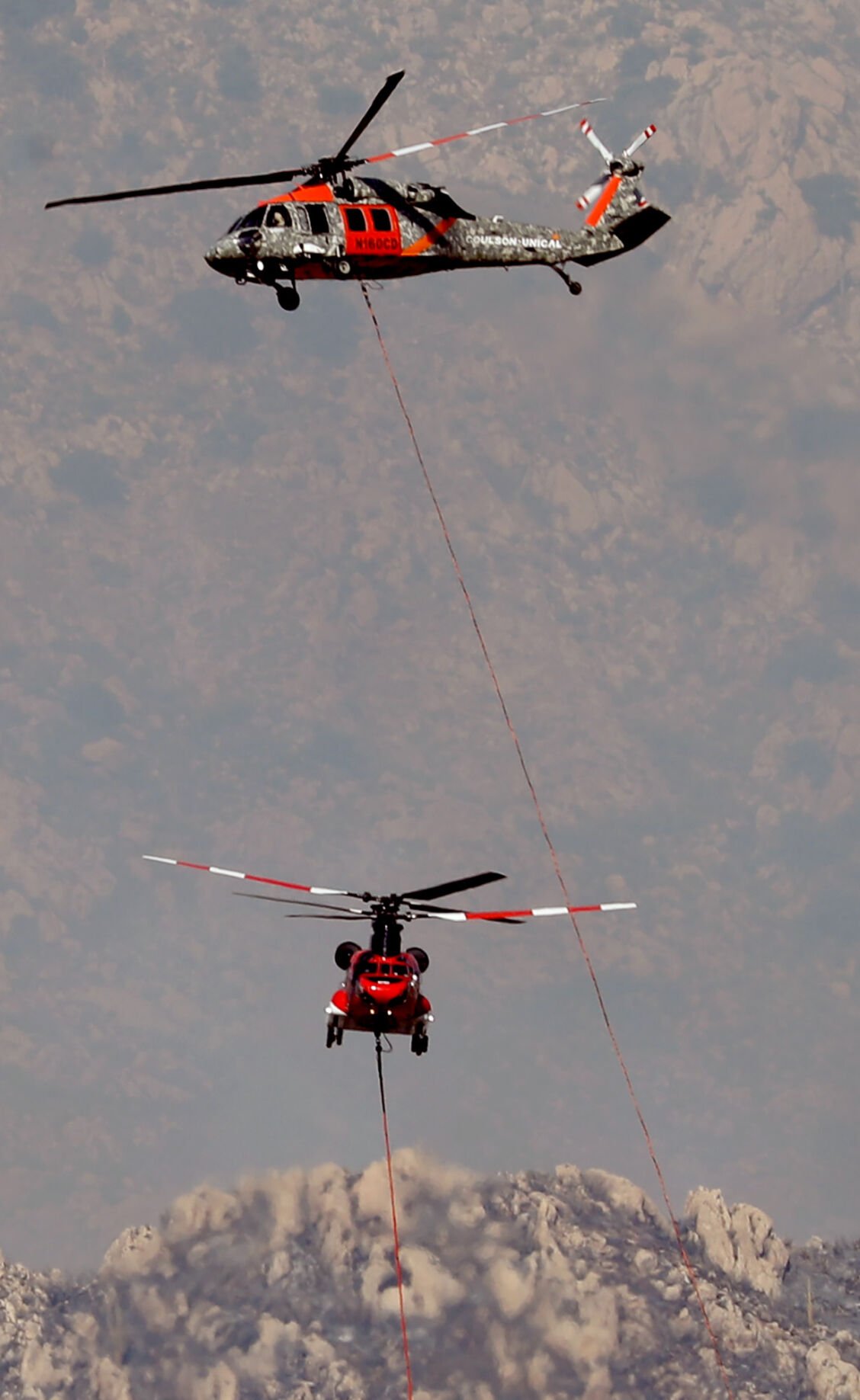
Two firefighting helicopters maneuver around one another while recharging at a dip site as the battle moves to the north to keep the Bighorn Fire from spreading, Oro Valley, Ariz., June 11, 2020.
Bighorn Fire in the Santa Catalina Mountains, 2020
Updated
A DC-10 VLAT drops below the ridge line as the aerial battle moves to the northwest and crews work to keep the Bighorn Fire from spreading through Catalina State Park, Oro Valley, Ariz., June 11, 2020.
Bighorn Fire in the Santa Catalina Mountains, 2020
Updated
A Chinook helicopter drops water on the line of flames advancing through grasslands at the northwestern foot of the Santa Catalinas as crews work to keep the Bighorn Fire from spreading through Catalina State Park, Oro Valley, Ariz., June 11, 2020.
Bighorn Fire in the Santa Catalina Mountains, 2020
Updated
The Bighorn Fire's northwestern front looms over homes as it burns into the central Santa Catalina Mountains, Oro Valley, Ariz., June 13, 2020.
Bighorn Fire in the Santa Catalina Mountains, 2020
Updated
A group of friends hangout on a high rock at Windy Point Vista while smoke from the Bighorn Fire flows over Mount Lemmon north of Tucson, Ariz. on June 14, 2020.
Bighorn Fire in the Santa Catalina Mountains, 2020
Updated
A Pima County Sheriff Auxiliary Volunteer motions for a four-wheel drive Type 3 fire engine from Three Points FD to proceed to Mount Lemmon on the Catalina Highway on June 15, 2020..
Arizona Wildfires
Updated
A DC-10 air tanker drops fire retardant along Samaniego Ridge just west of Mt. Lemmon Sky Center during the Bighorn Fire burning west of Mt. Lemmon in the Santa Catalina Mountains north of Tucson on June 16, 2020.
Bighorn Fire in the Santa Catalina Mountains, 2020
Updated
A Sikorsky firefighting helicopter drops water along a ridge top as the flames from the Bighorn Fire work their way onto the northern slopes of the Santa Catalina Mountains, Tucson, Ariz., June 16, 2020.
Bighorn Fire in the Santa Catalina Mountains, 2020
Updated
The same wind whipping the flags outside the Fairfield Inn & Suites on Oracle Road is whipping up the flames and smoke of the Bighorn Fire, Oro Valley, Ariz., June 17, 2020.
Bighorn Fire in the Santa Catalina Mountains, 2020
Updated
Flames break through the smoke as a finger of the Bighorn Fire scorches its way through a canyon on the west side of the Santa Catalina Mountains above Oro Valley on June 17, 2020.
Bighorn Fire in the Santa Catalina Mountains, 2020
Updated
People use a wildlife exit along Oracle Road to get a view of the Bighorn Fire churning through heavy fuels like Ponderosa pines below Summerhaven on June 17, 2020.
Bighorn Fire in the Santa Catalina Mountains, 2020
Updated
The Bighorn Fire became of machine of heat and wind, consuming incinerating large stands of trees on June 17, 2020.
Bighorn Fire in the Santa Catalina Mountains, 2020
Updated
A firefighting helicopter flies over a smoke filled canyon as it shuttles water to a line between the Bighorn Fire and Oracle, Tucson, Ariz., June 18, 2020.
Bighorn Fire in the Santa Catalina Mountains, 2020
Updated
The Bighorn Fire burning in Ventana Canyon in the Santa Catalina Mountains as the fire became a daily spectacle, viewable from nearly anywhere in Tucson, on June 18, 2020.
Bighorn Fire in the Santa Catalina Mountains, 2020
Updated
Traffic on Sabino Canyon Road drives under the glow of he Bighorn Fire as it claims Ventana Canyon on the south slopes of the Santa Catalina Mountains on June 19, 2020.
Bighorn Fire in the Santa Catalina Mountains, 2020
Updated
Flames on the outer eastern walls of Ventana Canyon as the Bighorn Fire continues burning the Santa Catalina Mountains on June 20, 2020.
Bighorn Fire in the Santa Catalina Mountains, 2020
Updated
Smoke would lay-in over the city on days with calm winds as the Bighorn Fire methodically progressed through he Santa Catalina range. Photo taken on June 21, 2020 from "A" Mountain.
Bighorn Fire in the Santa Catalina Mountains, 2020
Updated
Flames from the Bighorn Fire climb over a ridge near Esperero Canyon, silhouetting a stand of Saguaros as the blaze marches east on June 23, 2020.
Bighorn Fire in the Santa Catalina Mountains, 2020
Updated
Smoke from the Bighorn Fire clings to the foothills of the eastern slopes of the Santa Catalina and Rincon mountains and the cottonwood-willow forest and mesquite bosque running along the San Pedro River Valley, Cascabel, Ariz., June 30, 2020.
Bighorn Fire in the Santa Catalina Mountains, 2020
Updated
Bighorn Fire scar area: Cañada del Oro basin looking south at Sanmaniego Ridge in the Santa Catalina Mountains north of Tucson on July 1, 2020. The summit of Mt Lemmon is at left.
Bighorn Fire in the Santa Catalina Mountains, 2020
Updated
Bighorn Fire scar area: Looking from East Ski Run toward Oracle Ridge, left, and Sanmaniego Ridge, right, in the Santa Catalina Mountains north of Tucson on July 10, 2020.
Bighorn Fire in the Santa Catalina Mountains, 2020
Updated
Summerhaven sits like an island surrounded Bighorn Fire scar and Aspen Fire scar from 2003 in these aerial photos from July 15, 2020. The Mt. Lemmon Fire Station and control road jut out from a U-shaped turn of Mt. Lemmon Highway at upper left.
Bighorn Fire in the Santa Catalina Mountains, 2020
Updated
Bighorn Fire scar area: Charred debris from the Bighorn Fire moves down the Cañada del Oro Wash after a monsoon storm on July 15, 2020.
Bighorn Fire in the Santa Catalina Mountains, 2020
Updated
A burned section of the Catalina Mountains seen near Aspen Vista Point, on Aug. 1, 2020.
Bighorn Fire in the Santa Catalina Mountains, 2020
Updated
Deymo Fernandez, left, and Sara Hernandez, look at a burn scar from the Bighorn Fire on the North side of Mount Lemmon outside the Iron Door Restaurant in Mount Lemmon on August 2, 2020..
Bighorn Fire in the Santa Catalina Mountains, 2020
Updated
The burn scar from the Bighorn Fire on a portion of the North side of Mount Lemmon, as seen from the Mount Lemmon Fire Station on August 2, 2020.
Bighorn Fire in the Santa Catalina Mountains, 2020
Updated
Gregg Sasek, dispersed recreation manager for the Coronado National Forest Santa Catalina Ranger District, demonstrates how ground along the Palisade Trail has been burnt out making it easy for hikers to sink a leg into the soil, on Aug. 12, 2020. Various dangers are still being accessed throughout the Coronado National Forest as a result of the Bighorn Fire.
Bighorn Fire in the Santa Catalina Mountains, 2020
Updated
A sign at the entrance to the Pima Canyon Trail warns hikers of dangers after the Bighorn Fire damages hiking areas on September 30, 2020.
Bighorn Fire in the Santa Catalina Mountains, 2020
Updated
Snow covers a burn scar from the Bighorn Fire in the Santa Catalina Mountains outside of Summerhaven, Ariz. on Nov. 9, 2020. The Mt. Lemmon General Store in Summerhaven got about 1-2 inches of snow early Monday, according to the National Weather Service.
Bighorn Fire in the Santa Catalina Mountains, 2020
Updated
Damage from the Bighorn Fire can be seen along the Marshall Gulch Trail on Mt. Lemmon in Tucson, Ariz. on May 25, 2021.
Bighorn Fire in the Santa Catalina Mountains, 2020
Updated
Rosalind Perera walks along the Aspen Trail where damage from the Bighorn Fire can be seen on Mt. Lemmon in Tucson, Ariz. on May 25, 2021.
Bighorn Fire in the Santa Catalina Mountains, 2020
Updated
Damage from the Bighorn Fire can be seen along the Aspen Trail on Mt. Lemmon in Tucson, Ariz. on May 25, 2021.

