



Several members representing Tucson in the citizen-led committee charged with recommending a new iteration of a 20-year regional transportation plan have expressed frustration with what they call interference from staff stymieing their ability to make progress.
The Citizens’ Advisory Committee is a 33-member public body that’s one of many committees that report to the Regional Transportation Authority’s board of nine members from Pima County’s jurisdictions. The board makes key decisions on the delivery of billions of dollars worth of transportation projects.
Voters passed a half-cent sales tax in 2006 to fund $1.9 billion worth of transportation projects. While figuring out how to deliver the remaining RTA projects with an estimated $150 million funding shortfall, the RTA is preparing to present another 20-year transportation plan to voters called RTA Next, which could be on the ballot as early as 2024.
Tucson has agreed to delay two of its transportation projects to the next RTA to help make up the shortfall, but the city has a history of qualms with the RTA.
At the beginning of the year, Tucson vowed to leave the RTA by Feb. 1 unless the city had more of a say in the board’s decision-making processes and changes were made to address a massive funding gap for Tucson’s unfinished projects.
The city agreed to a compromise that involved increasing city-designated members on key RTA committees, specifically the citizens’ committee, and ultimately decided to stay at the table.
Eleven new members joined the citizens’ committee, joining 21 other members who’ve been on the committee since 2018. Some members, however, say they feel a draconian interpretation of Open Meeting Law is intimidating members and hindering their ability to provide meaningful input into the next transportation plan.
Arizona’s Open Meeting Law statutes outline how public bodies must meet openly to reasonably allow the public access to the discussions and decisions being made on their behalf. Members say they are discouraged from emailing each other or having in-person discussions outside of citizens’ committee meetings.
“The way that the RTA staff has insisted on interpreting the Open Meeting Law is, in my opinion, the wrong way,” said Rachel Wilson, an immigration lawyer and citizens’ committee member who joined this year’s new cohort of members. “We can’t have a discussion of any sort with other members of the CAC about transportation issues without, in their minds, violating the Open Meeting Law. So the problem is we’ve been compartmentalized.”
Meanwhile, employees of PAG, the metropolitan planning organization that oversees the various RTA-related committees, have alleged they’ve been harassed by citizens’ committee members. At the RTA Board’s Nov. 3 meeting, members met in executive session for nearly three hours “for legal advice and to discuss personnel matters relating to complaints by PAG staff regarding harassment and retaliation,” according to the agenda. The board approved a motion to “direct staff as discussed in executive session,” but no legal action was announced.
Farhad Moghimi, the executive director of the RTA, said he couldn’t comment on the citizens’ committee concerns about the Open Meeting Law because the subject is “interrelated” with matters discussed behind closed doors. He did provide some answers about the harassment claims over email, however.
“The RTA is following the open meeting law based on legal guidance from our attorney and direction from the RTA Board. We are asking the CAC to comply with our understanding of the law based on the legal direction we have received,” Moghimi wrote. “Given that the conduct of individuals is a confidential legal matter, we can’t get into the specific details. However, we understand that our employees are being harassed by several CAC members (and others) for holding them accountable to comply with PAG’s Code of Conduct or enforcing the Open Meeting Laws.”
He said staff is planning to review Open Meeting Law concerns “to ensure a broad understanding and full compliance.”
All citizens’ committee members the Star interviewed did not speak as representatives of the citizens’ committee nor the RTA, but as individuals sharing their personal experiences.
Open Meeting Law
At a citizens’ committee meeting in April, Paki Rico, PAG’s community affairs administrator who’s the staff lead of the citizens’ committee, advised the committee of the Open Meeting Laws members must abide by. Members are not to email each other or “meet for coffee or happy hour in person or remotely” to discuss items that may come up in committee discussions, a presentation to the citizens’ committee detailed.
One slide of the presentation reminded members of the consequences that could arise for repeat offenders who knowingly violate the Open Meeting Law: “up to $500 per offense, and up to $2,500 for a subsequent offense.”
Several citizens’ committee members with legal experience have emailed the RTA Board and PAG staff expressing concerns about the rules.
Abigail Okrent, a citizens’ committee member, sent an email to the RTA Board and Tucson’s mayor and city council outlining her concerns. Okrent said one citizens’ committee member sent a link to an article to Rico pertinent to current discussions to share with other members, to which Rico replied: “staff cannot pass on communication on behalf of a member to other committee members (OML violation).”
Okrent wrote in the email: “the only way we can communicate with other members in between meetings is through staff; this would be fine if staff would actually facilitate that.”
Moghimi responded to Okrent’s concerns in an email to chairs of the citizens’ committee, writing: “As we have discussed before, staff cannot allow themselves to be used to circumvent the Open Meeting Law.” The executive director cited state statute that says Open Meeting Law violations can occur when “members of a public body share their positions and proposals with other public body members through staff members or other non-members.”
PAG’s attorney Thomas Benavidez also weighed in on the matter, writing in a memo: “PAG and RTA staff and committee chairpersons must ensure that committee members strictly adhere to the Open Meeting Law. The law must be interpreted to apply broadly to prevent inadvertent violation.”
Daniel Barr, an attorney with nearly 40 years of experience in media and political law, reviewed the memo and experiences detailed by citizens’ committee members, and came up with a different opinion on how the Open Meeting Law affects citizens’ committee members.
A potential violation could arise if a quorum is established outside out the committee meetings — which would take 17 members of the 33-member body. Barr says a few members simply discussing items that could be tangential to committee items isn’t a violation.
“They can discuss actual committee items if they’re not a quorum,” Barr said. “What the Open Meetings Law requires is that public bodies take legal action in public meetings, and legal action means decisions made by a quorum of the public body. It does not prohibit people less than a quorum of the public body discussing issues.”
Regarding the question of if individual committee members are required to comply with PAG’s interpretation of the Open Meeting Law, the central focus of Benavidez’s memo, Barr said the citizens’ committee is simply “required to comply with the open meetings law, not whatever individual staff members seem to believe.”
Carolyn Campbell, the first vice chair of the citizens’ committee, was part of the last iteration of the committee and said while the Open Meeting Law reminders are normal, she hasn’t seen it discussed by PAG staff to the degree it is now.
“I’ve been involved on public committees most of my adult life,” she said. “I’ve never seen any public body interpret the Open Meeting Law in such a super conservative way … it’s become a lot of focus of our interactions.”
Stymieing progress
Amanda Maass, a citizens’ committee member, said the group is frequently dismissed with claims of Open Meeting Law violations that “have the impact of really stifling collaboration and discussion.”
Tom McGovern, the chair of the citizens’ committee, said he’s heard the concerns from members about how Open Meeting Law is potentially stalling the committee’s progress.
“I think their interpretation as expressed has been that the Open Meeting Law slows down the process of debate and deliberation and give and take by the committee,” he said. “And that’s probably generally true, but it’s also not right, really, for us to be deliberating and kind of discussing these items outside of the public view.”
Citizens’ committee members report another slow-down in progress when the committee redrafted the guiding principles it operates under. The citizens’ committee came to a unanimous decision to adopt a new version of the principles, which now includes goals like “providing equitable services and equitable growth” and “addressing the impacts of climate change.”
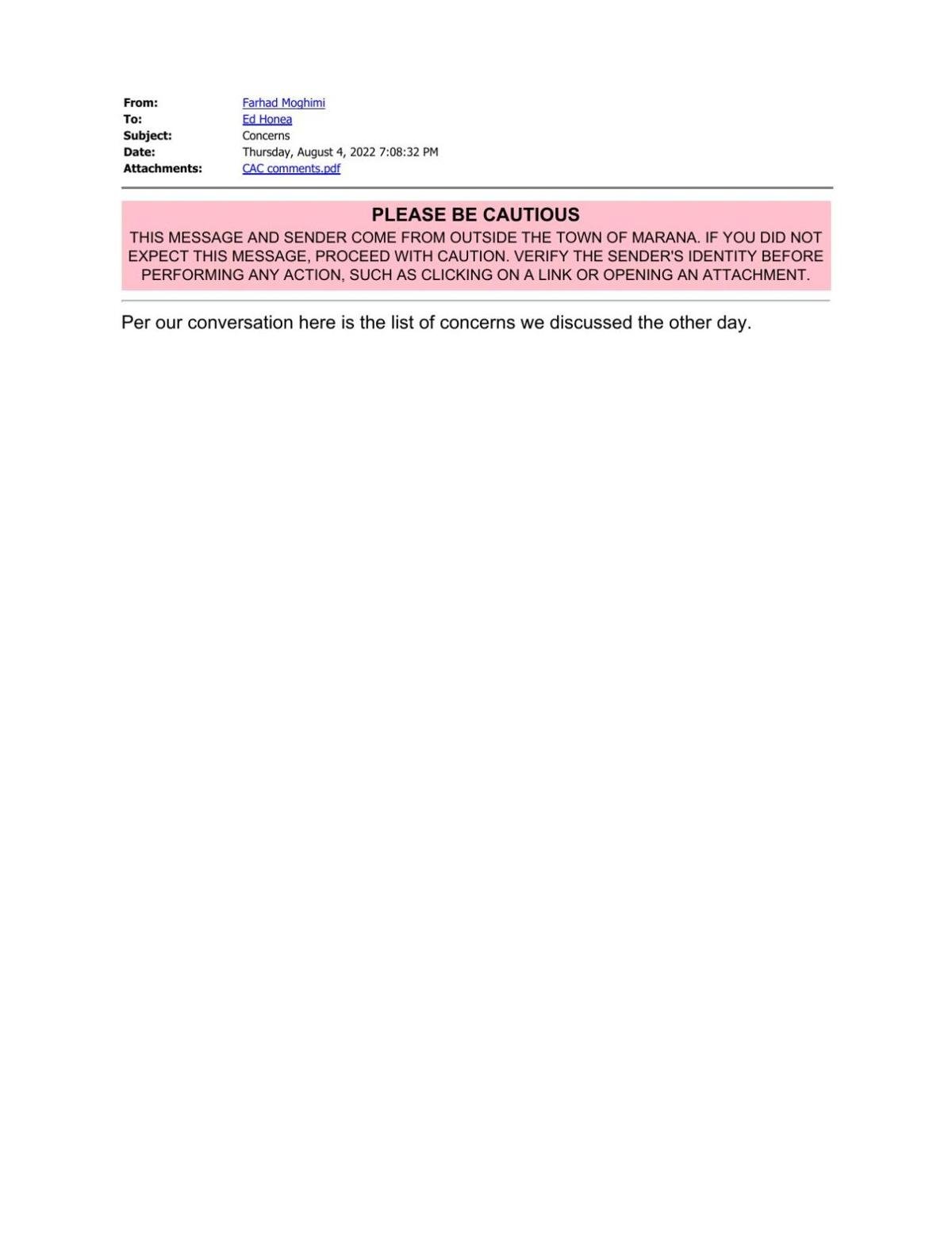
According to emails obtained from a records request a citizens’ committee member made, Moghimi emailed Marana Mayor Ed Honea on Aug. 4 summarizing a list of concerns about the guiding principles the mayor expressed in a previous conversation with Moghimi. Honea is also a member of the RTA Board.
“It appears there are a few very eager members of the CAC that want to establish no-growth and environmental policies that are stricter than state and federal laws for all the member jurisdictions through this regional transportation plan,” Moghimi wrote. “Policy issues will be addressed by the Board. Even then the Board cannot impose policies on individual jurisdictions.”
The email listed proposed changes to the principles that suggest changing “climate change” to “mitigate for environmental impacts.” Moghimi said, “Equity is also undefined and impossible to measure” and suggested: “Remove equity statement, again if it is a policy issue it will be addressed by the RTA Board.” According to both Honea and Moghimi, the changes were Honea's suggestions.
Members of the citizens’ committee subsequently received two memos from both Honea and Sahuarita Town Manager Shane Dille suggesting changes to the guiding principles.
Although the citizens’ committee has not changed its guiding principles, member Wilson said the discussion spurred by outside suggestions wasted committee time.
“We were forced to re-discuss our guiding principles that we had spent months working on. And that wouldn’t be such a big deal, but the thing is, our minutes in the CAC meetings are precious because we have a very limited range of things that we’re allowed to talk about in the CAC,” she said.
McGovern said the committee is still operating under the new guidelines. For now, the group is working on prioritizing a list of 108 potential projects that jurisdictions have submitted at an estimated cost of $4.5 billion. Initial estimates for the next RTA are $1.1 billion for named corridor projects, he said, and the citizens’ committee has to work in tandem with another committee to dwindle down the list.
The Technical Advisory Committee members are tasked with providing technical input to the citizens’ committee as it works on an RTA Next plan. The TMC has staff members from each jurisdiction, as well as citizens with specialties in capital planning and other experiences needed for the vast knowledge base regional infrastructure planning calls for.
Curt Lueck, a citizen member of the RTA, said the Open Meeting Law conundrum is reaching the technical committee, too. He said he also sees discussions ensuing without follow-up and meeting minutes that don’t accurately reflect discussions among committee members.
“We’re getting this edict that committee members shall not talk to each other outside of committee meetings,” Lueck said. “My frustration is that when we can talk, it’s basically muted. It’s really a strange situation. In my 40-some years of professional involvement in transportation plans, I’ve never seen anything as dysfunctional as this, to be real candid about it.”
John Bernal, another citizen member of the technical committee, said he’s had RTA-related conversations outside of committee meetings and “I don’t know that I’ve ever heard anybody complain about that or take issue with it.”
Faith in leadership
When asked if she’s heard concerns from members of the CAC before the Nov. 3 RTA Board meeting, Tucson Mayor Regina Romero, who represents Tucson on the board, said she’s “heard rumblings,” but believes the leadership in the citizens’ committee “are doing everything they possibly can so that everyone on that committee feels heard and feels as though their time is well invested.”
Pima County Supervisor Rex Scott, who represents the county on the RTA Board, said he’s heard some concerns but “so far, I don’t have any qualms about the way that the CAC leadership and PAG RTA staff have responded.”
Learn how Tucson public transit provider Sun Tran is electrifying its bus fleet.
 Pima County jail faces scrutiny amid decade-high number of deaths
