



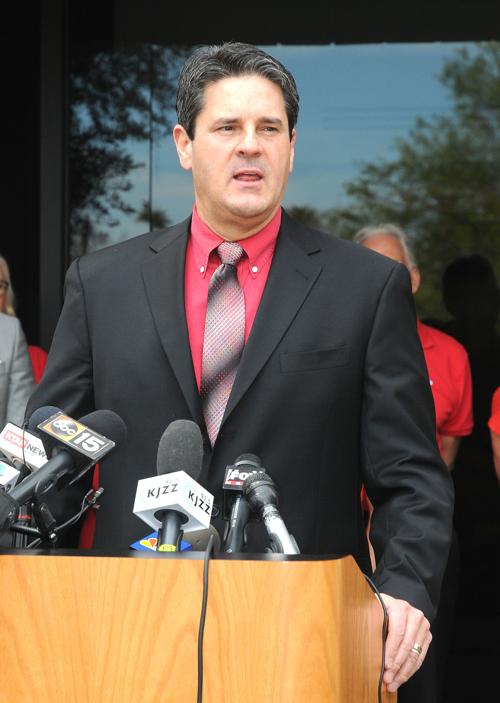
The head of the statewide teachers union said Wednesday a strike may be necessary to get salaries closer to where he believes they should be.
But not this year.
“A lot of work has to be done, a lot of storytelling has to happen so that people understand what the real issues are,” said Joe Thomas. The president of the Arizona Education Association told Capitol Media Services that centers on “support and respect.”
“Part of that comes as class size, part of that comes as a salary that keeps you in the state,” Thomas explained. And he said the 1.06 percent hike for this school year approved by lawmakers and a promise for an identical amount next year, is not going to cut it.
“Our teachers need to see something north of 5 percent,” Thomas said, something to bring salaries close to what they are in surrounding states.
But Thomas conceded that still leaves the question of whether anything will change if the estimated 50,000 public school teachers — or a significant share of them — abandon their classrooms for the picket line.
The issue arises in the wake of teachers in West Virginia securing a 5 percent pay hike from state lawmakers there after walking off their jobs. Education Week reports average salaries there already are close to $2,000 higher than they are here even before the new boost.
Thomas said that did not go unnoticed here. But he also said that his conversation with counterparts in West Virginia convinces him that kind of action doesn’t just happen.
“It’s months of discussions that lead to that frustration level,” he said.
Thomas said some of that was on display in Arizona Wednesday by teachers around the state who wore red to express their beliefs that their needs and the needs of classrooms are being ignored. He said that is a “statement of awareness that there are issues in our schools that people really need to start paying attention to.”
“And if that doesn’t work, well, then I don’t know what we’ll do next year,” Thomas said.
The last teacher strike in the state didn’t work out so well. That was in Sierra Vista in 1980 when slightly more than half of the district’s 300 teachers walked out at the beginning of the school year.
They were back in class a month later after schools remained open and the teachers were told to accept the school board’s last offer or be replaced. And the base salary remained unchanged.
Thomas, who moved to Arizona from Oklahoma 21 years ago, acknowledged this state’s general antipathy to unions — and strikes.
“I don’t think I’ve ever really seen that a statewide action could have the support, even among the teacher ranks to be successful,” he said. “But I’m really questioning that right now.”
What’s changed, Thomas said, is that teachers have seen year after year of state leaders ignoring not only the fact that salaries here are the lowest nationally but that Arizona has the third highest number of students per classroom.
“I believe they’re frustrated to the point where they just don’t believe they have many options left,” he said.
At the same time, Thomas said, the general public needs to be educated on what teachers already know is happening in Arizona.
“We have people that turn on a Facebook, any social media, and see advertisements out of Clark County, Nevada, every single day that tells them ‘You’re going to earn $11,000 more dollars and, by the way, we have just as much sunshine as you do in Arizona,’ Arizona has to wake up to that,” he said.
“A lot of work has to be done, a lot of conversations, a lot of storytelling still has to happen so that people understand what the real issues are,” Thomas explained.
Ultimately, though, the association’s rank and file will have to make some decisions.
“What teachers have to figure out is their level of frustration, their level of risk, and what it is they want to get,” he said.
One thing that is different than West Virginia, though, is that Arizona has what is likely the largest charter school system in the country. These schools, which can be run as for-profit or nonprofit operations, are permitted to hire whoever they want to teach.
That raises the question of whether a labor action by professionally trained teachers in traditional public schools would falter if their charter school counterparts refused to join.
Thomas, however, said he thinks there would be a unified front.
“I think they’re paid from the same meager funds and their salaries are just as poor as teachers in the district school are,” he said. “I don’t think that if you work in one or the other that you have a very different understanding of the respect you’re getting from the state.”

