


New teachers can’t afford to live in full-sized homes within the Vail Unified School District boundaries, so the district is thinking smaller.
Much smaller.
Like, tiny.
In an effort to ensure that teachers can afford to live in the generally well-heeled area that lacks affordable housing options, the Vail School District is looking to build a community of “tiny homes” for teachers.
Tiny homes are essentially minimalist urban homes built on top of flatbed trailers. They’re usually about 300 square feet but maximize space by using lofts, efficient storage and open-air designs that incorporate outdoor space. They’re popular with millennials, hipsters and others looking for a simplified, minimized or ascetic lifestyle.
The district plans to park the new tiny homes on a plot of land it owns and hopes to have at least four available before next school year.
When the site is fully developed, officials hope to build between 20 and 24 tiny homes to accommodate teachers in the district, with the possibility of opening other sites on district-owned land if the program is successful.
Vail Associate Superintendent John Carruth, who is spearheading the effort to get the tiny homes built, said he hopes they will offer new and young teachers — or those looking to downsize and minimize their carbon footprint — a cheap and hip option that will allow them to integrate into the Vail community. And district officials hope the tiny homes will help attract and retain teachers amid a nationwide teacher shortage.
“They’re tiny luxury homes. It feels luxurious, but it’s small. We want them to feel like it’s a cool and unique and honors the teachers and their profession,” he said.
But Joe Thomas, president of the Arizona Education Association, the state’s largest teachers’ union, said the idea of offering teachers tiny homes is somewhat insulting — and reflects the overall sad state of teacher pay, especially in Arizona, where teacher salaries are among the lowest in the nation.
“Tiny homes for our tiny salaries,” Thomas quipped.
Thomas described the plan as “somewhere between strange and innovative” and said while he wished it weren’t necessary, Vail’s attempt to ensure teachers have affordable housing within the school district boundaries is commendable.
Vail Superintendent Calvin Baker said while it would be nice to be able to pay teachers enough to buy homes in Vail, that’s simply not a reality for most teachers early in their careers, no matter where they work.
“I think the right way to frame it is not tiny homes versus suburban homes. It’s tiny homes versus small apartments, because that’s where most of us started,” he said.
CRUNCHING THE NUMBERS
The starting base salary for a teacher in Vail is about $36,000, which isn’t enough for single teachers, or families with a teacher as the main breadwinner, to afford housing in Vail, where the median household income is $83,000 and the median home sale price is about $260,000.
And Vail faces a somewhat unique problem — there’s not a single apartment complex anywhere in the district’s 425-square-mile boundary.
But Vail officials hope that what they’re planning will be better than an apartment complex and will inspire a unique community of teachers who want to be a part of Vail’s future.
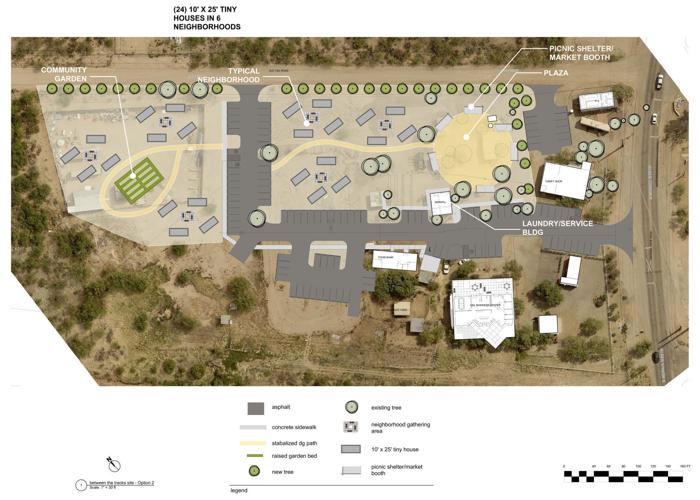
The tiny-home community would be built on a plot of desert land at Old Vail and Colossal Cave roads, right in the heart of old downtown Vail. The land already has a septic system and a well that the district owns.
The land is sandwiched between train tracks, tucked behind a community thrift store. It’s within walking distance of three schools, a shopping center, a Mexican restaurant and a Safeway that’s moving into the neighborhood. District officials hope the tiny homes will revitalize the area and celebrate Vail’s history.
Draft plans show neighborhoods of four inward-facing tiny houses, roughly 250 square feet each. The land is dotted with trees and includes a central plaza area, picnic shelters, a laundry area and a winding path to a community garden.
Figuring out how to finance the tiny homes has been the biggest hurdle so far, according to Baker. The district isn’t looking to make a profit on the tiny homes, but it also wants to be sure to recoup its costs.
“No one has done this before. ... The problem is lenders aren’t sure what tiny homes are yet,” he said.
The district is looking at a several different financing options, including a scenario in which the district would take out a loan to buy the tiny houses and charge rent of $500 to $600, not including utilities.
Baker said he’d also like teachers to be able to take out loans to buy tiny homes themselves, to instill a sense of ownership and help build young teachers’ credit. If that’s the case, the district would set up an employment agreement allowing teachers to park their tiny home on the district property for the duration of their employment.
The costs of tiny homes vary widely, and the district is exploring options in the $45,000 to $70,000 range.
If the district purchases the homes, they would likely buy several different sizes — likely between 250 and 400 square feet — to accommodate teachers with different family situations, including single teachers, married teachers, and maybe even a young family with a baby or two.
“It seems like when you get to four (people), that’s about the max,” Carruth said.
COMMUNITY BUILDING
The district has been holding meetings to discuss the project with Governing Board members, community leaders and teachers since late last year, and Baker said teachers are excited.
“If we had five or six units available today, I’m confident we could fill them,” Baker said.
If Vail meets its timeline of having at least one pod of four tiny homes up before next school year, it may be the first of its kind in the country. A Colorado school district is considering a similar plan, though it hasn’t started construction.
Darin Dinsmore, the Arizona representative for the American Tiny House Association, said a Sedona charter school is looking to build a few tiny homes for its employees, but hasn’t received the necessary permits.
But many rural school districts offer housing as part of their contracts to help attract teachers.
The Baboquivari Unified School District near Sells, for example, has dozens of rental units it supplies to teachers at a steep discount of between $180 and $280 per month. It also buses teachers into town daily from Tucson on Wi-Fi-equipped buses. Patagonia Public Schools renovated an old school building into teachers’ living quarters, creating apartments at a discounted rate of around $475 per month, though only two teachers currently live there, according to the district.
A lack of affordable housing within the district is not a phenomena unique to Vail, and many other communities, like San Francisco and New York, struggle with the same issue. But Thomas, the union president, said Vail’s predicament is unique for Arizona. He couldn’t think of another area where teachers can’t find some kind of affordable housing within the district boundaries.
“Scottsdale is kind of high, but there’s some affordable housing,” he said.
And education experts say living in the community where you teach makes a big difference, both for the teachers and the students and parents.
Thomas said if a teacher lives outside the community, they often have to rush home at the end of the day, meaning they can’t participate in after-school programs, attend school plays, or just run into students and parents at the grocery store.
“It’s hard to explain, but really, it comes down to the value of community,” he said. “You’re supposed to see important people from the community actually in the community.”
Many Vail Unified School District teachers live in Tucson and commute to work.
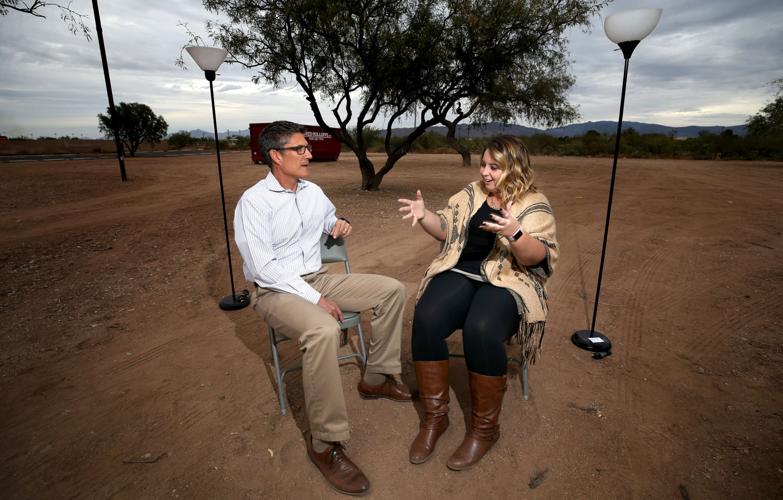
That’s the case for Samantha Frantz, a 28-year-old fifth-grade teacher at Cottonwood Elementary School who is in her second year teaching in Vail, after teaching for two years in her home state of Indiana before she moved to Arizona. She has a master’s degree in elementary education and could be earning significantly more working in Indiana, but she wanted a change and fell in love with Arizona.
After accepting a job offer with Vail, Frantz immediately began searching for a nearby apartment. But she quickly found there were none.
Instead, she and her two pug dogs moved into the Sabino Canyon area, a 40-minute commute to work, which was not only time-consuming but expensive. So Frantz broke her lease and moved to a two-bedroom apartment near 22nd Street and Pantano Road, where her commute is only about 20 minutes. But the apartment was a downgrade, she said.
“I’ll be honest, my apartment is not very nice. I wouldn’t live here as my first choice,” Frantz said, adding that although the apartment is only about 700 square feet, she never uses the second bedroom.
So when Vail started discussing the tiny-home idea, Frantz quickly got involved. Since then, she’s become enamored with the tiny-home movement, watching TV shows about tiny homes and following tiny-home builders on social media.
And while she was initially skeptical that the project would ever come to fruition, Frantz said after two years working in Vail, she knows when the district sets its mind to an innovative project, it gets done.
“I mean, they have Wi-Fi on school buses,” she said.
She thinks a tiny-home community would make the transition easier for new teacher like her by offering a sense of community and security among like-minded colleagues. Right now, she drives from Tucson to Vail and straight back home, where she doesn’t socialize with her neighbors.
“Because of where I live, I don’t explore Vail. I have no idea where the other schools are at, which is awful because I teach here,” she said.
“It’s tiny homes versus small apartments, because that’s where most of us started.” Calvin Baker, Vail superintendent

