

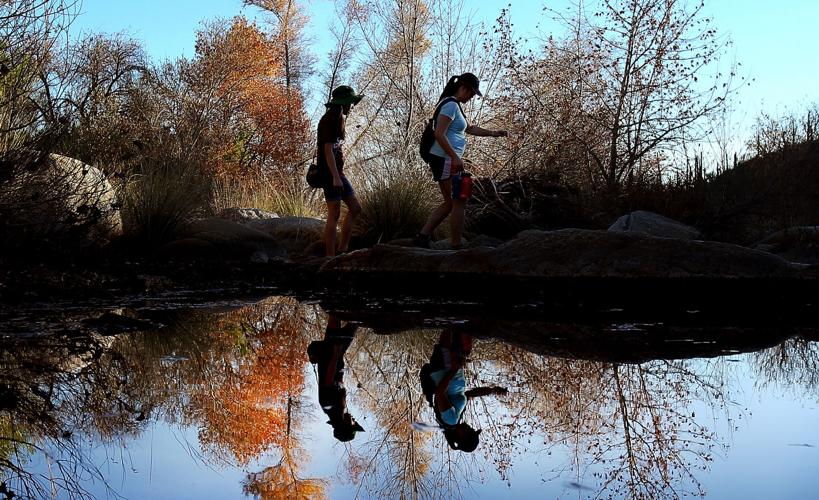
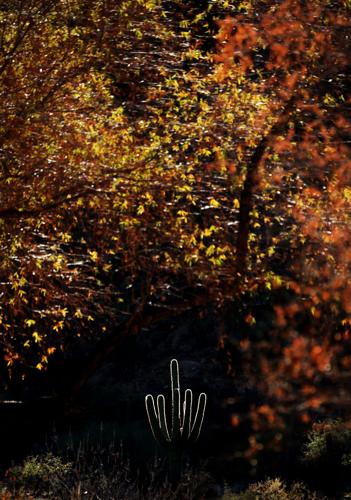
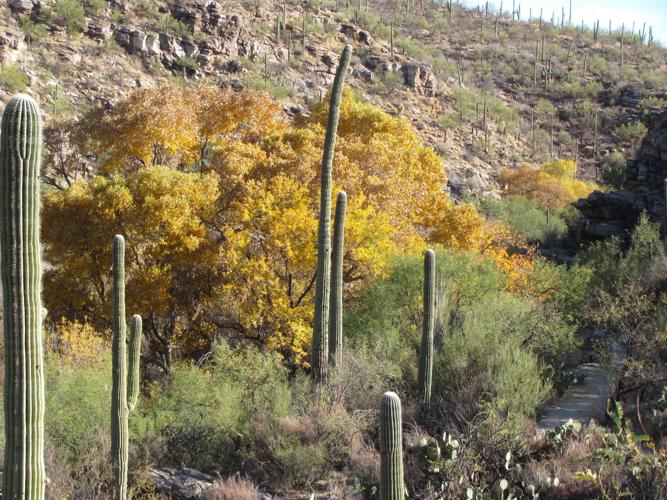
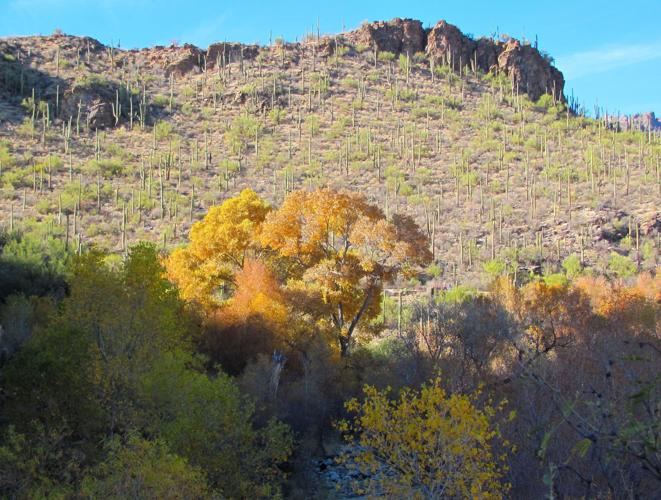

Trees along the creek in popular Sabino Canyon northeast of Tucson are still showing brilliant “autumn” color in January — but one of the foremost experts on the canyon says there is a troubling side to that unseasonable beauty.
“There are an unusual number of colorful leaves still clinging to Sabino’s big trees for this time of year,” said David Lazaroff, a naturalist and author of “Sabino Canyon: The Life of a Southwestern Oasis.” “Equally striking is the number of trees whose leaves are just beginning to change color.
“The effect of all this is pleasant to the eye but troubling to the soul,” Lazaroff said. “These are just the most visible changes to the natural scheme of things in Sabino Canyon resulting from a changing climate. More powerful floods and longer periods when the creek is dry are other climate-related effects.”
CLIMATE CHANGE FACTOR
Scientists at the University of Arizona note that a global warming trend is indisputable. But they emphasize that it’s not possible to say with certainty that specific phenomena — such as the very late autumn color in Sabino Canyon — are a result of climate change.
“There’s an incredibly clear warming trend where we’ve had these record warm years,” said David Breshears, a professor of natural resources at the university. “These types of responses — lower stream flow and changing phenology of plants (seasonal life-cycle events) — are not surprising.
“But it’s difficult to say that a specific change at a specific time is related” to climate change, Breshears said.
Others, including experts at the USA National Phenology Network in Tucson, said sparse records spanning a relatively short period of time are insufficient to attribute something such as a late leaf drop to a particular cause.
BONE-DRY CREEK
Prolonged drought conditions have left Sabino Creek bone dry for an unusually long period of time.
“We haven’t had any flow in Sabino creek since September 14,” said Chris Magirl, a research hydrologist with the U.S. Geological Survey.
That means the waterway, a favorite destination for many canyon visitors, has been without flowing water for 113 days as of Friday, Jan. 5.
Magirl said stream-flow records indicate that this is the fifth-longest no-flow period on Sabino Creek since measurements began in 1932, with the other four occurring in recent decades. The longest period of continuous dry days was 165, ending in March of 2006.
Magirl said it will take about an inch or more of rainfall, or snowmelt from the nearby Catalina Mountains, to get the creek flowing again.
The long-term outlook for the creek and vegetation in the canyon remains uncertain.
“No one can predict everything that’s coming,” Lazaroff said.
The Sabino Canyon visitor center is at 5700 N. Sabino Canyon Road. Admission is $5 per vehicle.

