

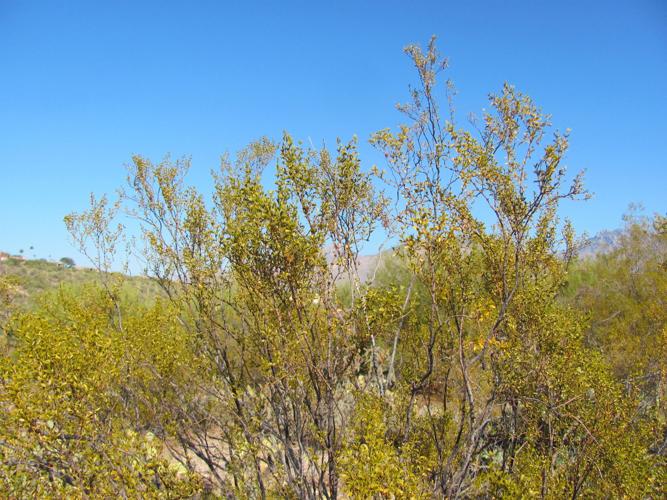
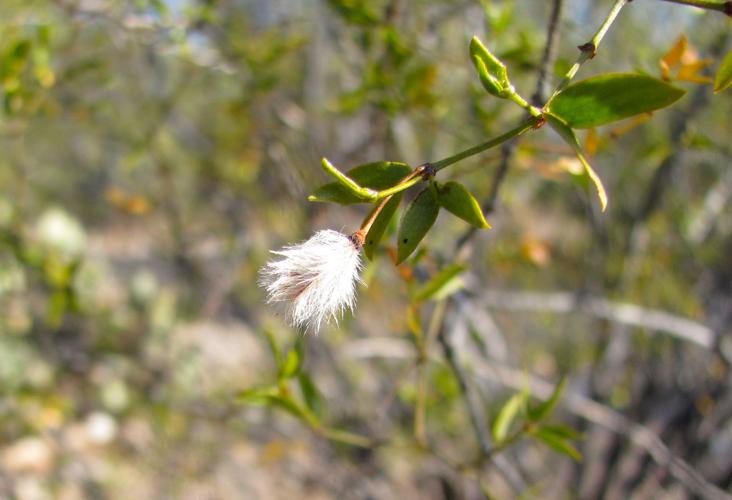
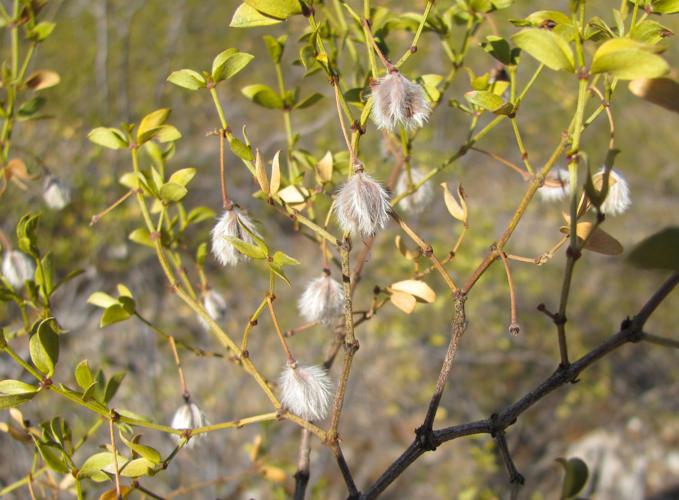

The creosote bush that grows in deserts around Tucson isn’t exactly spectacular in appearance — but one thing about it might astound you: its amazing age.
Creosote clones stemming from a single root system are believed to live for 5,000 years or much longer, scientists say.
Each individual stem, descended from the original seed, might live “only” 100 to 150 years — and even that’s pretty old.
The creosote bush, also known as greasewood, is the plant that gives off a pungent odor after desert rainfalls. Thousands of creosotes flourish on public lands around Tucson and in Foothills neighborhoods as well.
ANCIENTS OF THE DESERT
Estimates of the age of creosotes vary vastly — from a few thousand to more than 11,000 years.
One of the largest known creosote clones — a specimen in the Mojave Desert of California — is known as the King Clone.
“Estimates for the age of that clone range from 9,200 years to 11,700 years” based on carbon dating and other techniques, said John Wiens of the botany department at the Arizona-Sonora Desert Museum west of Tucson.
It’s important to keep in mind that those estimates refer not to the age of individual plant stems but to clones — numerous genetic replicas — stemming from a single root system.
An old creosote “is an individual plant, but not an individual stem,” said Mark Dimmitt, a retired director of natural history at the Desert Museum and an expert on desert plants. “It’s a clone, descended from the original seed.
“Each individual stem doesn’t seem to last more than 100 to 150 years, but by the time it dies it can produce a new one at its base,” Dimmitt said. “If it starts from a seed, everything that sprouts from that will be genetically identical.”
Wiens and Dimmitt note that there is some uncertainty about the age of the King Clone.
Dimmitt’s estimate for some of the oldest clones: “Two thousand, 4,000 and possibly as much as 5,000 years.”
AGE ISN’T EVERYTHING
While many desert dwellers are more smitten with spectacular species such as the saguaro than with the creosote, Wiens said he finds much to like about creosotes besides their long clonal lives.
“I myself love the plant,” he said. “I have two of them in my yard. It’s kind of ubiquitous in most of the Sonoran Desert, and you get used to seeing it. But when it comes into bloom, it can be gorgeous with all those yellow flowers.
“And then there’s the smell of creosotes after a summer rain,” Wiens added. “It’s the iconic smell of the desert.”
OTHER CLONES
“There are probably a lot more cloning plants than we realize,” Wiens said. “Coastal redwoods can grow from a clone.
“And the jumping cholla cactus has clones,” he said. “Every piece that falls off can become a new plant with the same genetics.”

