

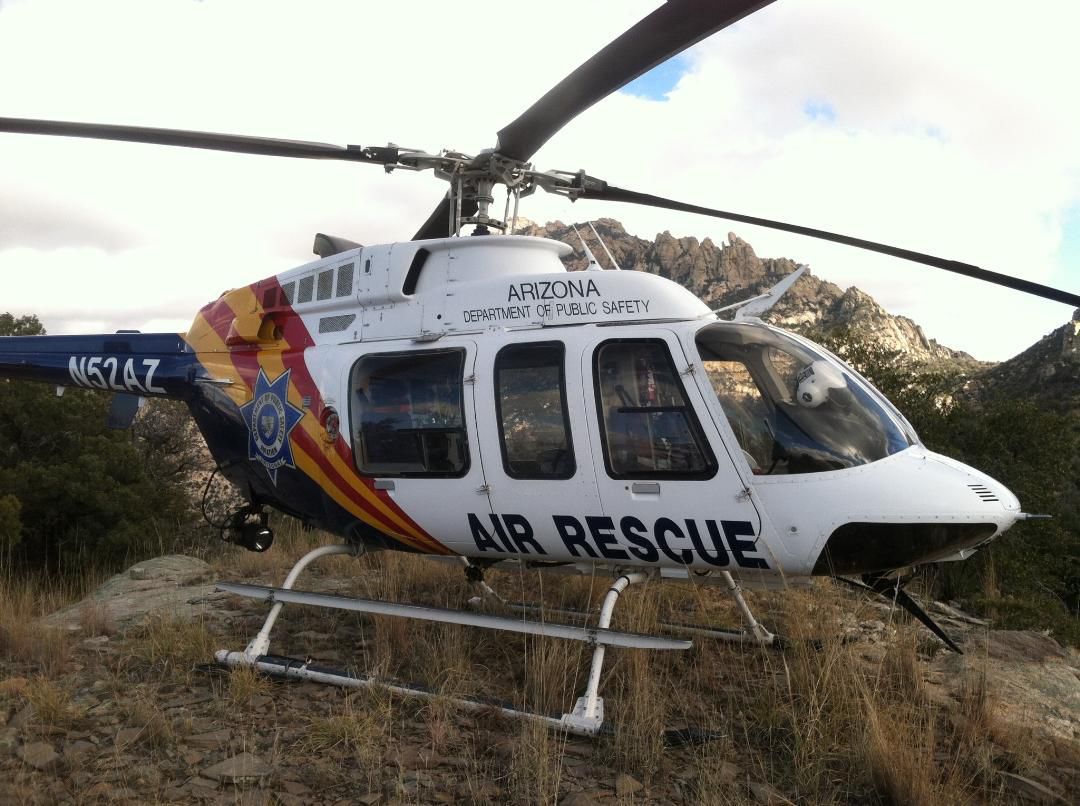

In Hunter French’s 23 years as a pilot for the Arizona Department of Public Safety, he’s never had a day like Sunday.
During two separate calls, his DPS Ranger helicopter was unable to land at either location and the crew had to perform technical rescues on six people, pulling each into the chopper by rope.
“Busy season is right now,” French said, adding that the six rope rescues were the most he’s done in a single day. “The weather is getting so nice that people want to get outside before it gets too hot.”
Hikers in distress on Southern Arizona’s trails are keeping other search and rescue crews busy, as well. Since last week, Pima County sheriff’s crews, along with aid from other agencies, have responded to 10 calls in mountainous and recreational areas surrounding Tucson, said a sheriff’s spokesman. Some hikers had fallen, hitting their heads or sustaining other injuries; others got lost or felt dizzy, sheriff’s reports show.
On Monday, an Air and Marine UH-60 Blackhawk crew rescued a hiker from a rugged ravine in Pima Canyon in the Santa Catalina Mountains, said U.S. Customs and Border Protection officials. The man was lifted into the helicopter and received medical treatment before he was taken to a hospital.
A member of the Southern Arizona Rescue Association posted on his personal Facebook page: “It’s getting hard to keep track of just the air ops let alone the calls. We’ll keep answering the call as best we can. Stay safe in the beautiful Tucson Backcountry.”
The SARA member also posted on his Facebook page that hikers should not engage in activity “too extreme” for their fitness level.
SARA crews, which are called in by the sheriff to aid in rescues, were out Monday in Sabino and Pima canyons, and Tuesday on a Butterfly Trail rescue in the Catalinas.
DPS’ experiences Sunday show what rescuers are up against.
On a shift that usually starts at 8 a.m., DPS paramedic Phil Castellano got the call about a Sycamore Canyon rescue shortly after 6:30 a.m. Sunday. He met French at the hangar, and by 7:30, the pair had figured out a rescue plan and were in the air.
Four hikers at Sycamore Canyon, located in the Coronado National Forest, contacted the Pima County Sheriff’s Department Saturday night after one of the group members began feeling ill and was unable to hike out. Rescue volunteers spent the night with the group, hoping that rest and rehydration would allow the woman and the rest of the group to walk out the next morning.
“I knew it would be a rope rescue when the Sheriff’s Department told us they weren’t able to make the hike,” French said.
Pilots always try to land the helicopter during rescues, but when that’s not possible, they try to lower a rescue employee or paramedic to the victim.
In both of Sunday’s DPS rescues, neither option was possible.
While the Sycamore Canyon hikers weren't injured, rescuing two victims at Seven Falls proved even more complicated, as one of the men had fallen and lost consciousness.
“Halfway through the Sycamore (Canyon) rescue, it became apparent it would probably be a busy day. I just didn’t know it would be that busy,” Castellano said.
Seven Falls, in the Sabino Canyon area near Tucson, is one of the hardest areas for crews to land the helicopter in due to crowding, and the idea never even crossed French’s mind on Sunday.
“I’ve never seen as many people as this weekend. There were hundreds,” he said.
The area also presents its “own unique challenge” in finding a place to let the crew out, and Sunday was no different. The spot the hiker had fallen to proved too dangerous for rescuers to get to by helicopter.
A Pima County sheriff’s deputy rappelled to the spot, loaded the victim into a Bauman Bag — a type of aerial backboard — and lifted him up to the helicopter.
The hiker’s friend, who was not injured, was hoisted up in a “Screamer Suit,” which allows the person to be secured in a seated position, French said.
Although the Seven Falls rescue involved a serious injury, a lot of hikers ended up needing rescues because of simple lack of preparation, Castellano said.
“People think they’ll be out hiking for an hour or two and it turns into six hours, and they’ve only brought one bottle of water,” he said, adding that at least a gallon per person is always a good idea.
The split between injury rescues and dehydration rescues is about 50-50. People should always plan for the “unplannable,” Castellano said.
In addition to bringing extra water, people should never hike alone and should always plan as if they will be out longer than they expect. It’s always a good idea to know the trail and do a little research before heading out, and if something happens, groups or pairs of hikers should never split up, French said.
French and Castellano, who have already conducted numerous rescues in Phoenix this year, say it’s only going to get busier.
In 2016, the Ranger crew performed 471 rescues statewide.

