


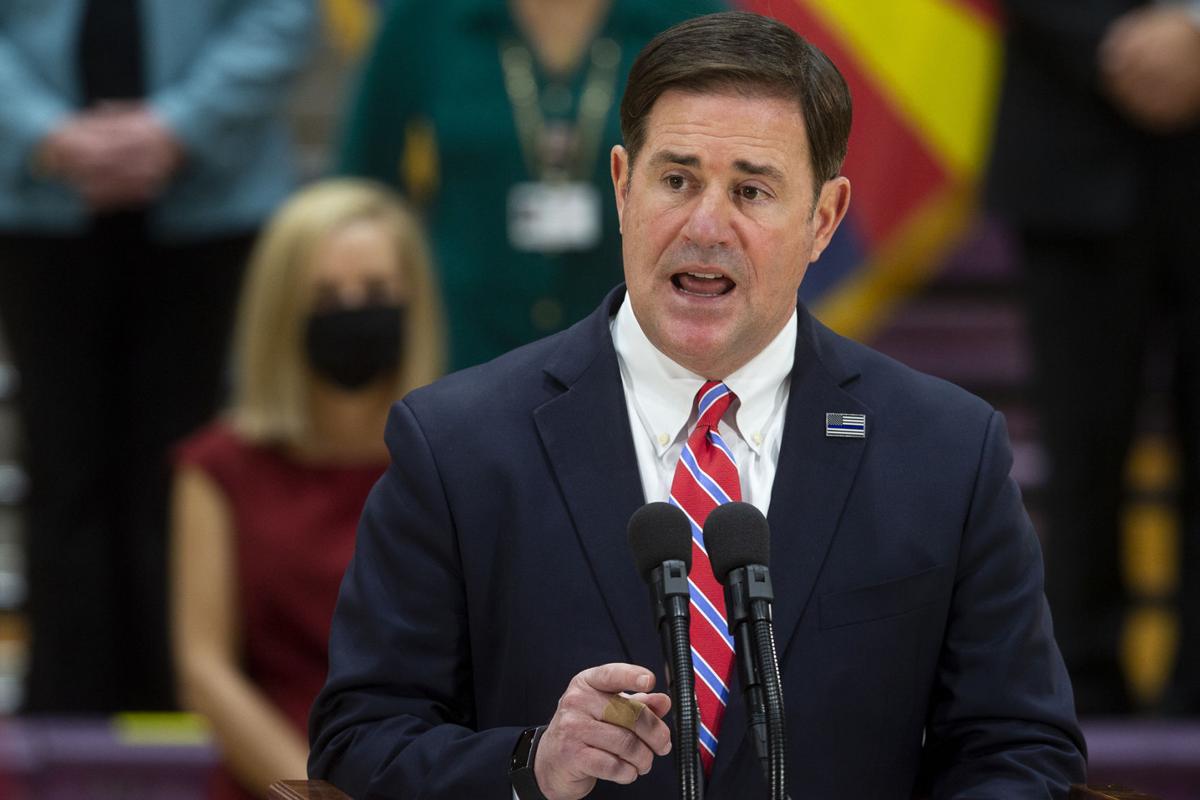
Gov. Doug Ducey has no plans to use state resources to make up for the fact that more than 430,000 Arizonans will see their jobless benefits cut by more than half within weeks.
“It’s on Congress,” the governor said Thursday when asked about the rapidly depleting federal account that is providing unemployed Arizonans with an extra $300 a week.
The last week for the extra payments could come at any time, Michael Wisehart, director of the state Department of Economic Security, said a week ago. And when the end comes, it will be sudden, with no advance warning, he said.
That will leave Arizonans who have lost their jobs through no fault of their own — some due to Ducey’s policies shuttering or curtailing certain businesses during the pandemic — with a maximum of $240 a week.
On one hand, Ducey said the state does have “money in the bank.”
“We have been financially responsible,” he said. But he called questions from Capitol Media Services about the state filling in some, if not all, of the lost benefits “hypothetical.”
Ducey’s message to unemployed Arizonans, if congressional action does not happen, was simple: “Plan ahead,” he said.
He brushed aside questions of whether he could live on $240 a week, which is the second-lowest state jobless benefit in the nation, with only Mississippi’s lower.
“This is on Congress,” he repeated.
Separately, the governor said the fact that President Trump admitted to journalist Bob Woodward that he publicly downplayed the risk of COVID-19 in February did not affect Arizona’s response to the virus.
“There has been a sense of urgency and seriousness about this since Day 1,” Ducey said. That included activating the state’s Health Emergency Operations Center in January to track suspected and confirmed cases and his declaration of emergency in March.
And the Republican governor said he trusts Trump and the administration.
“Trust is built through experience and actions,” Ducey said. “And on every ask that the state of Arizona has had, either to the president or the administration, they have delivered.”
It was an executive action by Trump that allocated $44 million in August to provide the extra $300 a week in unemployment benefits, after Congress failed to agree to continue the $600 weekly bonus provided earlier in the pandemic. Ducey put Arizona’s share of the August allocation at $725 million.
The Republican-controlled U.S. Senate considered a bill Thursday with funds for $300 supplemental benefits for the unemployed. But it is considered dead on arrival because Democrats want $600 payments, hazard pay for essential workers and a second round of stimulus checks.
In Arizona, aides to Ducey said he has set aside $400 million from the federal Coronavirus Aid, Relief and Economic Security Act, some of that being money he did not divide among Arizona cities, towns and counties.
Ducey has some other ideas about how he wants to spend the money. Those include providing some financial relief for businesses that are facing higher unemployment taxes by the end of the year.
From Ducey’s perspective, that leaves only the possibility of federal action to keep benefits from shrinking.
There is a separate question about the status of the financial stability trust fund, a special account that provides the money for Arizona’s $240-a-week unemployment benefits.
Before the pandemic there was more than $1.1 billion in the fund, all of it financed by a tax paid by employers on the first $7,000 of each worker’s salary.
And as of Sept. 5, there was less than $358 million available, and $50 million more a week is being paid out in benefits than taken in from employers.
If the trust fund becomes insolvent, the state would have to borrow the money from the U.S. Labor Department, and to pay it back through higher taxes on employers. That is why Ducey is looking at using some of the CARES money to replenish the trust fund, which would likely be a stopgap solution.
There are indications the situation is not getting better. The 430,000 Arizonans now collecting benefits compares with 371,100 in the week ending Aug. 8.
The weakest sector remains leisure and hospitality jobs, particularly among bars and restaurants. Ducey has shuttered the former entirely unless they change their mode of operation and agree to restrictions to help slow the spread of COVID-19. And although restaurants can open, they are limited to 50% capacity.
We encounter these beautiful creatures in our yards. Leave them alone and they'll move on eventually. Photo by Arizona Daily Star readers. Submit photos to tucson.com/readers
Photos: In Tucson, face masks are for more than just people
Face masks on objects
Updated
A Jeep sports with eyes like those from the movie "Cars" sports a COVID19 mask outside Alpha Graphics near the corner of Tanque Verde and Kolb, Tucson, Ariz., July 3, 2020.
Face masks on objects
Updated
The large Tiki head at the entrance of The Hut, 305 N. 4th Ave., wears a mask in response to the Coronavirus Disease (COVID-19) in Tucson, Ariz., on April 5, 2020.
Face masks on objects
Updated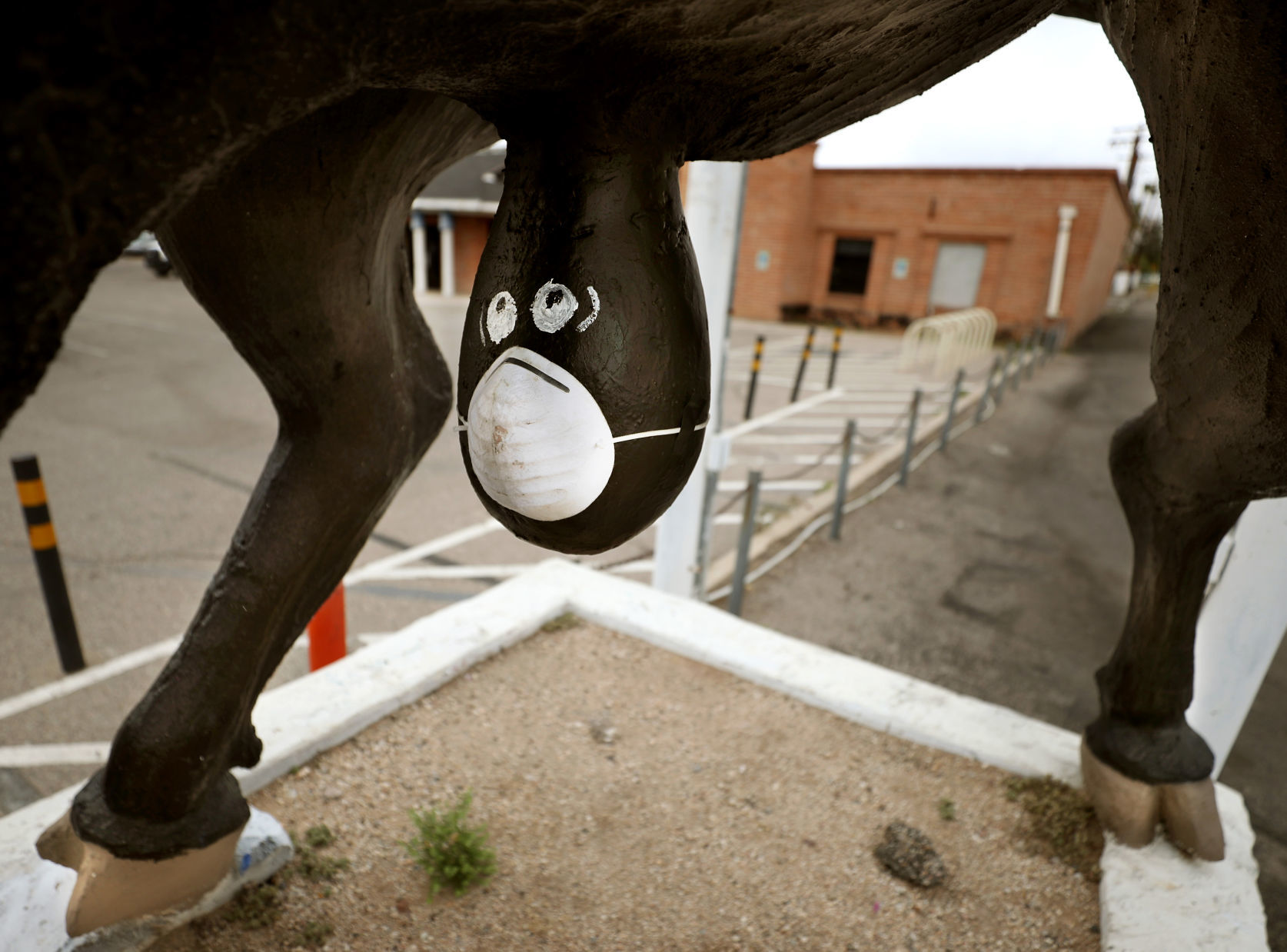
The noted bull testicles on the statue outside Casa Molina at Speedway and Wilmot, usually painted in various schemes and wild colors, are in these CONVID19 times now sporting a face mask, March 27, 2020, Tucson, Ariz.
Face masks on objects
Updated
A dinosaur statue over the doors of MATS Dojo at 5929 E. 22nd St., sports an athletic cup for a face mask in the second week of COVID-19 restrictions, March 31, 2020, Tucson, Ariz.
Face masks on objects
Updated
The venerable T-Rex outside the McDonald's at Grant and Tanque Verde comes around late, but strong, to the mask game, May 13, 2020, Tucson, Ariz.
Face masks on objects
Updated
The iconic Casa Molina bull and matador statue both sported masks on the first full week of the loosening of COVID-19 restrictions in mid-May.
Face masks on objects
Updated
Father Kino's horse practice safe social interaction by wearing a mask even if Father Kino himself isn't. The statue sits at Cherry Fields at 15th Street and Kino Boulevard, Saturday, May 2, 2020, Tucson, Ariz.

