



Hundreds of thousands of unemployed Arizonans are within weeks of losing more than half their jobless benefits.
And that would leave them with just the $240 a week — if not less — that the state provides, the second-lowest payout in the nation.
Michael Wisehart, director of the state Department of Economic Security, said Wednesday he has been assured there are sufficient federal dollars to pay the $300 in extra benefits in the special federal Lost Wage Assistance program for this week. That is the fifth week that has been available.
Wisehart also said he believes there’s enough federal cash for a sixth week.
He said, though, that given that other states are drawing against the $44 billion federal allocation, the dollars will dry up before the seventh week. And he said it will likely come without warning.
But Gov. Doug Ducey has no plans for the state to step in and try to make up even part of the difference.
“We’ve known these funds were limited,” said press aide Patrick Ptak. He said that’s why Arizona moved quickly to accept the offer by President Trump to get a share of that federal cash.
And going forward for Arizona’s unemployed?
“As we’ve said all along, Congress needs to work together to extend these benefits long term,” Ptak said.
Complicating matters, Wisehart said the economy remains soft and Arizonans continue to lose their jobs.
He said about 131,000 people filed first-time applications for benefits last week. That compares with 86,000 the prior week and 50,000 the week before.
The situation is even more dire than that.
Wisehart said the unemployment trust fund — the dollars set aside by a tax on employers to pay regular state benefits — will become insolvent in about eight weeks.
Put simply, the account that had $1.1 billion in it before the pandemic and the restrictions imposed by Ducey on business operations is now down to about $400 million. And Wisehart said the state is burning through the cash at a rate of $50 million a week, with no end in sight.

A visualization shows why face shields offer less protection for others in preventing the spread of COVID-19.
“Obviously the pandemic isn’t going to end soon,” he said.
That won’t mean an end to regular state jobless benefits. Instead, it will mean Arizona will have to borrow money from the U.S. Department of Labor.
“But you have to pay that money back, through taxes on employers, going forward,” Wisehart said.
And that, in turn, could provide a new financial impediment to companies still reeling from the effects of the pandemic.
Ptak said Ducey has set aside more than $400 million Arizona got from the Coronavirus Aid, Relief, and Economic Security Act. That could be used to pay jobless benefits going forward rather than forcing the state to borrow and raising taxes on employers.
But with $50 million a week more going out in benefits than what is being collected from employers, that becomes only a temporary solution.
That still leaves the question of the nearly 400,000 Arizonans who will lose that extra $300 a week sometime this month.
State law entitles those who lost their jobs through no fault of their own to collect half of what they were earning, with the proceeds coming from a levy paid by all employers on the first $7,000 of each worker’s salary. But lawmakers capped that at $240 a week. Only Mississippi pays less.
There has been little pressure on lawmakers to alter that given what has been the state’s relatively low unemployment plus a strong job market. In fact, in a typical pre-COVID-19 week, only about 18,000 Arizonans were collecting benefits.
As recently as July, Ducey refused to discuss altering the cap.
“It’s a hypothetical question because unemployment wasn’t really an issue before the pandemic,” he said.
In fact, he argued, in precoronavirus times there were plenty of jobs out there for people to find “at any time.”
All that changed with the economic chaos caused by COVID-19 and the business closures.
Wisehart advised those getting unemployment benefits to plan ahead for when they will no longer be there.
What might also help, he said, is working with members of Congress to come up with a new plan to provide expanded unemployment benefits — and quickly.
If — and presumably when — the trust fund balance goes to zero, it won’t be the first time.
Arizona had to start borrowing money a decade ago during the last economic downturn. It got so bad that the state eventually was in the red to the federal government to the tune of $600 million.
All that led to a surcharge on top of the tax that employers already pay. While the rate varies depending on how often companies lay off workers, the presumptive rate for new employers is 2% of the first $7,000, or $140 a year.
But paying off the note last time added another $42 a year per worker.
Photos: Community Food Bank hosts Drive-up Farmer's Market
Santa Cruz River Drive-up Farmer's Market
Updated
Andreas Anderson, community foods coordinator, places an order in the trunk of a customer's car during the Santa Cruz River Drive-up Farmer's Market by the Community Food Bank of Southern Arizona near the Mercado District on July 16, 2020.
Santa Cruz River Drive-up Farmer's Market
Updated
Victor Ceballos, garden education coordinator, says he loves to chat with customers as they wait to place an order for produce during the Santa Cruz River Drive-up Farmer's Market by the Community Food Bank of Southern Arizona near the Mercado District on July 16, 2020.
Santa Cruz River Drive-up Farmer's Market
Updated
Rick Rosenberg plays "It's You I Like" by Mr. Rogers on his ukulele as he waits to place an order for produce during the Santa Cruz River Drive-up Farmer's Market by the Community Food Bank of Southern Arizona near the Mercado District on July 16, 2020.
Santa Cruz River Drive-up Farmer's Market
Updated
Andreas Anderson, community foods coordinator, hands a bag of produce through a customer's car window during the Santa Cruz River Drive-up Farmer's Market by the Community Food Bank of Southern Arizona near the Mercado District on July 16, 2020.
Santa Cruz River Drive-up Farmer's Market
Updated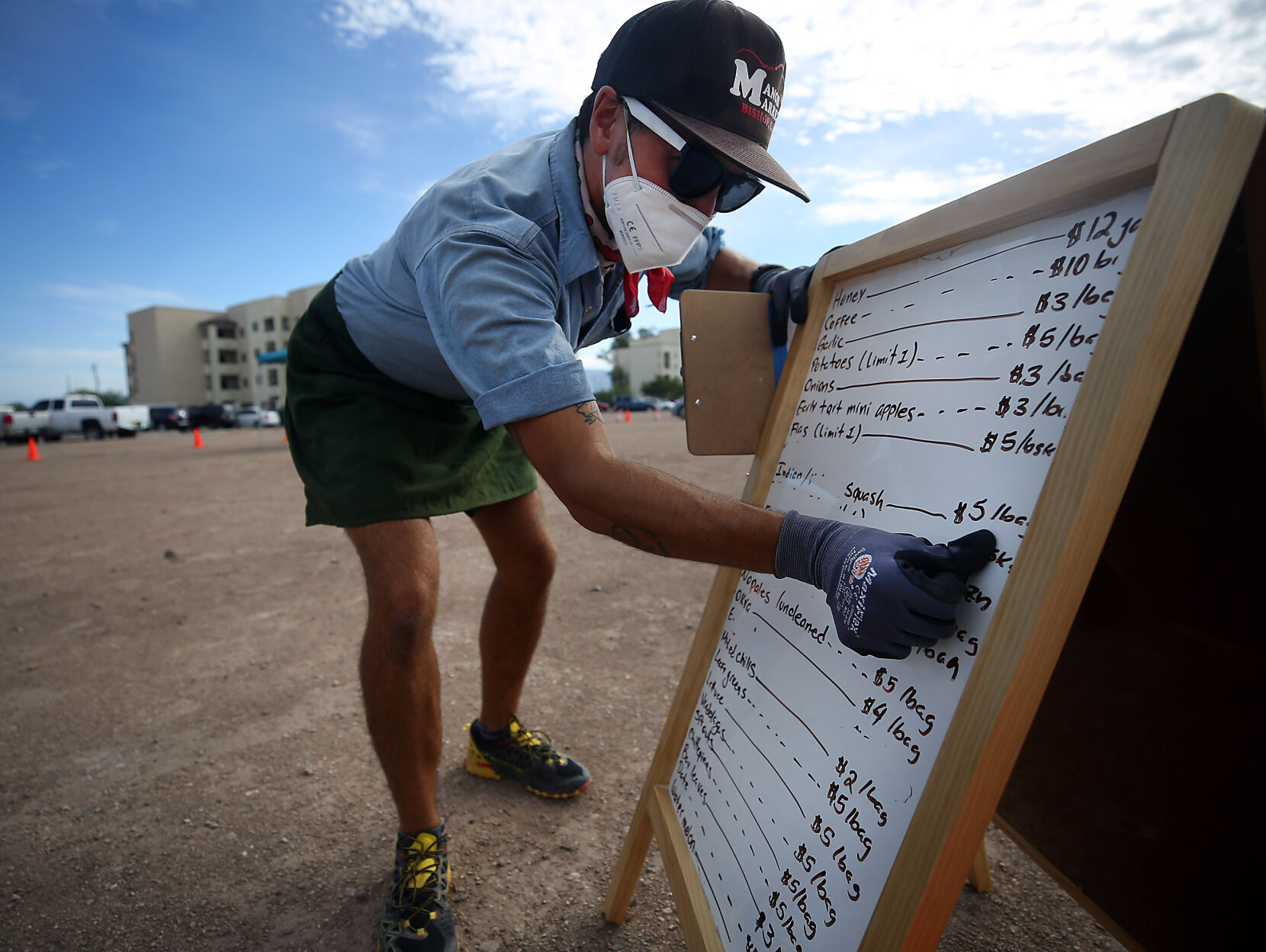
Andreas Anderson, community foods coordinator, erases tomatos from the white board after running out of them to sell during the Santa Cruz River Drive-up Farmer's Market by the Community Food Bank of Southern Arizona near the Mercado District on July 16, 2020.
Santa Cruz River Drive-up Farmer's Market
Updated
Andreas Anderson, right, community foods coordinator, takes an order from a customer during the Santa Cruz River Drive-up Farmer's Market by the Community Food Bank of Southern Arizona near the Mercado District on July 16, 2020.
Santa Cruz River Drive-up Farmer's Market
Updated
Cora Varas, a volunteer, double checks the order with a customer during the Santa Cruz River Drive-up Farmer's Market by the Community Food Bank of Southern Arizona near the Mercado District on July 16, 2020.
Santa Cruz River Drive-up Farmer's Market
Updated
Cora Varas, a volunteer, works on fulfilling a customer's order and then bringing it to their car during the Santa Cruz River Drive-up Farmer's Market by the Community Food Bank of Southern Arizona near the Mercado District on July 16, 2020.

