


After significantly exceeding the engineer’s estimate, the three bids that came in for the third phase of the massive Downtown Links project have been tossed out, forcing the city to look for ways to cut project costs.
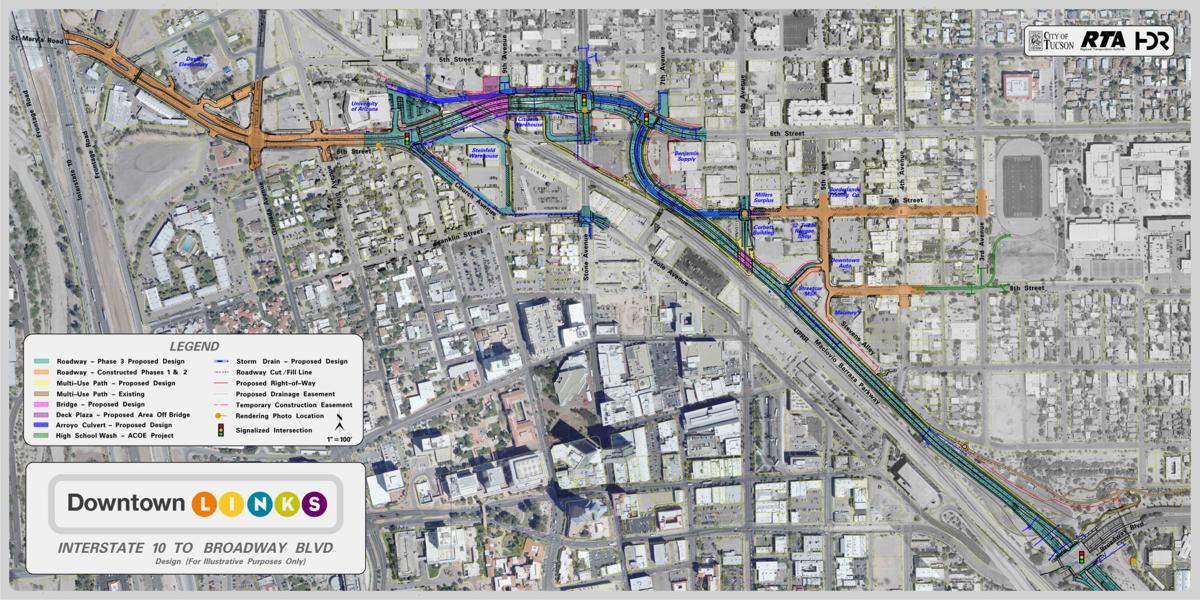
That’s according to an April 13 email from City Manager Michael Ortega obtained by the Star. The final phase of the project will take drivers from Barraza-Aviation Parkway to Interstate 10 on a new four-lane road that bypasses the frequently congested downtown area.
As first reported by the Star, the project was expected to cost $39 million. However, the lowest of the three bids — submitted by Granite Construction in late March — was $55.4 million, or 42 percent higher than the estimate.
That cost overrun “is the only outlier among more than 800 projects completed to date,” according to a statement from Regional Transportation Authority Chairman Satish Hiremath, who is also Oro Valley’s mayor.
As recently as last fall, bids on RTA projects were coming in roughly 17 percent under estimates on average.
Over the next few weeks, city staff, the RTA and a contractor will review the third-phase design, looking for potential cost savings.
There will be public outreach about proposed changes before the project goes out to bid again, according to Ortega’s email.
“I understand there was a lot of public comment on this project and we are sensitive to the input provided during the project development process,” Ortega wrote. “I have every confidence we will get to a point where Downtown Links can be constructed within the resources available for this project.”
“I applaud the city of Tucson’s decision, as the lead agency, for recognizing its responsibility and going back to the drawing board to rebid and deliver the project within budget,” Hiremath said in his statement.
It is the responsibility of individual RTA jurisdictions like Tucson to cover any cost overruns, according to materials provided to the Star by the RTA in response to a request for comment.
Prior to bidding, the RTA approved an additional 20 percent for the project.
Sam Credio, interim deputy city transportation director, said it was difficult to provide a likely timeline for the review and rebidding, but said the city and others are working “very quickly.”
The level of public outreach, which will depend on how significant the cost-saving modifications are, will have a big impact on the timeline, he said.
One area where there could be savings is in project specifications, which could perhaps be made clearer and avoid contractors budgeting for excessive levels of risk, according to Credio.
He said he couldn’t talk about which elements saw the biggest gap between estimates and bids because doing so could compromise the competitiveness of the bidding process.
City Councilman Steve Kozachik, whose ward includes a large portion of the project area, is skeptical that the budget can be met without substantially altering Downtown Links’ scope, and doing that is likely to anger a number of residents along the route.
“I don’t believe they’re going to get to their cost,” he said of the material changes and other less sweeping alterations discussed at a recent City Council meeting.
If it is possible, Kozachik said, he wondered why those cost-savings measures weren’t included in the first place.
During the development of the plan, amenities such as a deck park — which would sit on top of where Sixth Street is planned to dive under the railroad — and bicycle and pedestrian infrastructure were added to the design to address concerns in neighborhoods like Dunbar/Spring.
“If you simply turn this into a strip of asphalt cutting through peoples’ neighborhoods, people are going to legitimately go nuts,” Kozachik said, adding later that he wants a “robust public process” before the project is rebid.
Councilwoman Regina Romero, who represents Dunbar/Spring, said she would not support Downtown Links if it does not include the deck park.
Karen Greene, president of the Dunbar/Spring neighborhood association, said she is concerned the park will be sacrificed to come in under budget.
She said she hopes to soon get involved with the discussion about what changes will be made.
If there’s not a way to get under budget, she suggested diverting money from other city RTA projects, and pointed favorably to a recent letter to the editor published in the Star arguing specifically for scaling back planned projects on Broadway.
“Just do the basics on Broadway, skip Broadway and give Downtown Links Broadway’s money,” Greene said.
Credio said such a drastic step is not something the city can take on its own. He said that getting under budget will not require cutting the deck park, which he said the city “is committed to.”
“We’re looking at other places first before we start looking at things like scaling back amenities and scaling back scope,” he said.
“That’s the last resort. And that’s where the public process kicks in.”

