

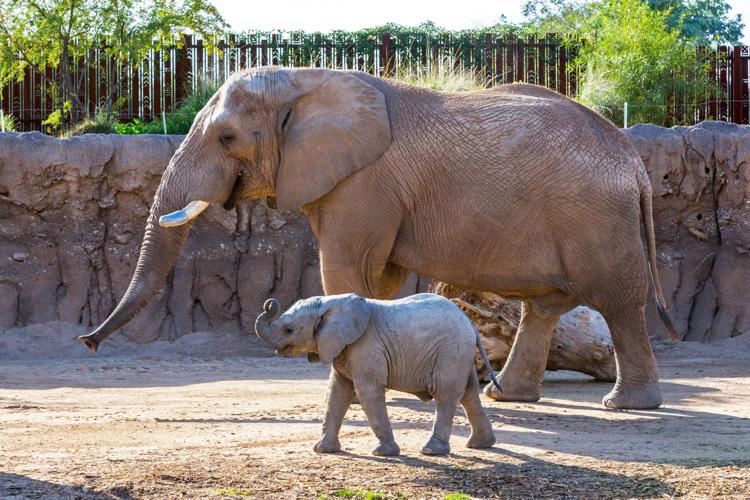


This fall, Tucson will say goodbye to Nandi’s dad, the African elephant Mabu.
Mabu and four other elephants came to Tucson from the San Diego Zoo Safari Park in 2012 to establish a breeding herd at Reid Park Zoo.
More than four years and one elephant calf later, Mabu is headed back to his former herd in Escondido, California. The 2014 birth of the female calf Nandi in Tucson means mission accomplished.
San Diego Zoo Global maintains ownership of the Tucson elephants as a satellite herd, said Vivian VanPeenen, Reid Park Zoo’s education curator. Mabu’s return to California is based on the safari park’s desire to reintroduce him as a breeding bull there, where he also has offspring.
Moving Mabu back to his former herd ensures that all of his “genetic material is not in one place but in multiple places, for the safety of the herd,” VanPeenen said.
In addition to Nandi, Mabu has fathered males Punga and Sundzu with Semba. The five elephants, along with adult female Lungile, currently live in Tucson’s Expedition Tanzania habitat, built for a breeding herd.
“While Mabu frequently interacts with his offspring here — he’s a great dad — it is natural for male elephants to wander between matriarchal groups,” VanPeenen said. “In the wild, he would be friendly with a group of females and then go to others.”
Sue Tygielski, the zoo’s elephant manager, suspects Punga and Sundzu may miss Mabu the most. The boys often wrestle with him. Nandi, who turned 2 on Aug. 20, will probably be least impacted by the departure. The size difference between bull and calf limits their interactions, Tygielski said.
“Right now, Mabu is a calming force on the herd, and sometimes when the herd gets too excited or too playful, he can just step among them and just quiet them down, so we lose that,” Tygielski said. “On the upside, he can also bully herd members around because he is the dominant one.”
Currently, there are no plans to replace Mabu with another male.
“The exhibit has done what we wanted it to do,” VanPeenen said, referring to the birth of Nandi. “Whether we have the opportunity to be a breeding facility in the future, we do not know.”
Mabu’s exact departure date is still unknown and will not be disclosed to the media in advance.
Although slated for sometime this fall, his exit depends on how quickly he completes training meant to familiarize him with a transport crate.
In the meantime, zoo staff are imposing overnight separations between Mabu and the rest of the herd. While the elephants do fine, “when he comes back, the boys start climbing all over him and are happy to see him,” Tygielski said.
Someday Punga and Sundzu may pack their own trunks to breed at other zoos. Male elephants typically won’t leave their herds until the ages of 11 or 12, Tygielski said. Punga is 9 and Sundzu is 5.
“The females will stay together, but whether or not Punga or Sundzu leave for other breeding herds in the future is many years away,” VanPeenen said. “Five elephants will keep Tucson busy.”

