

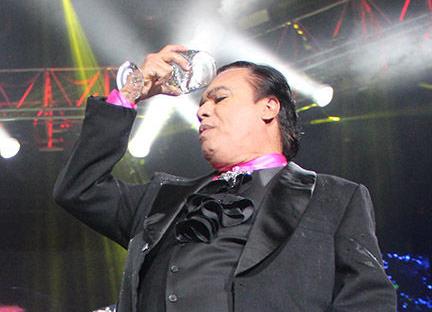


Andra Soria arrived at work at her UA office last Monday, full of sadness. The day before the legendary Mexican singer-songwriter, Juan Gabriel had died. His sudden death left her heartbroken.
His songs had been a big part of her young life, rekindling memories of her childhood in her native Mexico City and later her teen years in Phoenix and her recent years studying at the University of Arizona.
“They’re timeless,” she said of his songs. “Something everyone can relate to.”
When she arrived to work at the Adalberto & Ana Guerrero Student Center in the César E. Chávez Building, she found her co-workers also stunned and melancholy over Gabriel’s death from natural causes. As they talked, sharing thoughts and recuerdos, they turned their sorrowful feelings and memories into an act of homage: They erected a little altar in the second-floor hallway.
On a table covered with a blue blanket, the center’s staff placed two photos of the famed singer whose career spanned about 45 years. Several candles were also placed in front of a bouquet of sunflowers to celebrate the brightness and color that his music brought to the world. A gay pride banner hung on the wall behind the altar to honor his homosexuality. And a note on a yellow card invited students to write down their favorite songs of the more than 1,500 El Divo composed, and place the slips of paper in a clear plastic bowl.
Like rockers David Bowie and Prince, both of whom died earlier this year, Gabriel’s death left his adoring fans across the globe in mourning. But Gabriel, who died at the age off 66 in Santa Monica, California, was more than a popular music artist.
His songs permeated people’s lives. His music is heard everywhere, from radio to bowling alleys, from fiestas to funerals, at weddings, quinceañeras, social gatherings of all kinds. From Mexico, the country Gabriel lovingly serenaded, to the Mexican diaspora and their children in the United States, and throughout the Spanish-speaking world, his songs are the soundtracks to our lives.
“His music carries our stories, our histories,” said Michelle Téllez, an interdisciplinary assistant professor in the Mexican-American Studies Department at the UA. “His songs helped shaped identity.”
Alberto Aguilera Valadez, who took the stage name of Juan Gabriel, was affectionately known as Juanga. He grew up in Ciudad Juárez, across the river from El Paso. The youngest of 10 children, his mother put him in an orphanage. His young life was filled with despair and struggles, themes which would find their way into his music. His first hit song was “No Tengo Dinero,” (I Have No Money).
In 1971 he signed his first record contract in Mexico City and his rise to stardom began. He recorded and sang his own compositions, in various musical styles, but he also wrote songs for some of the top singers of their day: Lola Beltrán and Lucha Villa, both of Mexico and Rocío Dúrcal of Spain.
I came late to the Juanga lovefest. Although I grew up in Tucson surrounded daily by Mexican music, when his star took off, I rejected his music as uncool. I was a Chicano teenager discovering jazz and East Coast latin music.
Fast forward to the ’90s while working as a reporter in San Diego, I reimmersed myself in Mexican music, as I began to write about it for my newspaper. I interviewed Juanga in person and discovered his music. I began to understand his appeal and his importance in the music world and in the everyday lives of Mexican immigrants and their American-born children.
When he last visited Tucson in November, my wife Linda and I were there to share in the adoration and admiration for an artist and a person whose imprint on Mexican popular culture will remain.
Juanga, who easily flowed back and forth along the border, understood that his Mexican identity was that of his fans north of the border. Through his songs of hope, love and Mexicanidad, the border disappeared. The barriers went down when the artist, who sang for hours in live shows, sometimes in silk shirts and sequined jackets, brought people together, regardless of our proficiency in Spanish.
As Téllez said, Juanga’s music helps us recover and realize our relationships with family members, and with our culture.
It is “Amor Eterno” for Juan Gabriel.

